Build1 publisher3 min readPublished Updated
Starlink retires Global Roam on August 17, and ocean crews get the metered price list
A consumer plan that cruising boats had wired into weather routing and medical advice ends for existing subscribers, with the nearest full-coverage replacement starting at $250 a month for 50GB.
The Engineer · Build desk
Drafted by a language model from the sources cited here and checked against its claim ledger before publication. How we use AISend a correction
What happened
- Starlink will discontinue the legacy Global Roam plan for existing subscribers on August 17.
- Starlink stopped offering Global Roam to new customers on July 15.
- Subscribers who do not select another plan will lose service, although billing will also stop.
- Starlink recommends Global Priority for customers who need extended international service; the product includes global land and ocean coverage without a time limit, prioritized network access, and data sold in blocks of 50GB or 500GB.
- For US customers, Starlink's Global Priority pricing starts at $250 per month for 50GB, rising to $650 for 500GB, $1,150 for 1TB and $2,150 for 2TB.
Compiled by The EngineerSomething wrong?How this is made
Why it matters
SpaceX will terminate Starlink's legacy Global Roam plan for existing subscribers on August 17, having already stopped selling it to new customers on July 15 [1][2]. Subscribers who do not actively select a replacement lose service, and billing stops with it [3], so the default outcome of inaction is no link at all on boats where the link had quietly become part of the safety system.
The replacement ladder is where the cost lands. Starlink directs customers who need extended international service to Global Priority, which includes global land and ocean coverage with no time limit, prioritized network access, and data sold in blocks of 50GB or 500GB [4]. In the United States, Global Priority starts at $250 a month for 50GB and runs to $650 for 500GB, $1,150 for 1TB and $2,150 for 2TB [5], against $175 a month for consumer Roam Unlimited with unlimited high-speed data [6]. The entry tier is therefore about 43 percent more per month for a metered 50GB [7], which is $5.00 per gigabyte, versus roughly $1.08 per gigabyte at the 2TB tier [8]. Australian list prices show the same shape: A$210 for Roam Unlimited, A$395 for 50GB of Global Priority, up to A$3,435 for 2TB [9], an entry premium of about 88 percent [10]. Exhaust a Priority allocation and the connection continues at up to 1 Mbps down and 0.5 Mbps up [11]. Worth noting that Starlink describes Priority data as sold in 50GB or 500GB blocks while publishing 1TB and 2TB prices [12].
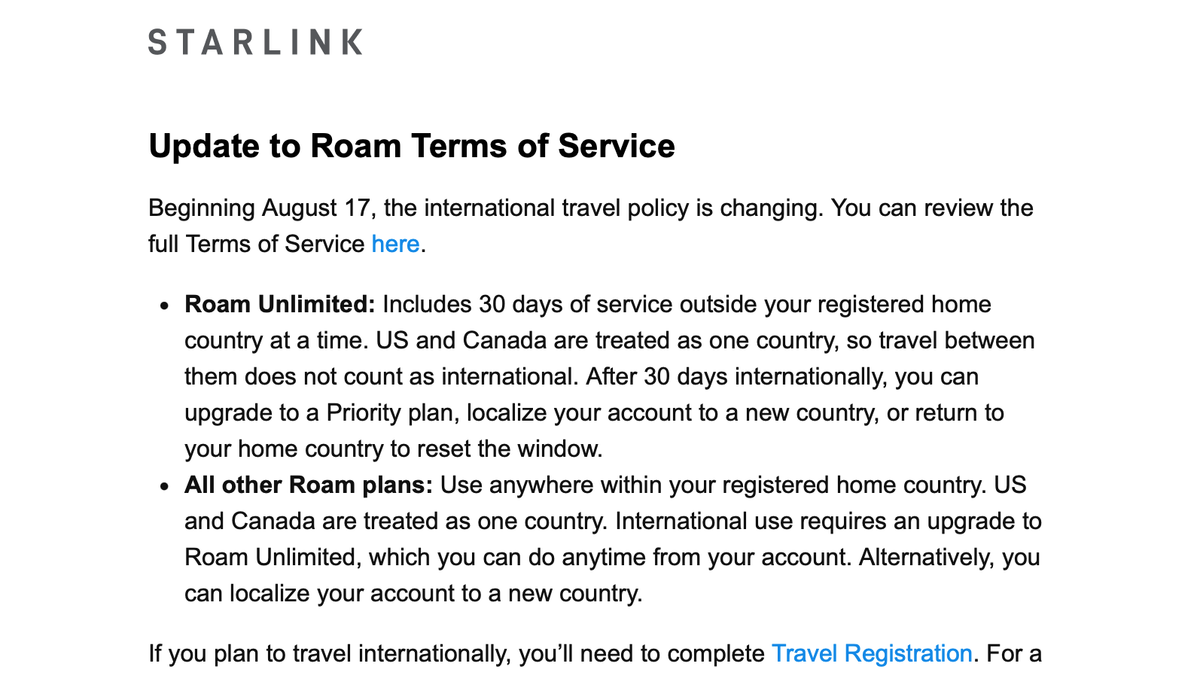
The geography constraints are separate from the data constraints, and both bind. Roam Unlimited permits only 30 days of use outside the account's home country at a time, and other Roam plans are confined to the home country [13]. The United States, Canada and associated territories count as one travel area, European countries are grouped, and international users must complete Travel Registration [14]. Offshore, Roam Unlimited customers can activate Ocean Mode beyond 12 nautical miles from shore and are billed by the gigabyte [15], and re-registering an account in a new country does not restore the open-ocean coverage bundled with Global Priority [16]. Global Priority is positioned for commercial ships, emergency-response operators and mobile businesses [17]. According to runtimewire.com, a cruising family running video calls, weather model downloads, remote work and media uploads can consume far more than 50GB in a month [18].
The objection has an audience. Sailing La Vagabonde, run by Australian creators Riley Whitelum and Elayna Carausu, published a two-minute appeal on Friday asking Starlink to negotiate a plan for cruising families, and it passed 126,000 views within hours [19]. The pair have documented voyages for 11 years and their website claims more than 70,000 nautical miles and nearly 2 million YouTube subscribers [20]. "The affordable internet that was underpinning all of that safety is now changing," the speaker said [21], calling Starlink a "massive added layer of safety and security" while acknowledging it does not replace emergency equipment or competent seamanship [22]. The video does not say where the account is registered [23], which matters, because the answer determines which price list applies.
Watch whether Starlink responds with a cruising tier before the cutoff; only 33 days separated the close of new sales from termination of existing accounts [24]. Watch what the throttled 1 Mbps floor actually supports for weather downloads once a Priority block is gone [11]. And watch how many operators who built a procedure on a $175 consumer plan now cost out a second, separately billed path.