Science1 publisher3 min readPublished
Satellite data puts Colossus 2's turbine field at 35 times a nearby plant's NOx rate
An MIT team used NASA's TEMPO satellite to estimate that temporary turbines in Mississippi emitted about 730 kilograms of nitrogen oxides an hour. SpaceXAI supplied a court submission saying local monitors have recorded no notable increase.
The Scientist · Science desk
What happened
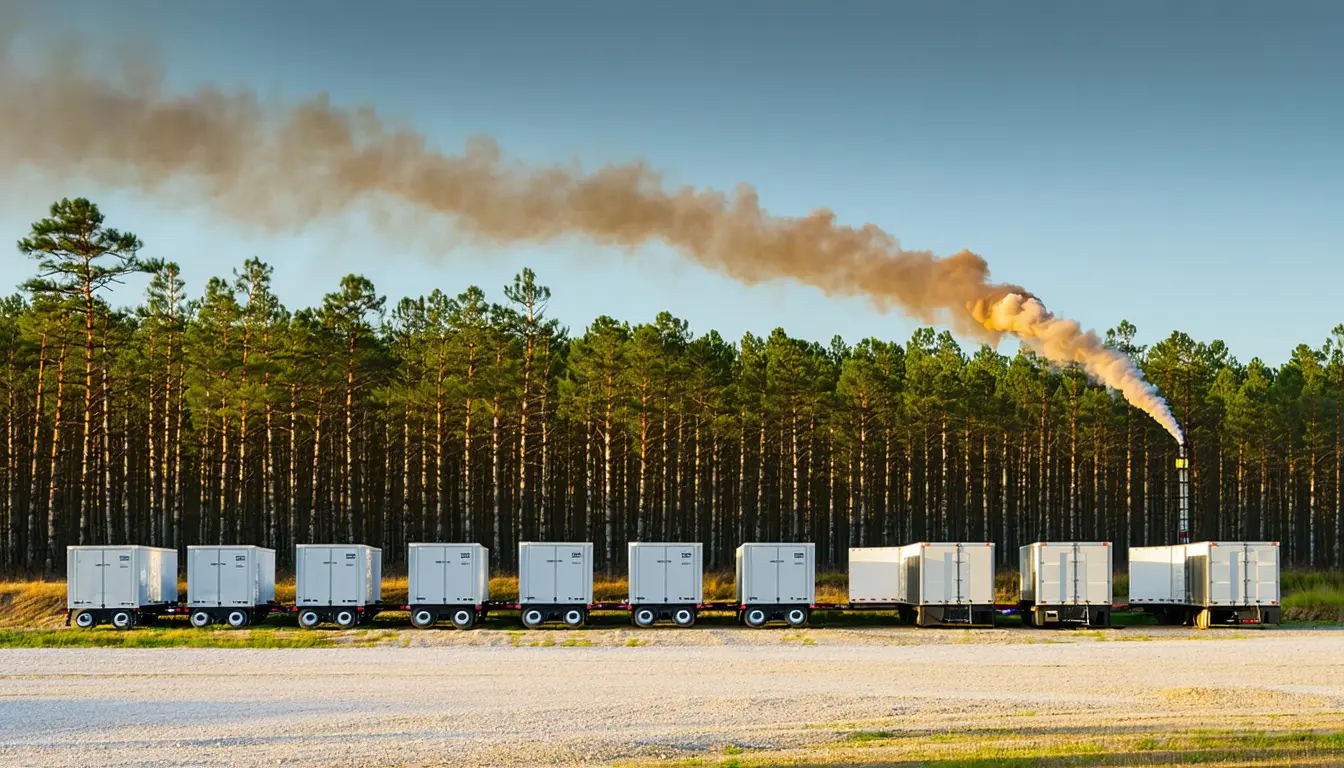
- Kevin Gauld's team at MIT used NASA's TEMPO satellite to calculate two-week-average NOx source rates for the site from August 2025 to mid-August 2026, first detecting emissions in December 2025.
- The number of temporary turbines on the Mississippi site rose from 27 in December 2025 to 69 by August 2026, and the estimated emission rate rose across the study period.
- Most of the temporary turbines powering Colossus 2 have no catalytic converters fitted, the equipment that normally controls NOx from gas power plants.
- SpaceXAI supplied New Scientist with a court submission from a third-party air-quality expert saying local monitoring stations have not observed notable increases in pollution concentrations.
- SpaceXAI promised in July 2026 to remove all 69 temporary turbines by July 2027 and replace them with 41 permanent gas turbines.
Compiled by The ScientistSomething wrong?How this is made
Why it matters
- contradiction Both figures can be right at once, so the residents' cases will turn on which measurement is accepted as evidence of exposure at the property line.
- constraint A source-rate estimate sizes what leaves the site and stops there. Anyone arguing harm has no measured change in ground-level ozone or particulates to cite.
- capability Outside researchers can now estimate a private site's emission rate at two-week resolution without site access, operator cooperation or stack data.
- exposure Campaigners and residents suing SpaceXAI and its subsidiary MZX Tech have an emission estimate produced by neither side of the case.
The Mississippi turbine field that powers the Colossus 2 data centre in Tennessee, now the largest operational data centre in the US [1][3], averaged about 730 kilograms of nitrogen oxides an hour between February and August 2026, by the team's estimate [11]. A gas power plant nearby in Mississippi averaged 21 kilograms an hour [12]. Divide one by the other and the temporary turbines run about 35 times the neighbouring plant's rate [13]; at the August 2026 peak of 1,180 kilograms an hour, about 56 times [14]. Having two sources inside one instrument's field of view is worth a lot, because the same retrieval and the same regional weather apply to both.
What TEMPO yields is a source rate: kilograms leaving the site per hour, inferred from what the satellite sees overhead. It is not a measurement of what a person breathes in a house two miles downwind. SpaceXAI and local authorities dispute the finding [2]. A monitor sited off the plume can read steady while the source rate climbs, so a station record and a source rate can both be accurate at once. Martyn Chipperfield at the University of Leeds, who was not involved in the work, said the levels are significant, and that the values reported in the vicinity of the temporary turbines are ones he has seen over central London [15].
The forward-looking number in the paper is a factor of 16. The current average rate is about 16 times what the site is expected to emit once the permanent turbines are running [23]. Work backwards from 730 kilograms an hour and that implies roughly 46 kilograms an hour, a little over twice the neighbouring plant's 21 [24]. The Mississippi Department of Environmental Quality granted permission for the permanent units in March 2026 [21], and SpaceXAI says the mobile turbines it uses, which it has begun making in-house, will all be fitted with pollution controls [22]. "Making sure these converters are fitted to these power generation systems is very important," said Peter Zoogman at Minerva University, California, who worked on the development of TEMPO [29].
Zoogman also converted the estimate into vehicle terms, calculating that each turbine emits roughly as much NOx in a year as 50,000 cars [18]. That comparison scales annual totals and says nothing about where the plume goes or who stands under it. NOx inflames airways and worsens symptoms in people with existing lung or heart conditions, and it reacts with other pollutants to form ozone and particulate matter [6]. Both the ozone step and the health step went unmeasured in this work. Ronald Cohen at the University of California, Berkeley, who called the paper "solid" [16], said: "It's very clear that there's a huge number of uncontrolled generators on this site, generators without emissions controls on them" [17].
What to watch
- Ozone and health measurements around the site: Zoogman called for that work, and the satellite paper contains none.
- A post-2027 TEMPO estimate for the 41 permanent turbines, which would test the promised 16-fold cut against measurement.
- Whether the ground-monitor data in SpaceXAI's court submission is entered and tested in the residents' cases.