Product1 distinct publisher3 min readPublished
Sonar's bet is that what survives AI-accelerated development is logic flaws no pattern scanner can see, so it has put an agent on them and files the proof into the queue developers already work through.
The Product Desk · Product desk

Compiled by The Product DeskSomething wrong?How this is made
The load-bearing word is "confirmed". Sonar says every candidate issue is investigated and proved out before a developer ever sees it [5], and that each finding arrives with its discovery path attached [6]. That is the difference between a tool that hands you a suspicion and one that hands you a reproduction, and it is the only version of this workflow that survives a sprint planning meeting.
Where I would push is the source of intent. The agent traces how code, data and a user's identity move through an application, forms a theory about where the implementation drifted from what the feature was meant to do, then goes looking for proof [4]. Intent has to come from somewhere, and the announcement does not name a source beyond the codebase itself and Sonar's playbooks, which are multistep sequences of security prompts encoding the company's own application security expertise [7][19]. That is generic knowledge of how a checkout flow or a tenancy boundary is supposed to behave, not knowledge of what your team agreed this feature would do. Expect strength on the recurring shapes and less on the rules peculiar to your domain. A user opening another customer's records is a shape anybody can describe [3]. The pricing exception your finance lead asked for in March is not.
The calendar is short for a product built on pre-verification. Beta opened on July 9 to SonarQube Cloud Enterprise customers [13], and general availability landed 49 days later [16]. In that window Sonar has published no precision figure and no count of what the alpha and beta actually turned up [18], so the accuracy that the whole triage model depends on is currently a claim.
Two things decide whether this earns a pilot slot. First, whether each sensitive feature has a written record of what it was supposed to do that somebody other than its author can check against, such as a ticket or an acceptance test. Second, whether one named person has the standing to hold a release on a confirmed access-control finding.
Both true, and you can start retiring some of the hand review this is meant to absorb [11]. Written intent but no authority, and what you own is a well-documented list of routes into other customers' data, sitting in a queue that has a groomer rather than an owner. Authority but no written intent, and triage time goes on arguing about whether the behaviour was deliberate. Neither, and the purchase lengthens the backlog without making the product safer.
Sonar is careful to call this an addition to its existing static analysis rather than a replacement for it [12], and the same plainness applies to the rollout: the pitch is detection, and what arrives on Monday is a second stream of findings into a list somebody already answers for. Teams that clear that list will get leverage out of it, and teams that do not will get a better-documented account of what they are not fixing.
Ranked by verification strength, evidence, and original report placement.
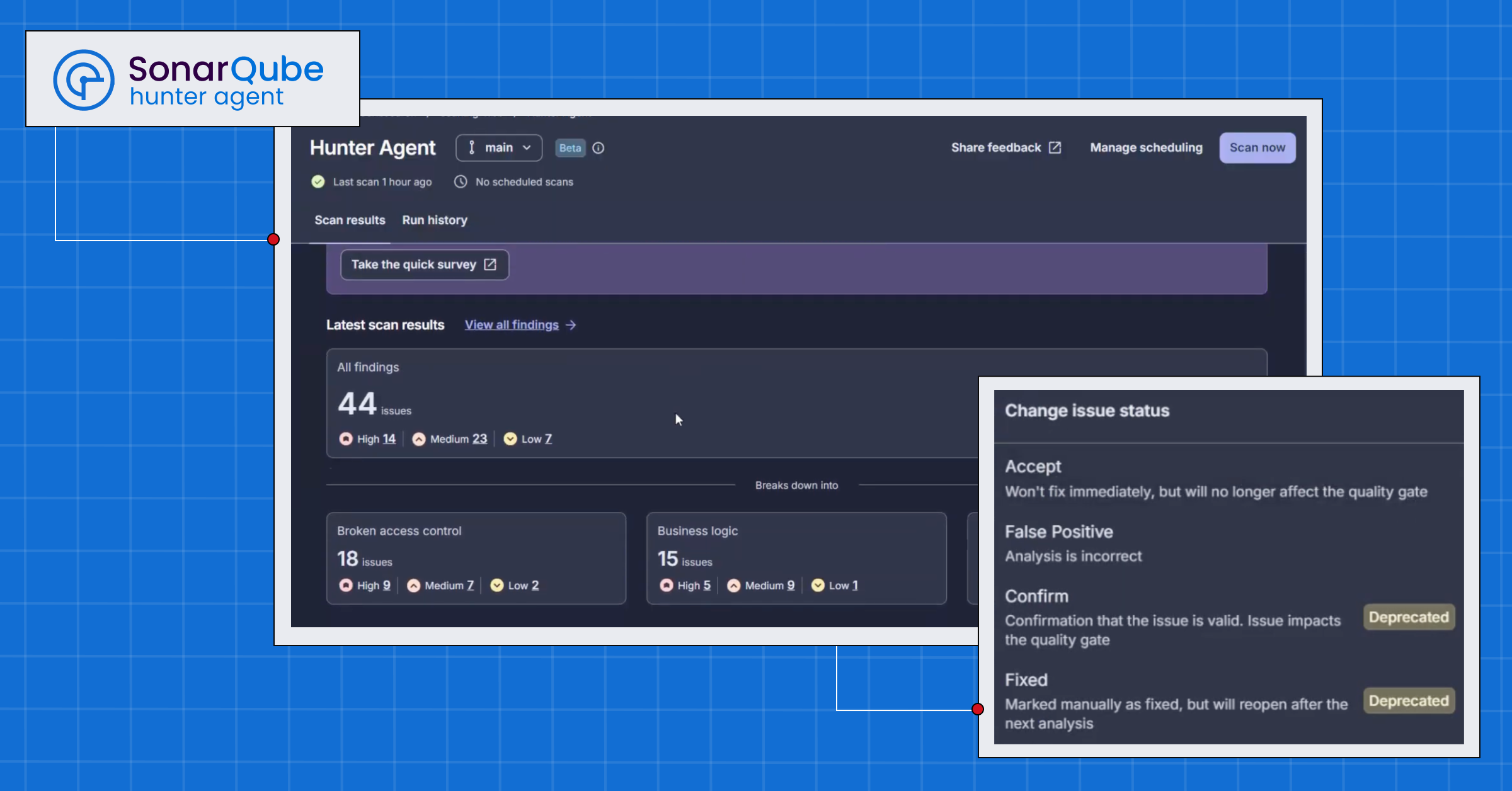
SonarSource Sarl released SonarQube Hunter Agent, an AI agent built to find security flaws that pattern-based scanning cannot see.
Broken access control, business-logic flaws and weaknesses in authentication or session handling are the three things the agent looks for, and pattern matching finds none of them.
The targeted vulnerabilities are ones where the code does what it was written to do: a user opens another customer's records, a checkout step gets skipped, a session stays alive long after it should have expired. Nothing reads as broken at the level a scanner works.
Under the hood the agent runs playbooks, multistep sequences of security prompts that encode Sonar's own application security expertise.
No second tool is involved: confirmed findings show up in the SonarQube issue list, in the same queue a team is already working through, and get assigned and tracked there like anything else.
Sonar said the shrinking gap between release and exploitation has made the problem bigger than it used to be, with AI-assisted development pushing code out faster than any audit cycle can follow and logic flaws going unnoticed for months at a time.
Distinct publishers with included, body-backed reporting in this cluster.
1 article · August 27, 2026
Follow any of these and your For You feed starts watching them — no settings page required.
product
Ox Alpha was GLM-5.3-Flash, and the number that decides displacement is 18 billion1 distinct publisher
product
Anthropic nudges its own agent-tampering risk from 'very low' to 'low'1 distinct publisher
build
The $559M-versus-$12.3B quarter matters more than the $65B run rate4 distinct publishers
product
Quintessent raises $40M to put quantum dots in the laser slot of AI fabrics1 distinct publisher
Evidence-backed comparisons of source perspectives and observed adoption signals. Read the methodology
Which Builder, Operator, and Investor concerns the observed source mix emphasized—not a truth score.
Evidence, demonstrated adoption, hype gap, incentives, and confidence are assessed independently, each on its own current evidence. How these are measured.
One vendor-sourced launch report, no measurements
Everything rests on a single SiliconANGLE launch write-up drawn from Sonar's announcement and a quote from its VP of code security. Documentary facts — release, GA on Cloud, July 9 beta, June portfolio launches, SAST-complement positioning — are clearly stated and internally consistent, which supports the announcement layer. The capability layer is unverified: no false-positive or precision figure, no count of what the alpha and beta found, no independent or customer evaluation, and no named intent source beyond the codebase and Sonar's own playbooks.
Availability milestones only, no usage disclosed
There is a real, staged availability trail — enterprise alpha, beta to SonarQube Cloud Enterprise customers on July 9, general availability on SonarQube Cloud on August 27, 2026 — plus two sibling agents shipped in June, which shows Sonar moving product rather than previewing slideware. But adoption by users is entirely undisclosed: no customer names or counts, no beta participation numbers, no findings volume, and Server (self-hosted) support is unscheduled, which caps the reachable base.
Capability framing runs ahead of disclosed proof
The framing is strong — flaws scanners 'cannot see', every candidate investigated and confirmed before a developer sees it, pipelines not slowed — while the disclosed proof is a shipping date. No precision or false-positive rate, no alpha/beta yield, no price, and no explanation of how intended behaviour is established beyond Sonar's own playbooks. The positioning is also honest in one respect that limits the gap: Sonar presents the agent as an addition to SAST rather than a replacement, and the workflow claims (findings in the existing issue list, background scheduling) are modest and checkable by any customer.
Vendor launch narrative, promotional publisher context
The story originates in a vendor product announcement: Sonar supplies the problem framing (AI-accelerated development outpacing audit cycles), the mechanism description, the executive quote and the image credit, and stands to gain from selling an agent into its SonarQube Cloud Enterprise base. The publisher appends its own solicitation — theCUBE alumni network membership and an AWS Marketplace referral ask — inside the same item. No adversarial source, customer, or competing vendor appears anywhere in the cluster.
Solid on the announcement, weak on efficacy
High confidence that the product shipped, when, and on which surface — those facts are explicit, dated and low-ambiguity. Low confidence in anything about how well it works or what it costs, because the cluster has one publisher, no independent testing, no quantitative results, and no pricing. The derived absence claims are reliable because they were checked against the full text.