Science1 publisher3 min readPublished
A light field's skyrmion number survives 270 metres of Johannesburg turbulence
At Wits, a beam whose polarization structure turbulence had rendered unrecognizable still delivered its skyrmion number unchanged. That is the basis for arguing free-space links should be made robust by encoding rather than by correction.
The Scientist · Science desk
What happened
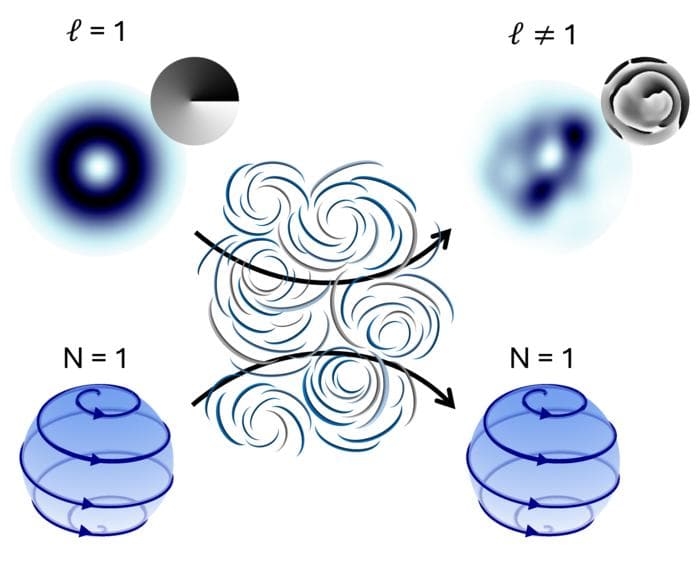
- A Wits group shaped 532 nm laser light into optical skyrmions with skyrmion numbers of 1, 2 and 3 and sent it down a 270-metre free-space link on the university's Braamfontein campus in central Johannesburg.
- Stokes polarimetry at the far end recovered the same skyrmion number in conditions running from calm, cool morning air to the erratic and intense distortions of midday heat over the campus.
- Andrew Forbes says the topological number came through even in cases where turbulence had scrambled the beam's vectorial polarization so badly that the underlying structure was unrecognizable.
Compiled by The ScientistSomething wrong?How this is made
Why it matters
- capability A quantity that arrives intact while its carrier field is degraded past recognition gives free-space link designers something usable for low-rate signalling in weather that breaks conventional encodings.
- decision Correction hardware now has a rival design lever rather than a replacement, because neither experiment weighs a topological encoding against an adaptive-optics-corrected channel on the same air.
- cost Detection gets more complicated as correction gets less: the receiver has to resolve polarization across the beam, which is a camera-and-analysis stage rather than a photodiode.
- constraint Robustness at the level of one symbol does not convert into capacity, so on present evidence the technique suits control and synchronisation traffic rather than payload.
A skyrmion number counts how many times every polarization state appears across a beam's whole cross-section [4], which makes it a property of the pattern rather than of any point inside it. Turbulence acts locally, blurring and shuffling polarization point by point. A local shuffle can leave a global tally untouched. Both Wits experiments are tests of that one idea in two physical systems that share almost nothing else [2].
Whether it survives usefully is a separate question. The classical run generated skyrmion numbers of 1, 2 and 3, and the numbers are always whole integers [7]. Three distinguishable symbols is about 1.6 bits per transmitted state [19], and the report of the work carries no data rate and no bit error rate [20]. What was measured is whether an invariant survives, in air that ran from calm cool morning to the erratic, intense distortions of midday over a city campus [9]. That is a genuinely hard optical path in the way that matters, since turbulence strength, not distance alone, is what scrambles a beam.
The stronger claim belongs to the researchers rather than to their data. Andrew Forbes, who heads the Structured Light Lab at the Wits School of Physics [3], and his colleagues say the approach offers a different way of thinking about robust communication in air or water than correcting distortions with ever more sophisticated hardware and algorithms [17], and the report frames the payoff as more reliable long-distance links, including space-based ones [18]. Pricing that trade would take the same 270 m campus path [8] run against a conventional encoding with correction applied, a comparison missing from the reported work [20].
The quantum experiment is the more interesting of the two and the more preliminary. Entangling two photons in orbital angular momentum builds the topology out of correlations between them [11], and OAM states are precisely the ones that come apart in distorting media, taking their encoded information with them [12]. The skyrmion number stayed close to 1 while the underlying modes crosstalked, which the team reads as the topological number being decoupled from that crosstalk and from the spreading of an individual photon's OAM [14][15]. What's missing is a sense of how close, or the turbulence strength at which the number finally slips. The flat statement that a topologically stable object is unaffected by external perturbations [6] describes ideal topology; a measured number close to 1 [14] is what an apparatus returns, and this one ran at a single skyrmion number inside a laboratory [13] rather than on the outdoor link [8].
So: topology is a real robust label, demonstrated on a real outdoor path at the worst time of day, and it carries when the vectorial polarization underneath it has been scrambled past recognition [10]. Forbes's summary, that conventional properties of an optical field degrade while the topological information encoded in it does not [16], is the finding and it is a good one. Turning a label into a channel needs higher skyrmion numbers to survive the same air, a threshold this work leaves unmeasured.
What to watch
- A run of the same Braamfontein path comparing a topological encoding against a conventional one with adaptive-optics correction, reported with bit error rates.
- Error bars on the quantum result, and a stated turbulence strength at which the topological number departs from an integer.
- Whether the entangled-photon experiment reproduces on an outdoor link rather than in a laboratory turbulence cell.