Science1 publisher2 min readPublished
PsychAD's single-nucleus models resolve brain-disorder risk to 32 cortical cell populations
Ninety-four models trained on more than 6 million nuclei from 1,494 prefrontal cortex donors assign risk genes for 12 brain disorders to neuronal, glial and immune populations. The signals hold in a veteran cohort of about 600,000.
The Scientist · Science desk
What happened
- The PsychAD atlas covers more than 6 million dorsolateral prefrontal cortex nuclei from 1,494 donors with and without major neuropsychiatric diagnoses, across European, African and admixed American ancestries.
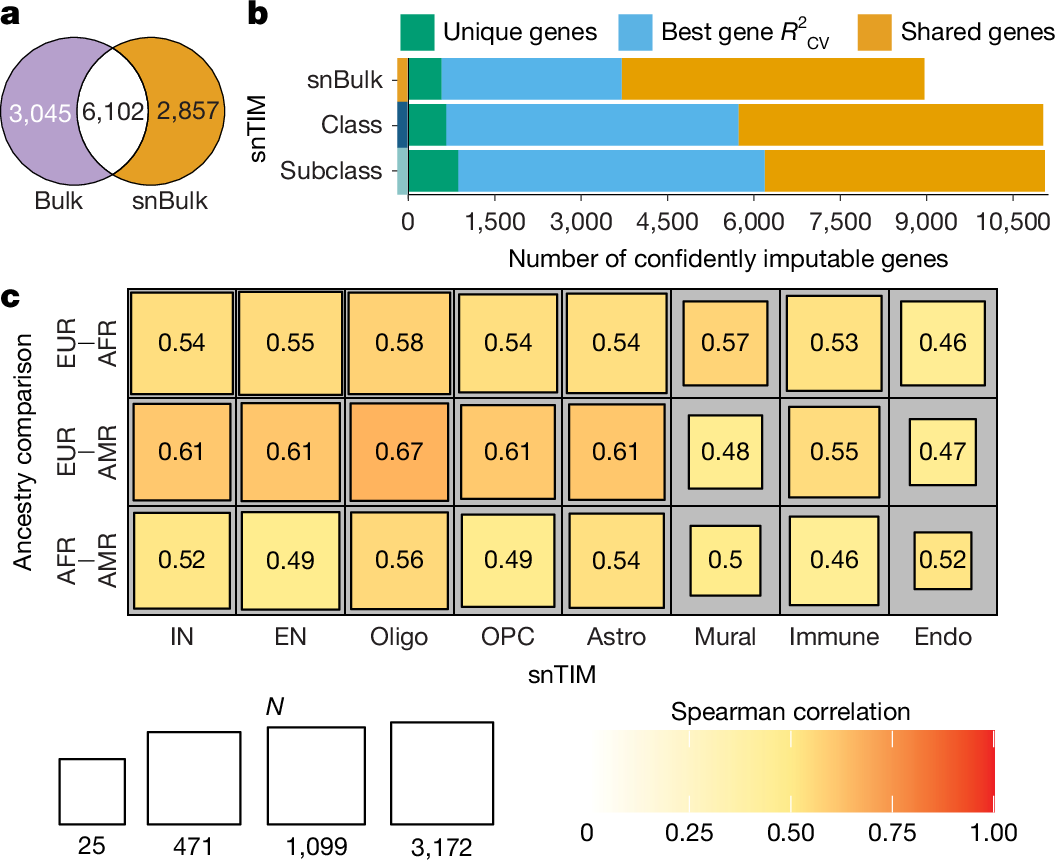
- From that data the authors trained 94 single-nucleus imputation models, covering combinations of three ancestries and 32 cortical cell populations, to predict genetically regulated expression.
- They ran the models against 12 neuropsychiatric and neurodegenerative GWAS, which also turned up disease-linked loci not previously reported.
- Thousands of the resulting gene-trait associations are undetectable in bulk tissue analyses, and many of them resolve to discrete neuronal, glial and immune cell populations.
- A phenome-wide association study of about 600,000 Million Veteran Program participants, run with ancestry-matched models, was used to validate the associations and refine causal gene prioritization.
Compiled by The ScientistSomething wrong?How this is made
Why it matters
- capability A prioritized gene now arrives with a cell population attached. A lab has a specific neuronal, glial or immune population to assay in, instead of picking whichever cell line is convenient.
- constraint The reference panel is one cortical region. Risk variants that act mainly in the hippocampus, the striatum or outside the brain cannot be localized by these models at all.
- decision Anyone building a brain TWAS pipeline has to defend a bulk homogenate panel now, given that the same summary statistics run against cell-type panels return associations bulk averaging hides.
- precedent Because replication used models matched to each ancestry, ancestry-matched reference panels become the comparison reviewers ask for.
A transcriptome-wide association study does not sequence RNA from the people who have the disease. It predicts expression from their genotypes, using a model trained in a reference cohort where genotype and RNA were measured together, then tests that predicted expression against GWAS summary statistics [8].
Most brain TWAS panels come from bulk homogenate cortex, largely in European-ancestry cohorts, and averaging neuronal and non-neuronal cells gives one number per gene per donor [7]. The PsychAD panel divides the dorsolateral prefrontal cortex into 32 cellular populations across three ancestries, and the authors trained 94 models on it [2]. Three ancestries times 32 populations is 96 combinations, so two of them have no model [10].
The atlas holds more than 6 million nuclei from 1,494 donors, which works out to roughly 4,000 nuclei per donor [1][11]. Spread evenly across 32 populations that would be about 125 nuclei per donor per population [12]. Cortical cell types are not equally abundant, and the abstract does not break the nuclei down by population. Prediction accuracy in a population follows the amount of data behind that population, so the common populations are where a model trains best and where associations are easiest to find.
Many of the GWAS loci at issue sit in non-coding regions that act on expression in particular cell types, which is the reason a cell-type-resolved panel can see signal that an averaged one cannot [9]. In the Million Veteran Program arm, run with ancestry-matched models, the authors report that the associations were confirmed, that cell-type-specific predicted expression is pleiotropic across neurological and mental health diagnoses, and that "trait-related dysregulation is conserved across ancestries" [6].
Conservation across ancestries is what makes the panel useful beyond the donors who built it. It remains an association between predicted expression and a diagnosis, and that does not show expression differing in living patients, nor that altering it alters the disorder. The paper's own framing is prioritization: an ancestry-aware atlas of genetically regulated expression meant to sharpen gene discovery and therapeutic target selection [14]. Both arms read one region of the brain, the dorsolateral prefrontal cortex [1].
What to watch
- Per-population donor counts and model performance in the supplementary tables, which would show which of the 32 populations the discoveries actually rest on.
- Which two of the 96 ancestry-by-population combinations lack a model, and whether the African and admixed American panels cover the same cell types as the European one.
- Whether prioritized genes survive perturbation experiments in the implicated cell population.