Invest1 distinct publisher3 min readUpdated
Washington's 9.9%, Maine's 2% and California's proposed 5% one-time billionaire levy give residency modelling real inputs. The retroactive start dates mean the window to react has already closed.
The Investor · Invest desk

Compiled by The InvestorSomething wrong?How this is made
Follow any of these and your For You feed starts watching them — no settings page required.
Convert the rates into money and the ranking changes. Each additional million of taxable income is worth $99,000 to Washington under its 9.9% levy [1] and $20,000 to Maine under its 2% surcharge [2], a ratio close to five to one [4]. Those are flow taxes on a year's earnings. California's proposed measure is assessed on stock: a taxpayer sitting at $2 billion would owe $50 million once [3], regardless of whether the year was good, and the measure names trusts alongside individual taxpayers [4].
Minnesota's proposal, 1% on taxable wealth above $10 million [7], is the one that matters for scale. Its threshold is a hundredth of California's [5], which is the difference between a levy that reaches a few hundred balance sheets and one that reaches a professional-services partner with a paid-off house.
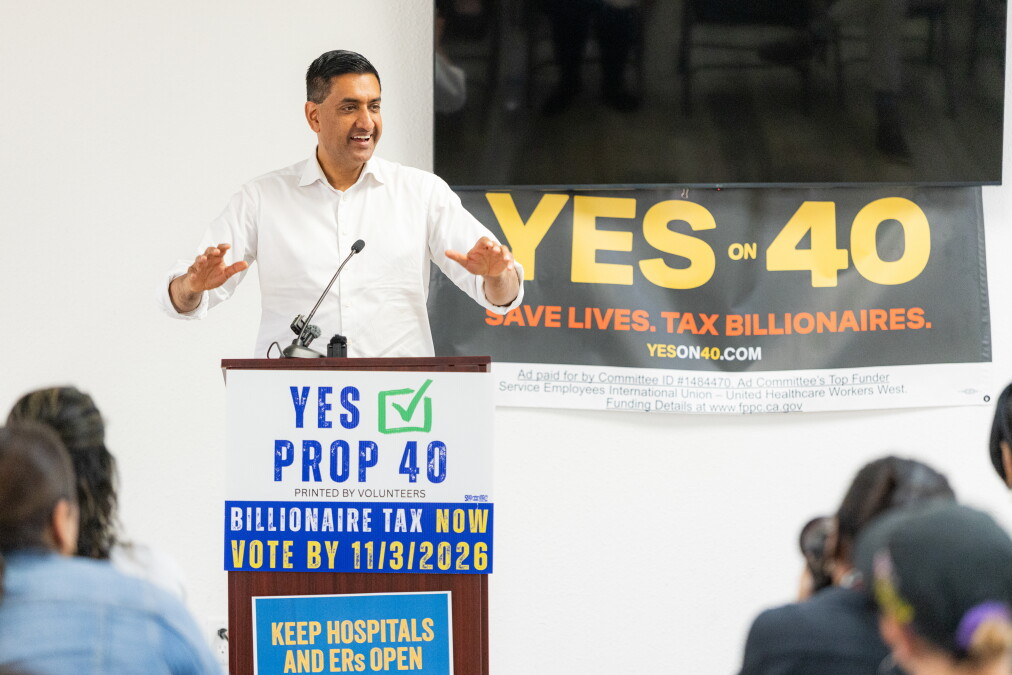
The California ballot does not resolve into a single number to plan against. Proposition 42 would bar new taxes on control or ownership of individually owned assets, retirement holdings and other personal savings, as well as retroactive taxes, and it is drafted to void the billionaire tax if it outpolls it, even if the tax also passes [6]. Proposition 41 would require pre-election audits of certain tax-related ballot initiatives and audits of special taxes, and would ban enforcement of certain taxes [5]. So the modelling matrix has at least three outcomes, and none of them can be priced before the votes are counted. EY's Damien Martin makes the narrower version of this point: because the California levy is on the ballot rather than in a statute, the analysis is different from analysing legislation, and it remains one factor among others [13].
The exit is where the arithmetic gets soft. David Heilich of Armanino says breaking domicile is not easy once established, particularly in states that audit the question aggressively [9]. Any modelled saving from a move is therefore a gross figure, before the cost of proving the move happened. Meanwhile the spread between origin and destination is widening from the other end: the Tax Foundation counts eight states that lowered individual income tax rates this year, including Indiana, Ohio, North Carolina and Oklahoma [8].
New York City shows what enforcement ambiguity actually costs a household. Baker Tilly's Andy Whitehair says clients have received notices indicating they may be subject to the city's pied-a-terre tax while a court case over the rollout is unresolved, and are asking whether to bother requesting an exemption for a tax that may or may not be in force [12].
Whitehair also argues that advisors may be better placed than CPAs or lawyers to raise these questions, because an adviser collecting an assets-under-management fee and meeting the client often will hear about next year's liquidity event early enough for the timing to matter [11]. He is a director in the national tax practice of an accounting firm [14], which makes the concession more interesting than the usual version. His practical framing is the empty-nester conversation: clients no longer tied to a location should be asked where it makes the most sense financially to live [10]. Washington's 9.9% does not bite until Jan. 1, 2028 [2], which is the one number on this list with enough runway to plan a realisation around.
Ranked by verification strength, evidence, and original report placement.
New York City's pied-a-terre tax is listed among existing wealth-style taxes alongside Washington's and Maine's levies.
Washington state has a 9.9% levy on taxable income above $1 million, effective Jan. 1, 2028.
Maine has a 2% surcharge, retroactive to Jan. 1, on income above $1 million, or $1.5 million for couples filing jointly.
A billionaire tax set for the California ballot in November would impose a one-time 5% tax on taxpayers' and trusts' accumulated wealth above $1 billion, retroactive to residents as of Jan. 1.
California's Proposition 41 would mandate pre-election audits of certain tax-related ballot initiatives, audits of special taxes, and would ban enforcement of certain taxes.
California's Proposition 42 would prohibit new taxes on control or ownership of individually owned assets, retirement holdings and other personal savings, as well as retroactive taxes, and aims to ban the billionaire tax if it receives more votes than the tax, even if the tax also passes.
Evidence-backed comparisons of source perspectives and observed adoption signals. Read the methodology
Which Builder, Operator, and Investor concerns the observed source mix emphasized—not a truth score.
Evidence, demonstrated adoption, hype gap, incentives, and confidence are assessed independently, each on its own current evidence. How these are measured.
Single trade source, named practitioners, no primary documents
Every claim traces to one American Banker article. Rates, thresholds and effective dates are stated specifically and three practitioners are named on the record with firms, and the eight-state rate-cut count is attributed to the Tax Foundation. But nothing is corroborated by a second outlet or a primary document: no statute or ballot text, no case name or docket for the pied-à-terre litigation, and no rate or base for the NYC tax at all. Client-behavior evidence is anecdotal.
Two enacted, one pending vote, one bill; behavioral response anecdotal
Adoption of the policy itself is partial: Maine's surcharge is retroactively live, Washington's is enacted but not effective until 2028, California's 5% is only a ballot measure facing a nullifying rival proposition, and Minnesota's 1% is an introduced proposal. Eight states moved the other way on income rates. Downstream adoption by clients and advisors is evidenced only by pied-à-terre notices and practitioners saying they now run scenarios - no counts, volumes or migration data.
Mildly overstated framing over a correctly reported parameter set
The underlying facts are reported soberly and the article repeatedly hedges that taxes are one factor among many. The cluster framing overshoots modestly: 'three live rates' includes a Washington levy that does not start until 2028 and a California 5% that is an unpassed ballot measure with an explicit rival kill-switch measure, and 'the window to react has already closed' holds only for the retroactive pieces (Maine's surcharge and California's Jan. 1 residency test), not for the regime as a whole. Practitioner urgency is also sourced entirely from firms that sell the planning work.
All expert sourcing from firms that bill for the resulting planning work
Every interpretive judgment in the story - that domicile is hard to break, that scenario analysis is prudent, that these conversations should start earlier - comes from paid advisory providers (Armanino, Baker Tilly, EY), and one quoted view directly argues that AUM-fee advisors are better positioned than CPAs or lawyers to own the client relationship on these decisions. The publisher's audience is that same advisory channel. The quantitative counterweight is attributed to a policy think tank rather than a seller. No conflict disclosure accompanies the practitioner quotes.
Specific and internally consistent, but single-sourced and status-fluid
Confidence is capped by the one-publisher cluster and by genuine legal fluidity: the California levy depends on a November vote and a competing measure, and the NYC pied-à-terre tax's enforceability is under active litigation with no detail supplied. The hard parameters are precise enough to model and the sources are named, which supports moderate rather than low confidence.
invest
Washington steps back on BNPL, so Brussels now sets the underwriting floor1 distinct publisher
product
Rillet's $100M reads as proof mid-market ERP is rip-and-replace, mostly at the cheap end1 distinct publisher
invest
Model the correspondent line as a decaying annuity, not fixed plumbing1 distinct publisher
invest
Three windfall bills and a $495bn pot: tax risk overtakes price in energy positions1 distinct publisher
Distinct publishers with included, body-backed reporting in this cluster.
1 article · August 24, 2026