Science1 publisher2 min readPublished
Laser-textured solar panels crystallise desalination salt at their untreated margins
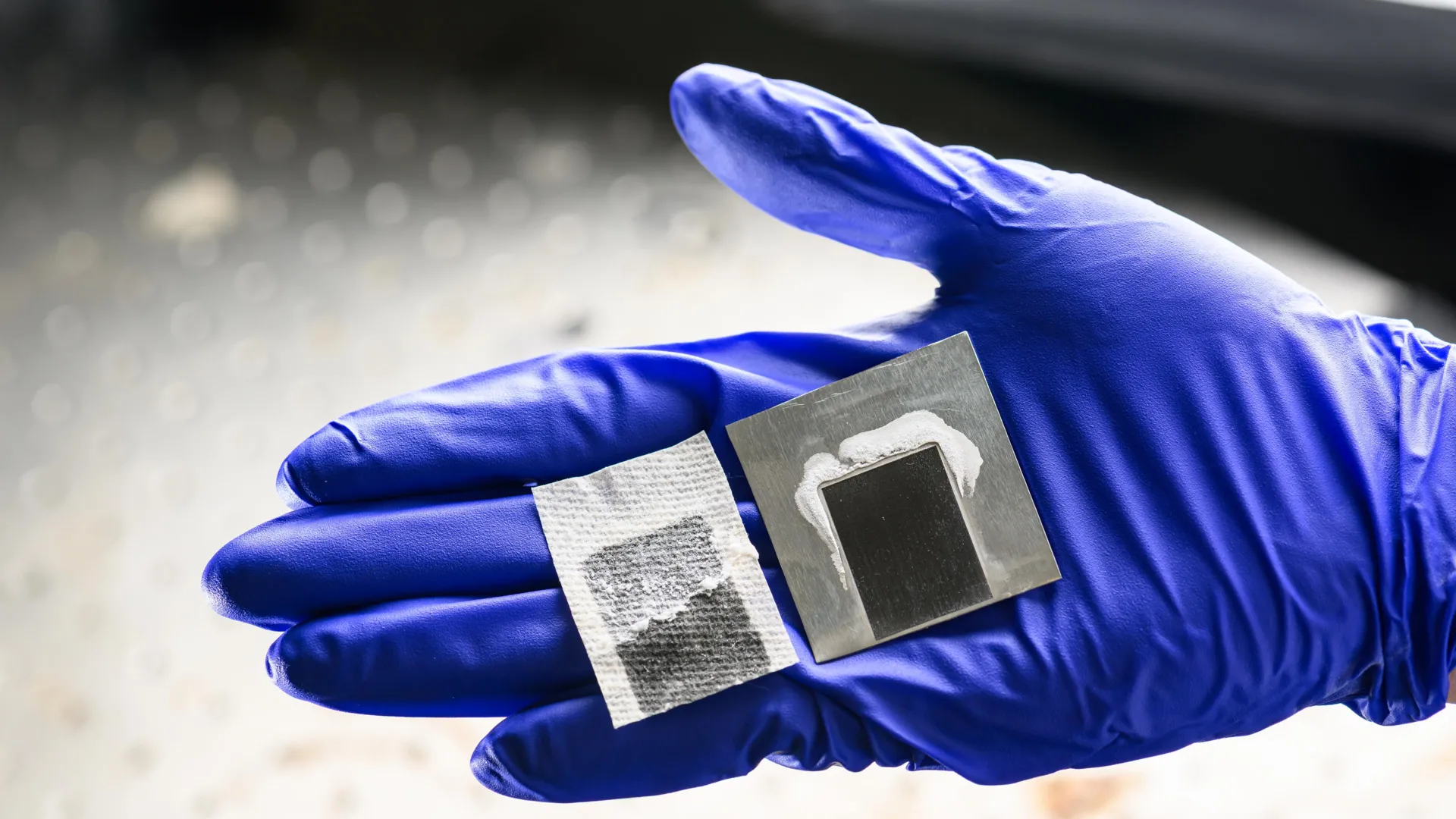
Chunlei Guo's group at Rochester reports a solar evaporator that moves salt off the hot absorbing zone and dries it at the panel edges. The test fluid was real seawater, magnesium and calcium included.
The Scientist · Science desk
What happened
- Researchers at the University of Rochester's Institute of Optics report a solar thermal desalination system designed to make fresh water without producing liquid brine and without chemical pre-treatment of the feed.
- The panels are black metal textured with ultrafast laser pulses, a treatment that makes the surface absorb sunlight very efficiently and also superwicking, so water spreads across it instead of beading.
- Evaporation happens on the treated active region, and the concentrating salts are directed outward into untreated passive areas along the panel's sides, away from where the water is evaporating.
- Chunlei Guo says earlier solar thermal desalination systems have often performed well in the laboratory using simplified artificial seawater made from water and sodium chloride.
- The release describes the system as removing nearly all of the leftover salt as a solid, and as able to recover valuable minerals such as lithium from what would otherwise be waste.
Compiled by The ScientistSomething wrong?How this is made
Why it matters
- constraint Scale decides how long one of these panels keeps running: if a hard mineral layer forms over the absorbing surface, water stops moving and the device stops.
- decision Anyone comparing evaporation rates across this literature has to read the test fluid first, because a sodium chloride solution leaves out the very compounds that form the blocking layer.
- capability Without a measured lithium recovery rate, the mineral co-product case that would help justify building a plant for salts as well as water cannot be costed.
- exposure If a solid-salt route works at scale, the plants it would relieve are the coastal ones whose discharge raises local salinity and reduces oxygen for marine organisms.
Salt buildup is what stops a solar evaporator working. The University of Rochester release says that once minerals form a hard layer across the active surface, they can block water movement and eventually stop the system [9]. The surface texture meant to prevent that is made with femtosecond laser pulses, each one quadrillionth of a second long, which is 10^-15 seconds [5][1].
Whether it works depends on which liquid you put on the panel. Sodium chloride is a forgiving test salt. It crystallises in a grainy, porous form, so water keeps moving through the deposit, dissolving accumulated salt and leaving the surface easier to clean [11]. Real seawater carries magnesium, calcium and much else besides, and some of those compounds crystallise into hard, dense deposits that are far less porous [12]. The release compares them to the scale inside a shower head or a tea pot, with the difference that seawater holds hundreds of times more dissolved salt than ordinary tap water [13].
In my view the test fluid is the most consequential choice in this work. A panel that clears sodium chloride has been checked against the easy deposit; the calcium and magnesium scale is the one that forms the hard layer and stops the panel [12][9]. The figure that settles the question is therefore hours of continuous operation on unmodified seawater.
The release does not report how much fresh water a panel produced, over what area or for how long it ran, and it does not discuss brine disposal permitting or where such a plant would sit [17]. Lithium appears in it as a mineral the system could recover, described as a way of turning desalination waste into a useful resource [14]. A mineral co-product would change what a plant is worth building, and that calculation needs a feed concentration and a recovered mass.
The problem being aimed at is well documented. Reverse osmosis and thermal distillation both consume large amounts of energy, often require treatment before and after the process, and generate concentrated brine [15]. Discharged back into the ocean, that brine can increase local salinity and reduce oxygen levels, creating harmful conditions for marine organisms [16]. The United Nations estimates that 2.2 billion people do not have safely managed drinking water [1].
What to watch
- Peer-reviewed figures for hours of continuous operation on unmodified seawater, and litres of fresh water per square metre per day.
- Any measured lithium recovery: feed concentration, recovered mass and purity, taken from real seawater rather than a sodium chloride solution.
- Whether the untreated passive margins themselves clog once dense calcium and magnesium deposits accumulate there over repeated cycles.