Science1 publisher2 min readPublished
A homozygous MAL deletion explains why a handful of people lack the AnWj antigen
The AnWj antigen has gone unexplained since 1972. Researchers found homozygous MAL deletions in five people who lack it, then made cultured cells react with AnWj antibodies by adding the normal gene.
The Scientist · Science desk
What happened
- The AnWj antigen was described on human red blood cells in 1972, and for decades no one knew which gene produced it or which protein carried it.
- Whole exome sequencing of people with the inherited AnWj negative phenotype found homozygous deletions affecting the MAL gene, present in both inherited copies.
- The International Society of Blood Transfusion has since reported MAL as a blood group system, numbered ISBT 047, with AnWj as its defining antigen.
Compiled by The ScientistSomething wrong?How this is made
Why it matters
- capability Blood services can now look for a DNA deletion when hunting compatible units, instead of depending on a scarce antibody to reveal an AnWj negative donor after the fact.
- constraint The genotype sorts only the inherited cases; the larger suppressed group carries an intact MAL gene, so the bench serology cannot be retired for them.
- precedent Assigning a stubborn serological specificity to a single gene is the route by which lesser-known antigens enter routine matching for patients with unusual antibodies.
An exome study that finds the same gene disrupted in five people, some of them relatives, has found a correlation and nothing more [4][7]. The step that makes it causal came next. The team put a normal MAL gene into cultured cells, and those cells reacted with AnWj antibodies; the altered version of the gene did not produce that reaction [9]. Further work showed that Mal, the small membrane protein the gene encodes, was both necessary and sufficient for the antigen [6][10]. That design rules out the ordinary alternative, which is that the deletion sat next to the real culprit and travelled with it through the family.
The denominator is the reason this took so long. More than 99.9% of people are AnWj positive [3], so fewer than one person in a thousand is negative [16]. Most of those are negative because a blood disorder or certain cancers have suppressed expression of the antigen [12]. Only a handful of people with the inherited form had ever been identified [13]. Five of them are in this study, including members of an Arab Israeli family [7], and the samples included blood donated in 2015 by the woman who was the first AnWj negative person identified in the 1970s [8].
Naming the gene is what turns a serological oddity into something a laboratory can look for in DNA, before a patient's antibody declares itself in a crossmatch. The University of Bristol said the finding could make it much easier to find extremely rare AnWj negative patients and donors and protect them from potentially dangerous transfusion reactions [15]. The risk it protects against is specific: an AnWj negative person who has made anti-AnWj antibodies and then receives AnWj positive blood can have those antibodies attack the transfused cells, which in some circumstances triggers a serious reaction [14].
The thing a MAL genotype does not tell you is why most AnWj negative people are negative. Suppression by an underlying disorder is not a deletion, so those patients carry an intact MAL gene and would type as positive on DNA while testing negative on the bench [17]. Serology is still the only way to see that group. The University of Bristol release does not say whether any blood service has put a MAL genotyping assay into routine donor screening.
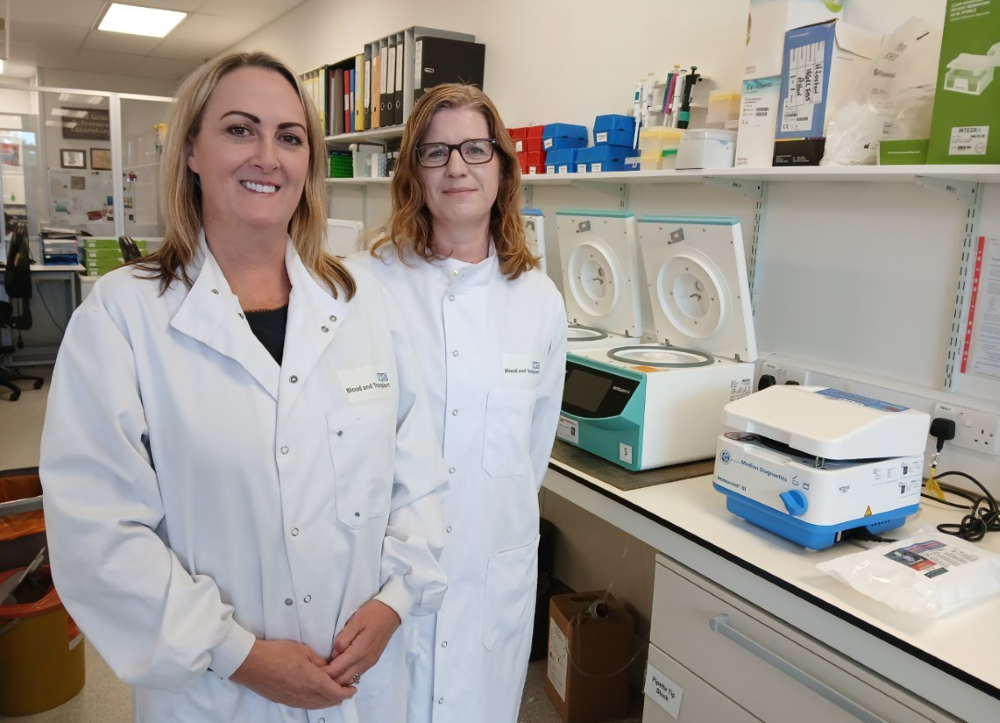
Fifty-four years separate the 1972 description of AnWj from this report [18]. The work was led at NHS Blood and Transplant in Bristol, including the International Blood Group Reference Laboratory, with colleagues at the University of Bristol [2], and the International Society of Blood Transfusion has since reported MAL as ISBT 047 [11].
What to watch
- Whether a blood service validates and publishes a MAL genotyping assay for routine donor or patient screening.
- Whether more inherited AnWj negative cases turn up once laboratories can screen DNA instead of relying on scarce antisera.
- Whether the suppressed AnWj phenotype gets a mechanism of its own, since those patients carry an intact MAL gene.