Invest1 publisher3 min readPublished
Humain's $2.5bn outside fund buys about a twentieth of the capacity it promised for 2030
The listing is three years out and the fund is small against a build PIF no longer wants to underwrite alone, which is why the export-control reading of Humain's fundraising deserves as much weight as the discipline one.
The Investor · Invest desk
What happened
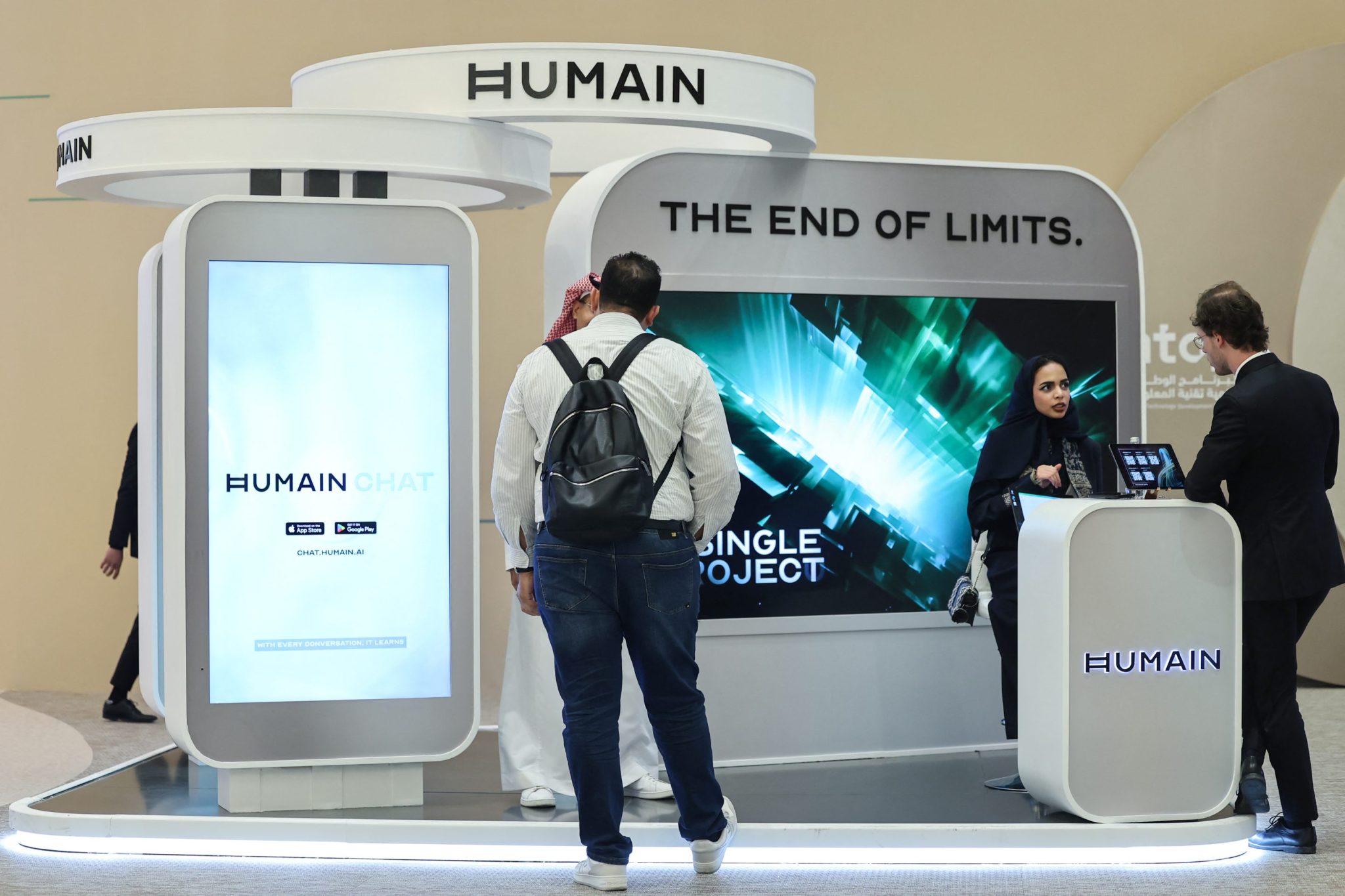
- Humain's chief executive Tareq Amin is assembling a team to prepare a listing, having told the Future Investment Initiative last October that he wants Humain quoted in Saudi Arabia and New York by 2029.
- Bloomberg reported last week that Humain is separately seeking $2.5bn from global and local investors to finance a new wave of data centre expansion across the kingdom.
- Official Saudi data puts national capacity at 467 megawatts in the first quarter of 2026, up from 68 megawatts in 2021, on more than SR56.2bn of data centre and digital infrastructure investment.
Compiled by The InvestorSomething wrong?How this is made
Why it matters
- constraint A 2029 listing does nothing for the 2026 to 2028 spending, so the heaviest construction years still have to be paid for by PIF, by debt, or by the $2.5bn fund, and Davis's sequencing objection lands squarely on that gap.
- contradiction Davis reads the fundraising as balance-sheet discipline while Soliman reads it as buying continued access to American chips, and the two readings imply different deal terms: one cares what the capital costs, the other cares whose it is.
- decision Humain's condition that investees commit Saudi compute or Saudi headcount means anyone funding the halls is also funding a campaign to fill them, which shifts the underwriting question from capex to contracted occupancy.
- precedent If G42 keeps its licence-free chip window by selling a majority to Americans, control of a Gulf AI champion becomes the going rate for compute, and Humain's raise is where that template gets tested next.
The per-capita figure explains the roadmap better than the roadmap does. Alvarez & Marsal put Saudi data centre capacity at 12 watts per head against roughly 50 in the UAE and the United States [16], and 467 MW installed at 12 watts implies a denominator near 38.9 million people [1]; 38.9 million at 50 watts is 1.945 GW [2], which is within rounding of the 1.9 GW Humain says it will have by 2030 [13]. The 2030 plan, then, is parity with where the UAE already is, and the 6 GW promised for 2034 works out at about 154 watts per head [3], call it three times parity.
Getting there is a financing problem before it is an engineering one. The kingdom has put SR56.2bn, which official figures translate as $14.98bn, into data centres and digital infrastructure to reach 467 MW from 68 MW in 2021 [15], a blended $32m per MW [4]; the 1,433 MW still missing at 2030 [5] costs roughly $46bn at that rate [6], and the $2.5bn fund Bloomberg reported Humain assembling from global and local investors [10] is 5.4% of it [7]. The blended rate includes digital infrastructure that is not data halls, so treat it as an order of magnitude rather than a quote. The pace is the less forgiving number: 399 MW added in about five years is some 80 MW a year, while 1,433 MW by 2030 needs about 358 MW a year, four and a half times the delivered rate [8][9]. Humain has told Bloomberg that timeline holds despite the U.S.-Iran war [14].
Kurt Davis Jr of Alvarez & Marsal calls the listing a funding-discipline decision as much as a monetisation one, at a point when PIF has been explicit that portfolio companies must reduce their draw on the sovereign [5]. Against a fund that PIF puts at $900bn [4], $2.5bn is 0.28% [10], so the instruction is directional rather than material. And the same company is scaling a $10bn venture fund, possibly larger, by the end of 2026 [11], writing cheques only where the recipient commits to Saudi compute or Saudi headcount, because as Tareq Amin put it, "we don't do passive investments" [12]. That is capital pointed outward to buy occupancy for halls that do not exist yet, which pairs neatly with the A&M observation that hyperscalers entering new markets increasingly lease instead of build [17].
Mohammed Soliman of McLarty Associates reads the same fundraising through export controls: both G42 and Humain want to stay inside the American AI ecosystem, and outside capital, possibly an American majority, is how they keep the access, with Saudi Arabia lacking the A:5 designation and Humain preparing for a G42-style arrangement with Washington [9]. G42 disclosed last week that it has held preliminary talks with US companies over selling a majority stake [7], and its licence-free window for advanced chips runs to 2027 unless it changes structure [8]. On that reading, who writes the cheque matters more than what the cheque is priced at.
Both readings can hold, and the more interesting version is that the discipline directive sets the deadline while chip eligibility sets the structure, since an IPO in 2029 pays for nothing in 2027 and arrives, as Davis notes, mid-construction with most of the capex still ahead [6]. Two outcomes would break the discipline thesis. PIF writing another large primary cheque into Humain during the 2026-2028 build would make the sovereign-draw language rhetoric. A fast close of the $2.5bn with American strategic investors rather than the local and global institutions described would make it a structural manoeuvre wearing a financing label.
What to watch
- Whether Washington grants Saudi Arabia an A:5 designation, and what structural conditions come attached to it.
- Whether the $10bn venture fund launches by end-2026 at the larger scale Amin floated, and whether the Saudi-compute condition survives negotiation with outside limited partners.
- Whether Humain publishes audited figures ahead of the listing, and what they show about capex already committed versus capacity energised.