Science1 publisher3 min readPublished
Archaeologists twisted rope in ten minutes through a 35,000-year-old ivory baton
A perforated ivory rod from Hohle Fels was catalogued as a prestige object until its discoverer noticed spiral grooves inside each hole, and a replication with cattail fiber suggests it made rope that never survived.
The Scientist · Science desk
What happened
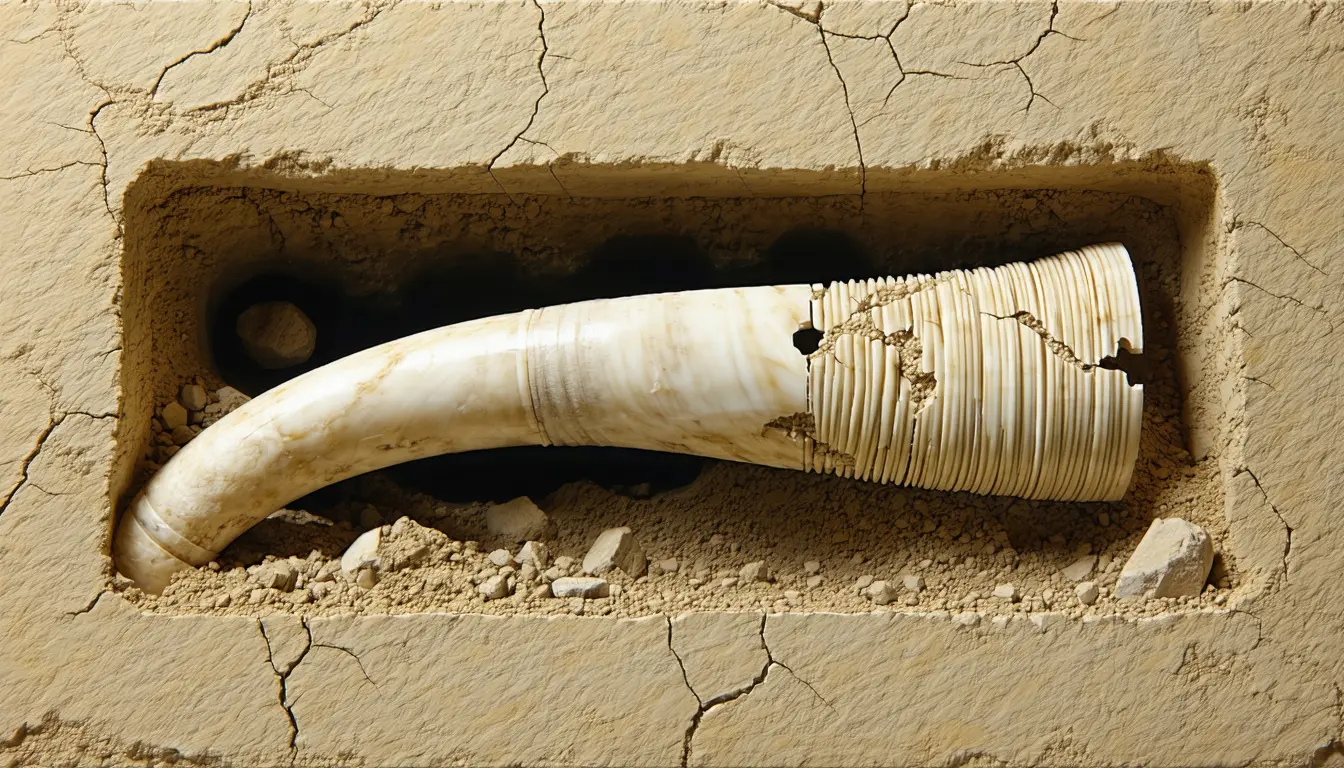
- A 20-centimeter ivory rod perforated with four small holes came out of the Hohle Fels cave in southern Germany in 2015, cut from a mammoth tusk more than 35,000 years ago.
- The object was first read as a symbolic item associated with prestige or power, until the archaeologist whose team found it noticed carefully carved spiral grooves lining every hole.
- Threading cattail fibers through the grooved perforations, the researchers found the grooves oriented the strands and produced five meters of thick, strong rope within ten minutes.
- None of the rope the cave's inhabitants would have made in quantity has survived. The ivory tool is the only piece of that production system still in the record.
- Markings on stone tools from France and the Netherlands, about 250,000 years old, are the oldest evidence of fiber use and suggest the tools were bound to handles with cord.
Compiled by The ScientistSomething wrong?How this is made
Why it matters
- constraint Any inventory of Palaeolithic technology is an inventory of what preserves, so the denominator for a site's toolkit is unknown and site-to-site comparisons partly measure burial conditions.
- capability If a grooved perforation does the aligning, one hand-held rod puts tens of meters of cordage inside an afternoon's work, and rope supply stops being the limiting step for hafting stone points to shafts.
- precedent The same argument is now available for any perforated baton sitting in a museum drawer under a symbolic label: look inside the holes, and grooves would make the functional case.
The grooves are what make the reinterpretation testable. A spiral cut inside a perforation holds a strand in place while the rod turns, so fibers pushed through the four holes come out oriented instead of tangled. Nicholas Conard, an archaeologist at the University of Tubingen, said the inference was quick: "If you're pushing something through a hole and rotating it ... you're very quickly in the world of fiber" [5].
Veerle Rots of the University of Liege led the experimental work on the object [8]. The replication rate, half a meter of rope a minute, comes to about thirty meters in an hour of the same work [9].
That is a feasibility result. It shows that a piece of mammoth ivory can make strong rope fast and that the grooves help with alignment; it does not show that this particular baton was used that way. The phys.org account does not include use-wear or residue analysis of the original or a comparison trial with ungrooved perforations [22].
Hohle Fels has produced what may be the world's oldest musical flutes and the Venus of Hohle Fels, so the site is known for objects that preserve [21]. "There's certainly a lot of bias in what we're viewing in the archaeological record, because we are focusing on the things that preserve," said Emma Finestone, a paleoanthropologist at the Cleveland Museum of Natural History [11]. Archaeologists lean on stone and bone to reconstruct prehistory while plant and animal products go largely unexamined [12]. Bruce Hardy, a paleoanthropologist at Kenyon College in Ohio, puts a size on what is missing: he said more than 90% of what happened during a prehistoric day is lost to us, and that a lot of it ran on technology we do not think about [13]. That number is an estimate of what a day contained.
Fiber's record runs older than any surviving fiber. The oldest piece anyone has held is six millimeters of three-ply cord made by Neanderthals about 50,000 years ago at Abri du Maras in France, found by Hardy and colleagues, and how it lasted is unclear [14]. That cord is roughly 15,000 years older than the lochstab [23]. Two hundred thousand years separate the hafting inference from that surviving strand [19]. Hardy thinks the technology is older still: "This is probably a very old technology that goes back much further than this, to an ancestor shared by modern humans and Neanderthals," he said [16]. phys.org puts that shared ancestor at more than half a million years ago [16].
Rots calls hafting a "revolutionary moment" in technological history. "It fundamentally changes the use of stone tools and allows a whole range of new possibilities in how you're conceptualizing a tool," she said [17]. The tools carrying those binding marks were in Europe some 205,000 years before Homo sapiens reached the continent 45,000 years ago [20].
What to watch
- A peer-reviewed write-up of the Rots-led replication, including whether ungrooved perforations perform measurably worse.
- Re-examination of other perforated batons already catalogued in European collections for spiral grooves inside the holes.
- Any new find of preserved Palaeolithic cordage, which would date the technology directly instead of through tool marks.