Science1 distinct publisher3 min readPublished
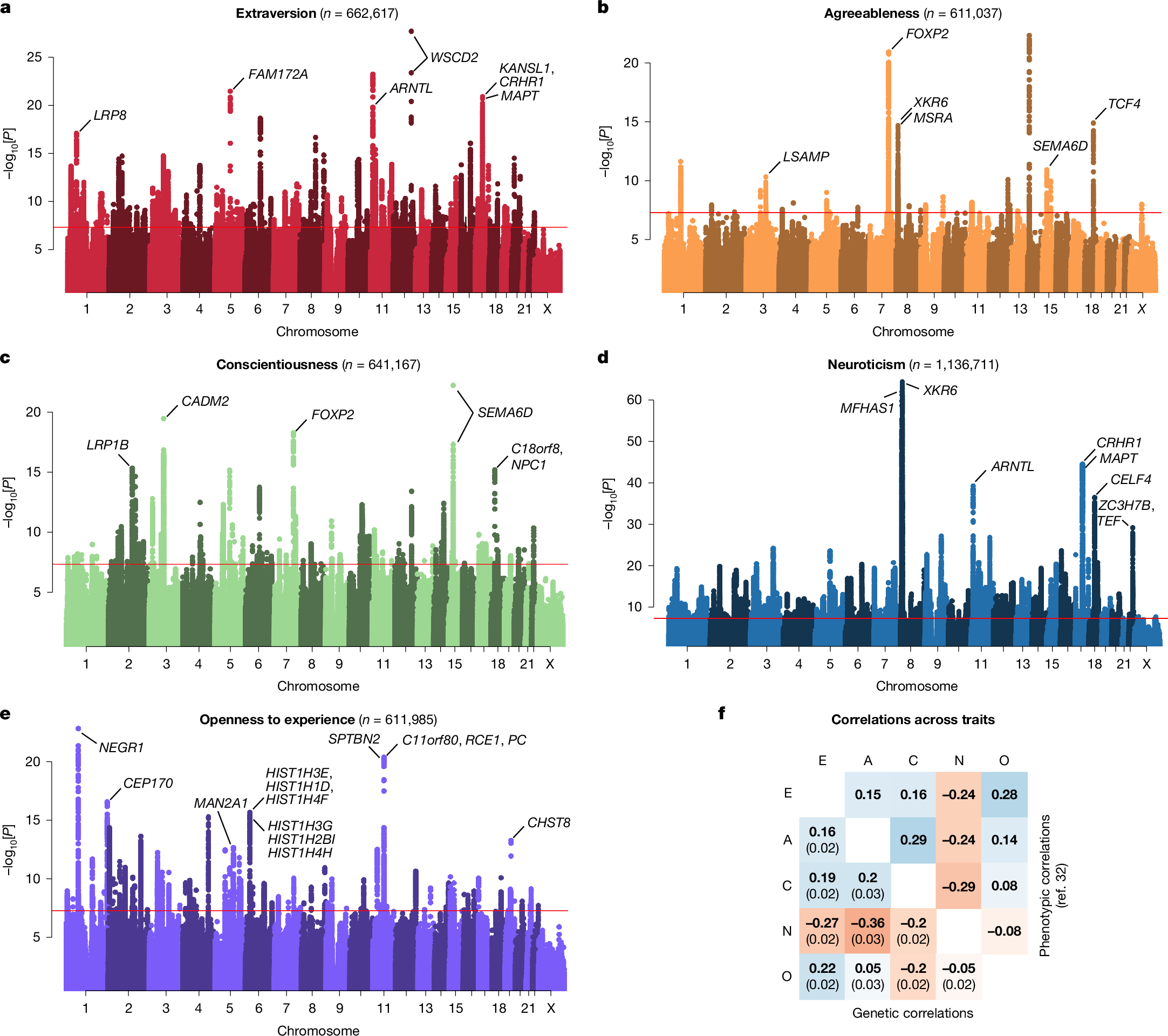
The Revived Genomics of Personality Consortium pooled 46 cohorts and up to 1.14 million people to find 1,260 lead variants for the Big Five, and even after correcting for questionnaire noise they explain under 14 percent of variance.
The Scientist · Science desk

Compiled by The ScientistSomething wrong?How this is made
Two numbers sit in the same sentence of the abstract, and the distance between them is a correction rather than a difference between traits. Common variants account for 4.8 to 9.3 percent of the variance in the personality measures themselves, and 9.3 to 13.3 percent among instruments with typical measurement reliability [4]. The higher band describes the trait as psychologists intend it. The lower band is what you get with questionnaire noise left in the denominator, which is also the only place a real screening tool would ever operate.
SNP heritability is a ceiling on prediction, not a measurement of it; a polygenic index trained on finite data lands underneath. Take the ceiling anyway. Variance explained of 13.3 percent implies a correlation of about 0.36 between score and trait [4], with 86.7 percent of variance in the well-measured trait unaccounted for [5]. For ranking job applicants or pricing an individual policy, 0.36 is a weak instrument, and it is the optimistic bound.
The loci count moves much faster than the variance does. Adding the five per-trait totals gives exactly the 1,260 lead variants reported [1], against 253 in the comparison studies [2], close to a fivefold increase [3], with neuroticism alone supplying 706 of them, or 56 percent [8]. Meanwhile the paper's own SNP-heritability estimate, 4.8 to 16.2 percent across traits and models, is described as consistent with previous personality GWAS [5]. Sample size bought resolution about where the signal sits rather than more signal.
What the extra data did buy is harder to obtain and easy to undervalue. Associations hold, though not identically, across four Western country clusters, self versus close-other reports, age groups and measurement instruments [10]. Within-family GWAS on up to 50,725 participants [2] and polygenic index analyses point to minimal confounding by the shared family environment, in contrast to many other social and behavioural traits [12], and the authors report minimal spousal assortment for personality in recent history [11]. That is a gain in credibility, at the same magnitude.
Twin, pedigree and rare-variant methods put personality heritability nearer 40 to 60 percent [6]. Common variants, at their best here, capture roughly a fifth to a third of that [6]. The residue sits with rare variants and genetic interactions among other things, and the paper is explicit that every method finds personality substantially influenced by environment [7]. The abstract also reports European-like and African-like genomes without giving a breakdown [1], so nothing in this material settles how the indices transfer across ancestries.
The thing this doesn't tell you is how any of it behaves as a decision rule about one person. The same paper reports Mendelian randomization and genetic correlation results pointing to widespread, potentially causal associations between personality and consequential life outcomes [13], which is the result most likely to be quoted at a hearing, and the variance table is the reason it cannot be converted into a score anyone should be judged by. The consortium posted a plain-language FAQ alongside the paper [14], which reads like an author group that expects to be misread.
Ranked by verification strength, evidence, and original report placement.
The study meta-analysed data across 46 cohorts comprising 611,037 to 1.14 million participants per trait, with European-like and African-like genomes, for GWAS of the Big Five personality traits.
The authors identify 1,260 lead genetic variants associated with personality, including 824 novel variants.
Common genetic variants explain 4.8 to 9.3 percent of the variance in measures of each trait, and 9.3 to 13.3 percent among instruments with typical measurement reliability.
SNP heritability accounts for an estimated 4.8 to 16.2 percent of total personality variation across traits and models, which the authors describe as consistent with previous GWAS of personality.
Estimates of heritability from classic twin and pedigree studies and from molecular genetic methods indexing rare variants and genetic interactions range from around 40 to 60 percent.
Distinct publishers with included, body-backed reporting in this cluster.
1 article · September 1, 2026
Follow any of these and your For You feed starts watching them — no settings page required.
science
Rydberg chain spectra match Ising CFT predictions, turning a simulator into an instrument1 distinct publisher
science
Sleep tech turns rest into evidence, and employers are the ones who will need rules1 distinct publisher
science
A neck bypass for Alzheimer's reached hundreds of hospitals on the strength of one video1 distinct publisher
science
South Africa moves to license its scientists, with a year in jail for the unregistered1 distinct publisher
Evidence-backed comparisons of source perspectives and observed adoption signals. Read the methodology
Which Builder, Operator, and Investor concerns the observed source mix emphasized—not a truth score.
Evidence, demonstrated adoption, hype gap, incentives, and confidence are assessed independently, each on its own current evidence. How these are measured.
One paper, and it does the checks a skeptic would ask for
Everything traceable in this story — the 1.14 million participants, the 1,260 lead variants, the 13.3 percent ceiling — comes from the same Nature paper, with nothing else in our coverage testing it. What keeps this well above a single-source shrug is the internal discipline: within-family scans on 50,725 people, polygenic scores checked in five held-out cohorts, and consistency tests across reporter, age and instrument. The remaining softness is verification, not rigour; the arithmetic tying the per-trait counts to the headline is ours, and nobody outside the consortium has re-run the rest.
Nothing to observe yet
No one in this reporting is using these results: no score shipped, no clinic or company taking them up, no downstream analysis by anyone outside the consortium. The plain-language FAQ the authors posted is outreach, and treating publication as uptake would be dressing up a press moment as traction. Better left blank.
The authors undersell before anyone else can
Nature's own abstract calls the variance explained 'moderate', puts the 40-to-60 percent twin-study comparison in plain view instead of a discussion-section footnote, and states outright that environment matters on every method — restraint that is rarer than it should be in genomics. The one place ambition runs ahead is the causal language: Mendelian randomization and polygenic prediction 'indicate' potentially causal links to health, psychopathology and even residential mobility, and that hedge is carrying a lot of weight for a result no one has replicated.
The consortium grading its own homework
The only voice in this story is the group whose work it is, and the closing self-assessment — architecture that is 'robustly generalizable, minimally confounded and widely relevant to human experience' — is an authors' verdict, not a referee's. Pushing the other way, those same authors surface the numbers that constrain their claim rather than hiding them. No funding, data-access or commercial arrangement appears in what we have, so this reads as ordinary academic salesmanship rather than anything with money behind it.
Precise about what was measured, vague about what it means
We can check this story against itself and it holds: the five per-trait loci counts add up to the 1,260 headline, and the ratio against the 253 loci of prior work is exactly the fivefold jump implied. What we cannot do is triangulate. There is no replication attempt, no methodologist objecting to the reliability correction that lifts 9.3 percent to 13.3, and no reporting on what the 46-versus-10 split between European-like and African-like cohorts does downstream. Enough to state the findings confidently; not enough to bet on their durability.