Science1 publisher2 min readPublished
Binghamton's entropy-ranked guesses solved 99% of simulated Wordle puzzles
A Binghamton team scored each candidate word by how much uncertainty it was expected to remove and reported solving 99 percent of simulated Wordle puzzles. The university did not say how many games it simulated.
The Scientist · Science desk
What happened
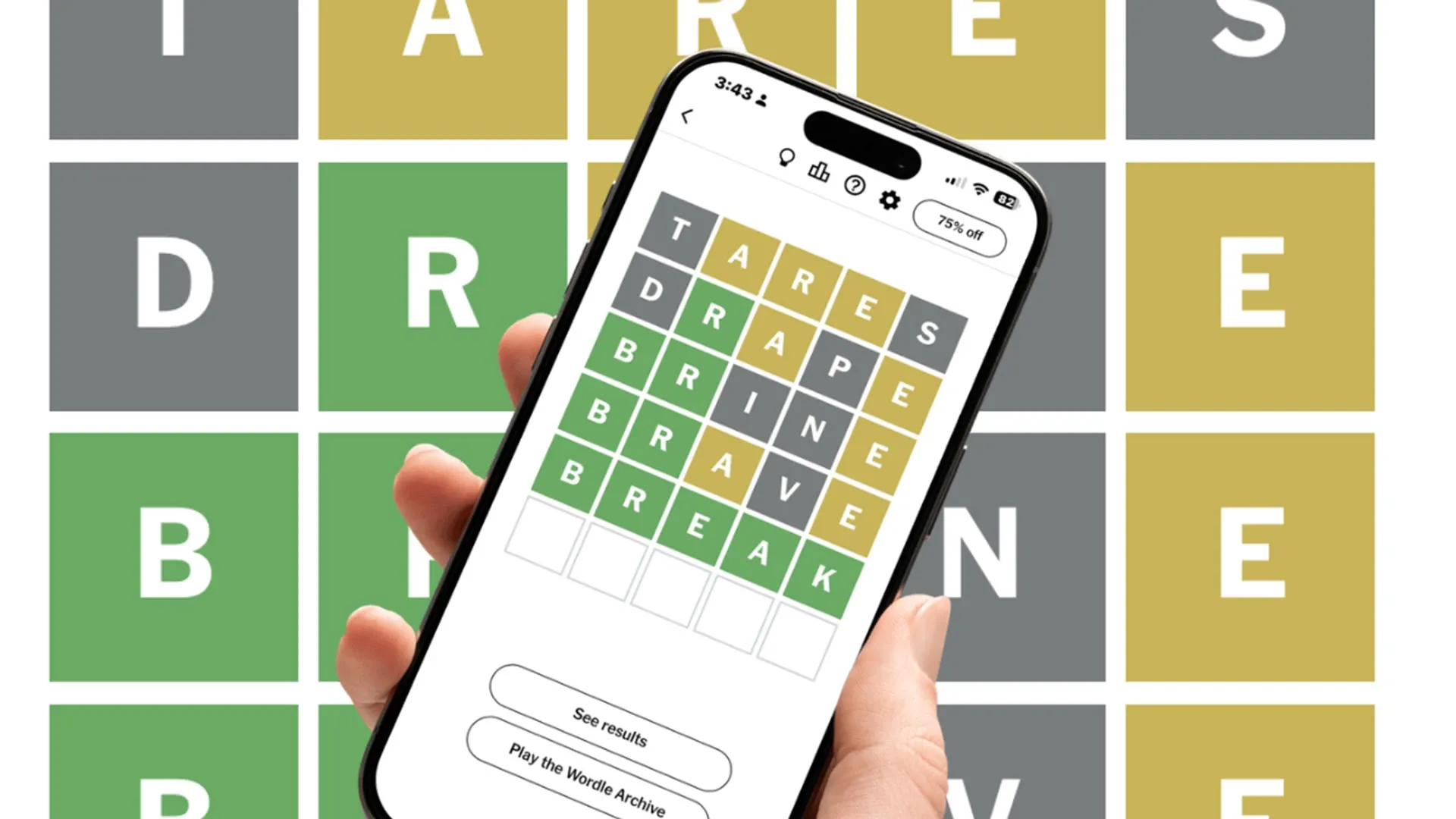
- Binghamton University researchers scored each candidate Wordle guess by Shannon entropy, the expected reduction in uncertainty about the hidden word, so every guess is chosen to shrink the pool of possible answers.
- In simulations the strategy solved 99 percent of Wordle puzzles, according to the university.
- The team dropped the usual objective of picking the word most likely to be correct and instead looked for the guess that would eliminate the greatest number of remaining possibilities.
- A word with little chance of being the solution can score highest, because its letters divide the surviving candidates into smaller groups when the colors come back.
Compiled by The ScientistSomething wrong?How this is made
Why it matters
- capability Ranking options by expected information gain needs no training data and no model, only a list of what is still possible and a rule for what feedback each query would return.
- constraint The score is computed over an enumerated candidate set, so a search whose remaining possibilities cannot be listed inherits none of the reported success rate.
- decision Anyone judging the result has to decide what a bare solve rate is worth.
Shannon entropy is a measure of uncertainty, used in information theory to study how efficiently information can be transmitted, stored or processed [13]. Applied to a guess, it scores the feedback that guess would produce. Binghamton's team computed it over the options still standing after earlier guesses had eliminated some, and preferred the word that would remove the greatest number of remaining possibilities [7][16]. Since the game colors each letter separately [6], a word built from letters that split the survivors into smaller groups can be worth more than a word that might actually be right [8].
"Let's say you're at a certain guess. The previous guesses will eliminate a whole bunch of options, and based on the remaining options, guessing some words will send you into a trajectory where information gain is speedier," said Congyu "Peter" Wu, the assistant professor who led the work at the School of Systems Science and Industrial Engineering [9][3].
Donald Stephens, a doctoral student on the team, described the swap in objective [4]. "By applying Shannon entropy, the objective shifts to maximizing the expected reduction in uncertainty rather than the probability of being right," he said [11]. Some of what the method recommends can look strange or even random to a human player, according to the university [17].
The 99 percent is a solve rate in simulation [1]. Binghamton did not report how many games were simulated, an average number of guesses, or a score for a likelihood-first strategy run on the same puzzles [15]. At 99 percent, roughly one puzzle in a hundred still ran past the limit of six guesses [14]. A solve rate tells you the six-guess budget held [5]; it leaves unmeasured the gain over a player who always guesses the likeliest word left, and Stephens's claim that the approach "can lead to solving the puzzle in fewer guesses" is the part a guess-count distribution would settle [11].
The entropy score requires an enumerated set of candidates to compute over [16]. Wordle supplies one, because the opening guess can be any valid word and the feedback rule is fixed [18][6]. Running the strategy during a real game means launching a separate script or program alongside the puzzle [12].
What to watch
- Publication of the paper with the number of simulated games and a distribution of guesses per solve.
- A same-puzzles comparison against a strategy that always guesses the likeliest remaining word, which would size the gain.
- Whether the ranking holds when the solver cannot enumerate the candidate answers it is scoring against.