Product1 publisher3 min readPublished
Some Centcom staff relied too much on Palantir's Maven before the Iran school strike, officials say
Officials told Bloomberg some Centcom staff relied too much on Palantir's Maven AI before a US strike killed more than 165 at an Iranian girls' school. The reported failure is users trusting a fused screen too far. Builders of AI decision support have to design for that risk.
The Product Desk · Product desk
What happened
- US officials earlier told Semafor that AI had nothing to do with the strike, blaming analysts who missed public information about the school or never added it to the targeting database.
- Over the past year the Defense Department has rapidly made Palantir's Maven a cornerstone of the US military apparatus.
- Several former senior US military officials now work for Palantir, some with high-level clearances at Centcom's Tampa headquarters, to keep the software running in secure environments.
- Palantir took on Project Maven after Google dropped the contract in 2018, in large part because of protests by Google's own employees.
Compiled by The Product DeskSomething wrong?How this is made
Why it matters
- contradiction An inquiry that adopts the Semafor account would fix the targeting database and leave the over-reliance Bloomberg's officials described in place, so the version the Pentagon accepts decides what gets changed.
- exposure Because Palantir's former-military staff keep Maven running inside Centcom's Tampa headquarters, questions about how operators relied on the tool reach the vendor as well as the command.
- constraint The case weakens a human signing off on each strike as a defense of AI targeting tools, since the officials locate the failure in the people reviewing Maven's output.
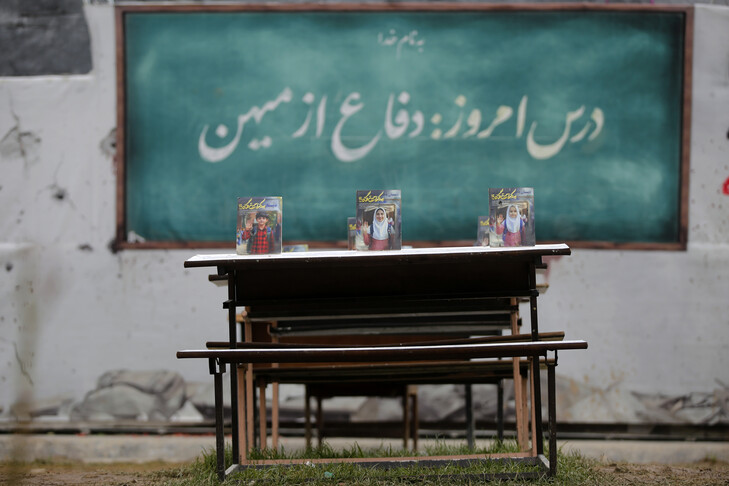
The Shajare Tayyiba Elementary School was there to be found [13]. The site had once been a military compound, but satellite imagery showed its outdoor play area by 2017 [7]. Semafor, citing Reuters, reported that even a scan of Iranian business listings turned it up [10].
Semafor took that as an argument for more machine help. It wrote that the error was "one that AI would not be likely to make" and that "a deeper look at satellite imagery or, simply, an internet search could have forestalled the disaster" [12]. Bloomberg's reporting, by Ben Bartenstein and Krishna Karra, puts part of the blame on the people using Palantir's Maven [2].
The two accounts fit together. A school missing from a targeting database is a human data error, and a fused screen cannot display a row nobody entered. Whether anyone went looking for the gap depends on how far the team trusted the screen. Maven's pitch is that screen: AI-enabled software for targeting and command and control that fuses more than 150 data inputs into "a coherent set of information to inform commanders' decisions" [3].
The human in the loop is supposed to be the safeguard, reading the fused view and overriding it when something looks off. Some Centcom personnel relied too much on the AI embedded in Maven, officials told Bloomberg [1]. Techdirt, which argues the real risk from AI is human behavior and not rogue software, wrote that people sometimes "stop thinking in the presence of these AI machines" [14].
The reporting does not say what Maven displayed for this site, or how often Centcom operators checked its output against anything outside it. The officials' account supports a finding of over-reliance by some staff without identifying a flaw in the interface [1].
For anyone shipping AI decision support, I would sort each action on two axes. One is whether it can be undone. The other is whether the screen shows what the answer rests on, including which inputs are stale or empty. Where the action can be undone and the sources are visible, let people move fast. An undoable action with hidden sources is tolerable if the team tracks how often users override the tool. For an irreversible action with visible sources, require the operator to open one underlying source before confirming. The fourth cell, irreversible and opaque, is where over-reliance costs the most, and in my view it needs a design change before it needs more training. The forced check has a cost: it slows every irreversible action, and operators who see the same prompt all day learn to click through it.
The way to tell whether that check works is to count how often operators open the source and then change their answer. In the Shajare Tayyiba case, that source could have been Google Maps, where the school was apparently labeled, according to Techdirt [8].
What to watch
- Whether a Pentagon investigation says which account it accepts: the targeting-database error Semafor's officials described or the over-reliance on Maven that Bloomberg's officials described.
- Whether further reporting shows what Maven displayed for the Shajare Tayyiba site at the time of the strike.
- Whether Centcom or Palantir disclose changes that require operators to check a source outside Maven before an irreversible action.