Product1 publisher3 min readPublished
ORNL builds its duct radiation monitor around a crystal that costs a dollar or two
Oak Ridge's detector straps onto a ventilation duct and samples once a minute on battery, or once a second when it is wired over Power over Ethernet. The crystal that makes it cheap costs a dollar or two.
The Product Desk · Product desk
What happened
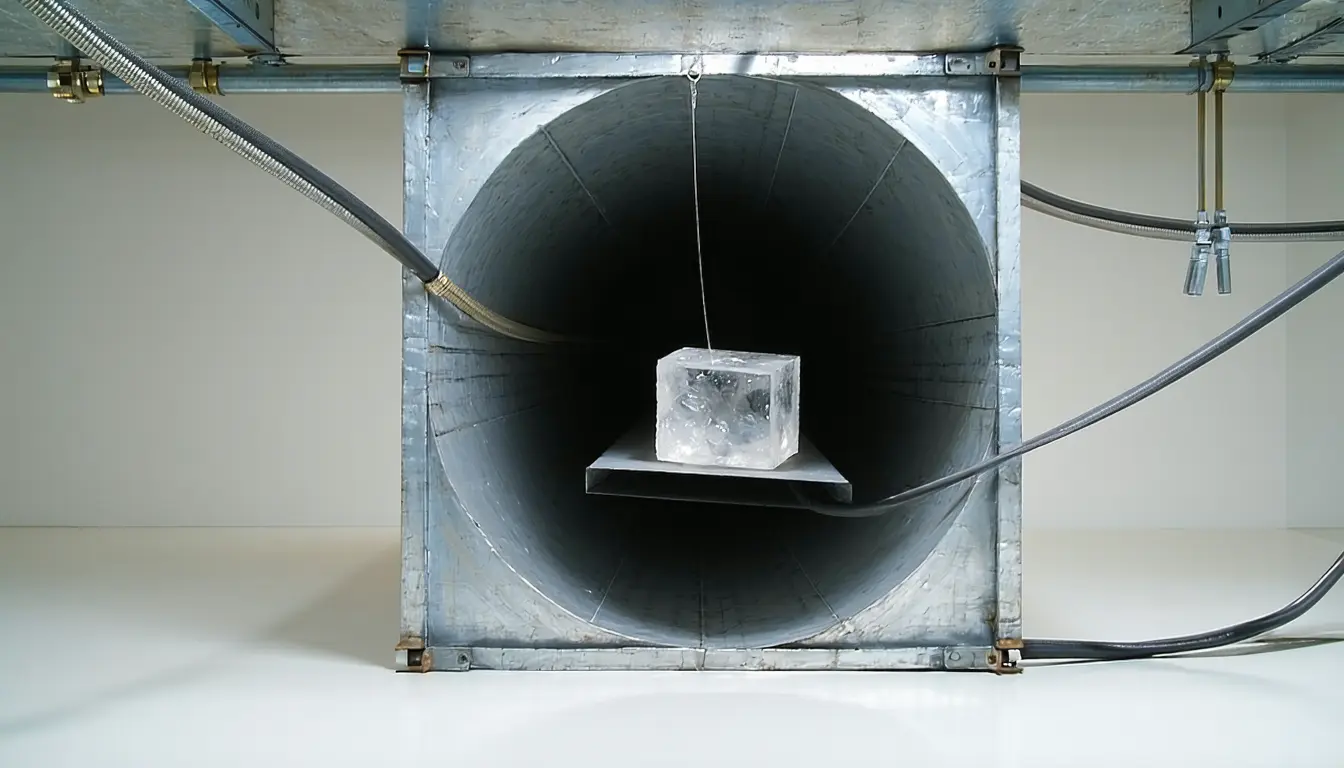
- Oak Ridge National Laboratory has built a low-cost radiation detector that mounts on facility air ducts and monitors nuclear material buildup continuously, in place of slow manual inspection.
- Microscopic uranium dust escapes sealed processing zones and particulate filters, then settles along the interior walls of metal ductwork over long periods.
- An algorithm trained on real facility data from live testing at ORNL is meant to analyze radiation signatures and trigger alerts automatically once it is integrated.
Compiled by The Product DeskSomething wrong?How this is made
Why it matters
- cost The thousand-fold saving Goetz cites rests on the crystal; the facility still pays for the photomultiplier, the microcontrollers, the cable runs and the staff hours to interpret counts.
- constraint Until the trained algorithm is integrated, the monitor reports pulse counts against thresholds the facility sets, so the interpretation work stays with in-house staff.
- exposure Once a duct is instrumented, the facility owns a minute-by-minute timeline of accumulation that it has to be able to explain, including whatever gaps a dead battery leaves in it.
The install decision gets made duct by duct, and it comes down to cabling: structured cable pulled into the space above a processing area, or a technician swapping the battery once a month. On battery the monitor runs up to a month and stores one sample a minute [4]. Wired over Power over Ethernet it streams and saves every second [4], sixty times the sample rate [2], about 86,400 records per duct per day against 1,440 [3]. ORNL swapped the older USB connection for Ethernet so the run from an overhead duct to a central monitoring hub can be longer [5].
Callie Goetz, the overall project lead, said: "This is a thousand times more affordable than current technology, while the purpose-built design offers a more accurate, user-friendly, and financially beneficial alternative for nuclear facilities" [12]. The figure underneath that is a crystal price. ORNL built the detector around a plastic scintillating crystal costing a dollar or two, where the alternatives it lists run $1,000 to $10,000 [8], and it puts typical detection components upwards of $10,000 [9]. Divide the cheapest alternative by the dearest plastic crystal and the saving is 500 times; take the dearest alternative against the cheapest plastic crystal and it is 10,000 [1]. The finished unit also holds a silicon photomultiplier and digital microcontrollers [10][11]. ORNL did not publish a price for the assembled device, and its account names no regulator that has accepted the data [16].
Project lead Brett Witherspoon describes the electronics as low-power analog processing joined to secure digital microcontrollers, with compact silicon photomultipliers in place of bulky vacuum tubes for better temperature resistance and lower size and cost [11]. The team is stress-testing the electronics for extreme heat, aiming at molten salt reactors, small modular reactors and outdoor perimeter portals [15].
An algorithm trained on real facility data gathered during live testing at ORNL is meant to read radiation signatures and fire alerts the moment material builds to unsafe levels, once it is integrated [14]. What a facility gets before then is a pulse count. The crystal flashes when radiation strikes it, the photomultiplier turns each flash into an electrical signal, and the system tallies pulses in the energy bands uranium produces and flags levels above the ones the facility has set [10].
Before any of this is worth mounting, a facility has to settle per duct whether PoE can reach it, what count triggers a human response and whether that count is written down, and who owns the response overnight. With those fixed, the wired mode shortens the interval between material settling on the duct wall and somebody acting on it [1][3]. Without them, a duct produces 86,400 records a day that nobody reads [3]. Goetz said the devices will "reduce their regulatory burden" [13].
What to watch
- A published price for the assembled monitor; the crystal is the only component ORNL has costed.
- Whether the heat-hardened version reaches molten salt reactors, SMRs or outdoor perimeter portals, and at what temperature rating.
- Whether any regulator accepts the continuous duct stream in place of manual surveys, as Goetz's regulatory-burden claim implies.