Security1 publisher3 min readPublished
Rabbit's OS3 hands a cloud chat window direct control of five endpoints per account
OS3's local agent installs with one command and then takes orders from a chat session in Rabbit's cloud, with each task's content crossing Rabbit's servers on the way to the model provider the user picked.
The Watch · Security desk
What happened
- Rabbit released OS3, an agentic operating system that runs in the company's cloud and drives a user's computers through a local agent installed with a single command.
- One OS3 account can connect up to five devices, including Windows, Mac and Linux PCs, cloud virtual machines, dedicated AI computers and Rabbit's r1 handheld.
- OS3 is live now, and after onboarding the account can be reached from a desktop or mobile web portal, Telegram, iMessage, RCS, SMS or the r1.
Compiled by The WatchSomething wrong?How this is made
Why it matters
- decision Endpoint policy has to decide whether a one-command installer that grants a cloud chat session control of the host counts as remote access software, because standing it up needs no ticket and no admin console.
- exposure Whoever holds the OS3 account can drive the host from a messaging app, so a stolen session turns into interactive access to a workstation without malware on the machine.
- constraint A reviewer cannot say in advance which steps the agent will take unattended, because the confirmation prompt is the only described brake and the sensitive-action list is unpublished.
- precedent Hardware that ships with OS3 as its default operating system arrives with the control channel already installed, moving the decision out of software approval and into what staff are allowed to plug in.
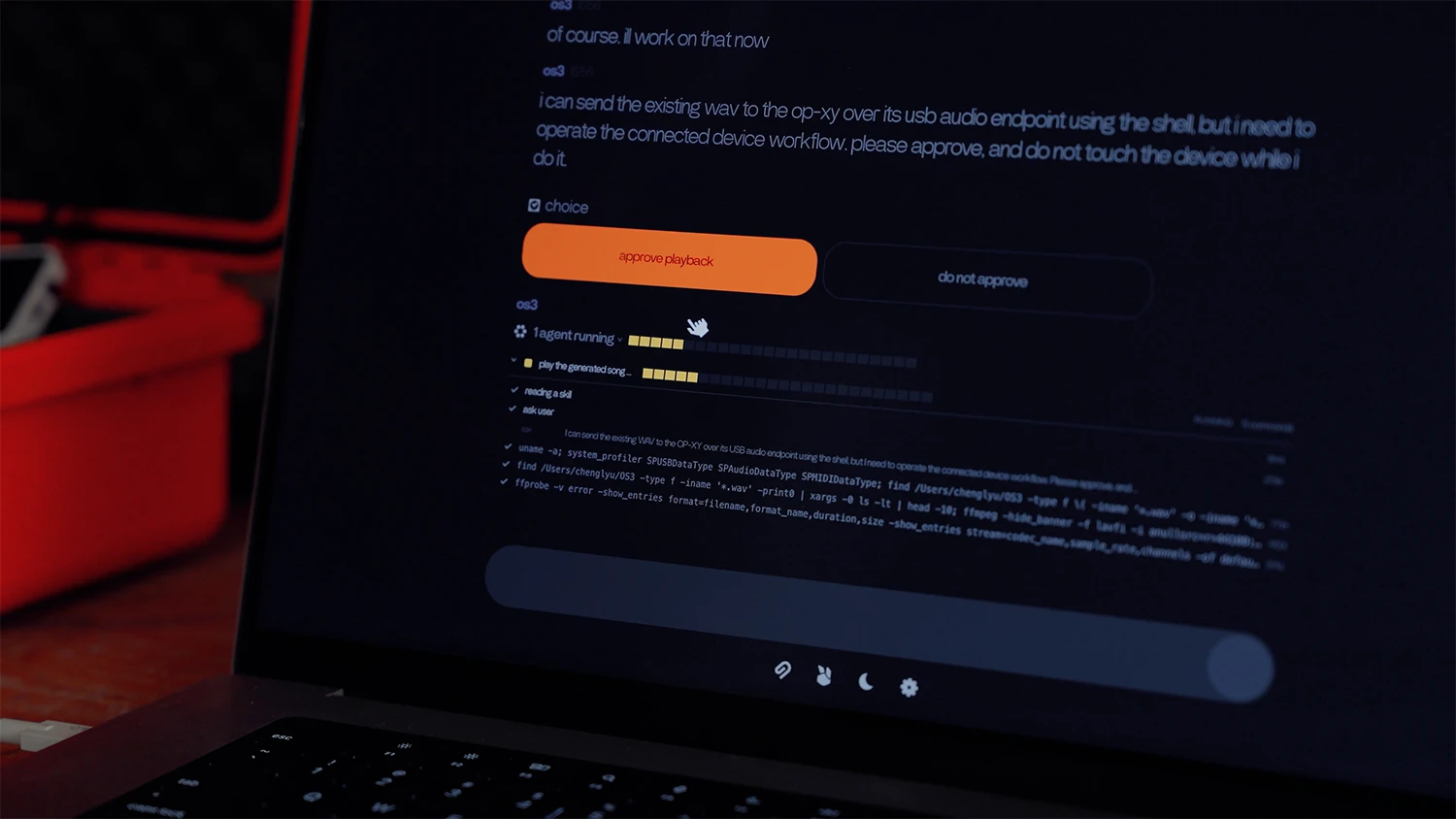
One command is the whole installation [2]. After it runs, instructions arrive from a chat session hosted in Rabbit's cloud, and the agent operates desktop software, local files and web pages, or writes and runs code, to finish the task [3]. The permission model stays where it was: the host operating system prompts for system-level access locally, the user can revoke it at any time, and Rabbit says sensitive actions require confirmation [10]. Rabbit did not list which actions count as sensitive [11].
What leaves the endpoint comes in two parts. Rabbit says the local agent does not copy, store, use or sell a user's files, and that the files stay on the computer [7]. Conversations with OS3 and the memory it builds from them sit on Rabbit's servers, and the company says it keeps no copy of what it relays onward [8]. The relay is what a data policy has to account for: when a task runs, Rabbit's servers process the relevant content and prompts, then pass them to the model provider the user picked, which handles the data under its own terms [6]. Help Net Security's example is a contract summary, which puts the contract's text in front of two companies [9].
The employee picks the second custodian. Users supply API keys from frontier AI labs, cloud router platforms or locally hosted models, and can switch models without losing context, memory or skills [12]. An egress rule written around one provider's endpoint stops matching the traffic as soon as the key changes.
Skills extend what the agent can do, and they install from anywhere they are published, by Rabbit's account: paste the URL into the chat and OS3 sets it up, with no command line step and no extra configuration file [13]. Help Net Security noted that the convenience also skips the point where a user might read what they are adding to an agent that controls their computer [14].
Once onboarding is done, the same account answers from the web portal on desktop or mobile, Telegram, iMessage, RCS or SMS, or the r1 [15]. Four of those six are messaging transports [19].
Jesse Lyu, Rabbit's founder and CEO, said the company spent two and a half years building toward "a system you don't operate, but instead just tell it the outcome" [16]. OS3 is live at os3.rabbit.tech [15]. It follows twelve consecutive months of device updates, including rabbitOS 2, a terminal mode and bring-your-own-key support for DLAM, Rabbit's computer-control technology [18], and it will be the default operating system on the cyberdeck Rabbit plans to ship [17].
No flaw in OS3 is needed for any of this to land on a corporate machine. A user who installs the agent has given software that takes orders from a chat window direct control of the host, and the content each task needs passes through Rabbit's servers on its way to a model [5].
What to watch
- Whether Rabbit publishes the list of actions it treats as sensitive, and whether reading local files is among them.
- Whether endpoint vendors ship detections or install telemetry for the OS3 local agent.
- Whether skills published outside Rabbit get any review before a pasted URL installs them into an agent with host control.