Science1 distinct publisher3 min readPublished
Prime assembly hybridises complementary DNA flaps on both the genome and the donor, so kilobase cargo can be deleted and inserted in one reaction without a landing pad. How well it works depends on which cells you try it in.
The Scientist · Science desk

Compiled by The ScientistSomething wrong?How this is made
The design problem is how a donor fragment finds its place when nothing has been broken for it to recombine into. Prime editors already write short single-stranded 3' flaps at a genome locus, and earlier work used exactly that to duplicate megabase-scale chromosomal DNA in human cells [14]. Prime assembly writes the flap twice, once on the target and once on the cargo, so the two hybridise and initiate strand exchange [1][2]. Using two pairs of flaps rather than one is what converts insertion into replacement: the excision and the insertion are specified by the same annealing event. The authors, writing at nature.com, state that no earlier system performed both at once [12][15].
What it is being measured against falls into two camps. Nuclease routes, including homology-directed repair, homology-independent targeted integration and primed microhomolog-assisted integration, move large payloads but leave indels at the target site [8], and double-strand breaks carry a documented tail of unwanted large deletions and chromosomal aberrations, plus cell death [9]. Break-free recombinase routes such as PASSIGE avoid the break but take two steps, installing a landing pad before the donor goes in [10]. Transposon, bridge-RNA and retrotransposon systems have remained relatively inefficient in human cells [11].
Then the denominators. Divide the primary T-cell result by the cell-line result and you get 28.1 over 57.8, or 49 per cent [16]; the mouse hepatocyte average is 7.4 per cent of the cell-line figure [17]. That gradient reads like delivery rather than chemistry, but the material supplied does not separate the two, and the honest position is that a transfection-friendly line and a primary T cell are different experiments about the same enzyme.
Accuracy deserves the same treatment. More than 90 per cent of integrated fragments were accurate [5], which is a floor rather than a point estimate. Applied to the best replacement figure, that permits up to about 5.8 per cent of cells to carry an imprecise insertion [18]. The thing this doesn't tell you is what the imprecision consists of, and for a therapeutic product the difference between a few lost base pairs at a junction and a partial cargo is the difference between a release assay that passes and one that does not.
For cell therapy, the abstract pairs the 28.1 per cent CAR figure with functional engineering [6][20], without potency or persistence data in the portion available. In mice, the delivery route was hydrodynamic injection [7], which shows the chemistry running in a live liver and says nothing about a formulation anyone could dose. On the evidence supplied, prime assembly is a strong result about editing chemistry and an open question about delivery, which is why the ex vivo number is the one likely to move first.
Ranked by verification strength, evidence, and original report placement.
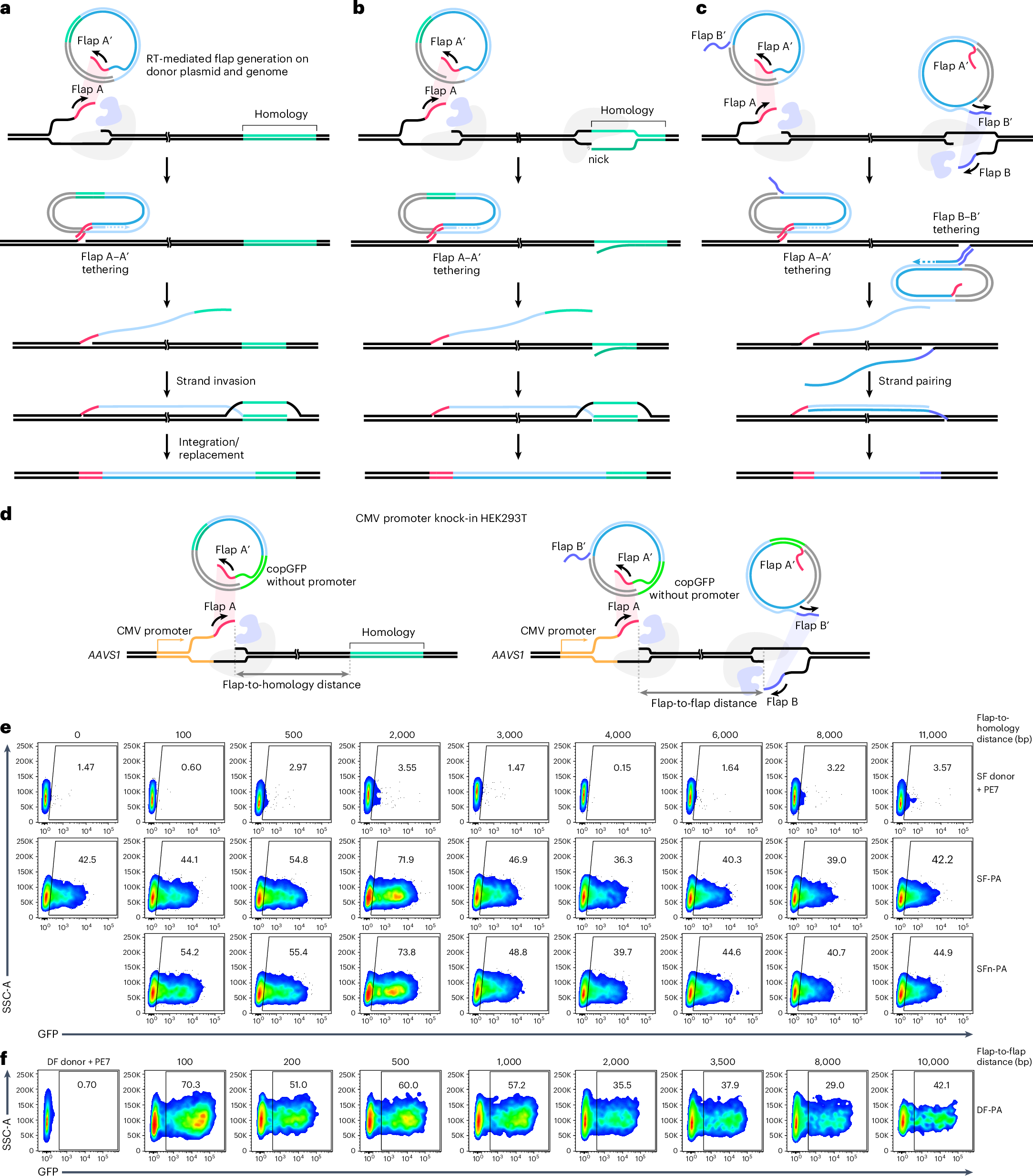
Prime assembly (PA) adapts prime editors to produce one or two pairs of 3' flaps on both the genome and the donor DNA.
The 3' flaps anneal to each other precisely, similar to Gibson assembly in DNA oligonucleotides, and initiate strand exchange, allowing megabase-scale genomic excision and/or kilobase-scale donor insertion at the gene of interest.
PA accepts DNA plasmids and linear double-stranded DNA as donors, ranging from 1.0 to 6.5 kb in size.
PA showed an efficiency of up to 57.8% in replacing endogenous sequences with a 2.9-kb donor DNA fragment in HEK293T cells.
PA enables site-specific chimeric antigen receptor integration with up to 28.1% efficiency in primary human T cells.
Distinct publishers with included, body-backed reporting in this cluster.
1 article · August 27, 2026
Follow any of these and your For You feed starts watching them — no settings page required.
science
Rydberg chain spectra match Ising CFT predictions, turning a simulator into an instrument1 distinct publisher
science
Sleep tech turns rest into evidence, and employers are the ones who will need rules1 distinct publisher
science
A neck bypass for Alzheimer's reached hundreds of hospitals on the strength of one video1 distinct publisher
science
South Africa moves to license its scientists, with a year in jail for the unregistered1 distinct publisher
Evidence-backed comparisons of source perspectives and observed adoption signals. Read the methodology
Which Builder, Operator, and Investor concerns the observed source mix emphasized—not a truth score.
Evidence, demonstrated adoption, hype gap, incentives, and confidence are assessed independently, each on its own current evidence. How these are measured.
One primary report, quantified but unreplicated
The measurements are specific and falsifiable — 57.8%, above 90%, 28.1%, 4.3% — and each is tied to a named cell type or animal rather than floated as a capability. They also all come from the group that invented the tool, in the paper that introduces it, and the portion of the text available to us stops before the genome-wide off-target and indel data that would show what donor-directed annealing costs at the target site.
Founding-paper demonstrations only
The tool's entire track record fits inside its first publication: an immortalised cell line, primary T cells at the bench, and mice dosed by hydrodynamic injection. No second laboratory, no company, no preclinical program, no protocol reuse appears anywhere in this reporting — which is what you would expect on the day of disclosure, and is also why the number is this low.
Headline number is the easiest case
Gene replacement in one reaction is a genuinely large idea, and the paper does not hide its weaker numbers — but the number that travels is 57.8%, obtained in HEK293T, the most permissive cell line in the business. Move to primary T cells and it roughly halves; move to mouse liver and it is under a tenth. The claim that no system had yet achieved precise gene replacement is a statement about the literature, made by the authors, and nothing else in this reporting checks it.
The method's inventors are its only narrators
A methods paper is an argument for its own method, and this one's literature review doubles as competitive positioning: break-dependent routes damage the target, recombinase platforms need two steps, transposon and bridge-RNA systems underperform in human cells. Each objection is defensible as written; arranged together, they leave prime assembly as the only remaining door. Funding, patent and competing-interest disclosures are not part of the material we have, so the commercial stake behind the work is unreadable from here.
Solid measurements, untested outside one lab
We can be fairly confident about what was measured and much less about what it will mean. The efficiencies are concrete and the mechanism is specified well enough to be tried elsewhere; but the drop from cell line to primary cells to liver is exactly the stretch where large-cargo editing tools have historically stalled, and no source outside the paper speaks to it yet.