Science1 publisher3 min readPublished
Albedo and water balance decide whether dryland tree planting cools anything
A phys.org explainer sets the Bonn Challenge's 350-million-hectare target against dryland ecology, where planting trees can cut river flow and darken bright ground enough to cancel part of the carbon gain.
The Scientist · Science desk
What happened
- The Bonn Challenge commits to restoring 350 million hectares of degraded and deforested land by 2030, a target that can treat naturally open land as a candidate for tree cover.
- The African Union launched the Great Green Wall in 2007 to halt the Sahara's southern expansion across 22 countries from Senegal to Djibouti, and the article says results after almost 20 years are mixed.
- Drylands cover about 40 percent of Earth's surface, support billions of people, and drive much of the year-to-year variability in the global carbon cycle.
- Ecologists have warned that planting trees in old-growth grasslands and savannas can damage biodiversity and ecosystems rather than restore them.
Compiled by The ScientistSomething wrong?How this is made
Why it matters
- constraint The tonnage leaves water out, so a target denominated in hectares of tree cover registers a success even where the planting has lowered the flow in nearby rivers and streams.
- exposure The people who feel a falling water table, a drier downstream ecosystem or a thinner household supply are on the receiving end of a siting decision made upslope of them.
- decision A funder now has to pick a definition of success before picking a method: forest-like appearance, or recovered soil function and vegetation on land that was never forest.
- precedent Once albedo is priced into restoration accounting, projects on bright open soils become harder to justify than their carbon numbers alone suggest.
Tree planting is easy to account for, visible and easy to communicate, the phys.org article says [19]. Carbon inventories are denominated in tonnes. Two of the effects that determine whether a planted hectare in a dryland cools anything are measured in other units, and the article argues that counting tonnes while ignoring one of them can exaggerate the benefit of planting [12].
Its premise is ecological. Native grasses, shrubs, scattered trees and biological soil crusts are parts of a functioning biome, not signs that an ecosystem needs restoration [5]. A recent United Nations report says the world will likely overshoot the 1.5 C target set in the 2015 Paris Agreement by 2030 [1].
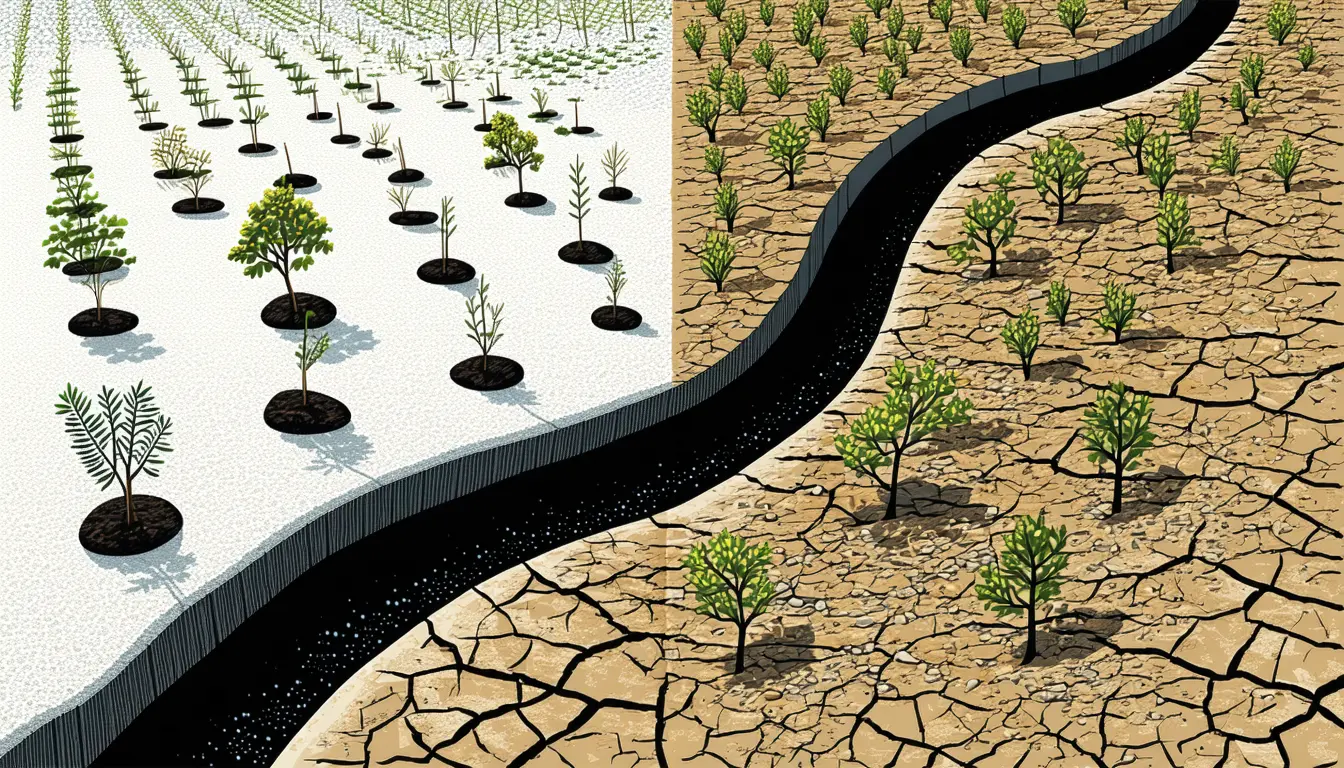
Albedo is the share of sunlight a surface reflects. Open vegetation and light-colored soils often reflect more than a dark canopy, so converting them to forest increases the solar energy the land absorbs [10]. Research cited in the article shows that albedo change can offset a substantial share of the climate benefit expected from added tree cover, with especially important consequences in some drylands [11].
The second effect runs through water. Trees use water, and planting ill-suited species in water-limited ecosystems can substantially reduce the volume flowing through rivers and streams, with knock-on effects on groundwater levels, downstream ecosystems, farming and household water security [8]. The claim is site-specific. In some locations, appropriate native trees can provide shade, habitats, food and carbon storage, and the article locates the problem in large-scale reforestation that ignores the water balance [9].
The article describes the albedo offset only as a substantial share, without a figure [11], and while it says global restoration targets can identify naturally open ecosystems as candidates for tree cover, it puts no number on how much of the 350 million hectares sits on such land or what any of it costs [7]. So the strong charge, that a meaningful fraction of restoration spending is buying carbon claims at the expense of grassland function, is not settled here. The narrower case is: a target written in tree cover does not measure streamflow or reflectivity, and both move when the trees go in [8][11].
The counter-example the article offers is farmer-managed natural regeneration, which protects and manages native trees and shrubs that resprout from existing roots, stumps or seeds [13]. In Niger, farmers regenerating white acacia and other useful species helped regreen about five million hectares without mass seedling campaigns [14]. That is roughly 1.4 percent of the Bonn Challenge total [18]. Because farmers select the regrowth, the mix can be adapted to crops, livestock and locally valued species [15]. In Burkina Faso, farmers revived and improved zai, planting pits that collect runoff and concentrate manure or compost around crops, and soil and water conservation research finds such practices can rehabilitate degraded land and improve production under difficult rainfall [16]. In those cases restoration is defined by recovered soil function and vegetation [17].
What to watch
- Whether restoration accounting adds streamflow and albedo terms alongside tonnes of carbon, and who audits them.
- A published breakdown of Great Green Wall hectares by ecosystem type, which would finally size the grassland-versus-forest mismatch.
- Site-level effect sizes in the peer-reviewed literature for how much albedo change offsets carbon gain in specific drylands.