Loading today’s stories
Product1 distinct publisher3 min readUpdated
Phonak runs two neural networks on one hearing aid chip, and only Phonak has measured the result
EON claims 37% less power, a 25% smaller shell, 20% less weight and 38 hours per charge against Phonak's own previous generation. The speech gain rests on the company's own testing.
The Product Desk · Product desk
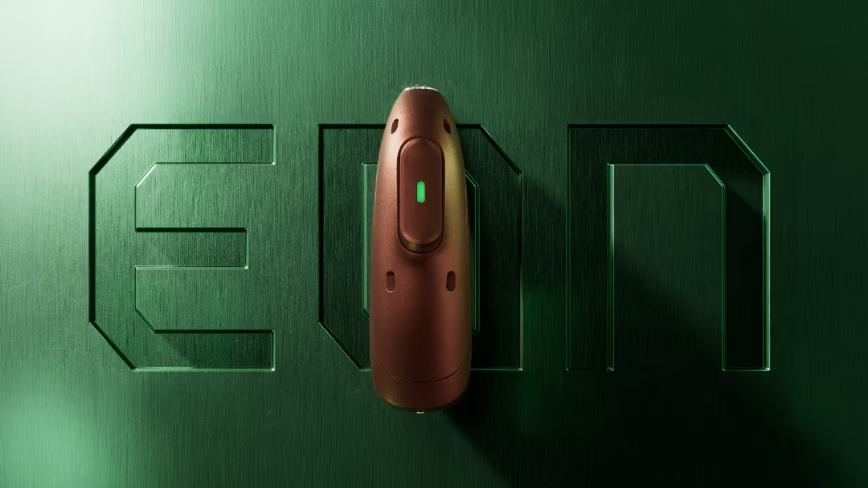
What happened
- Phonak launched EON, a hearing aid platform built around a newly developed processor the company calls HYPERSONIC, which it says runs two artificial intelligence systems in parallel while drawing 37% less power than the previous generation.
- Phonak is a Sonova-owned brand.
- Spheric Speech Clarity 3.0 uses a deep neural network to separate speech from background noise as it arrives.
- AutoSense OS AI 8.0 classifies the surrounding sound environment and adjusts which features are running to suit it, so the wearer is not expected to switch programmes manually when moving between a restaurant and a street.
- EON is 25% smaller and 20% lighter than the previous Sphere generation, according to Phonak.
Compiled by The Product DeskSomething wrong?How this is made
Why it matters
The number worth holding onto is not the 37%, it is that the power figure arrived alongside a smaller shell and a longer runtime [1][5][6]. A processor can post a lower draw on a bench and hand the whole saving back to a bigger cell. Phonak instead says 25% of the volume and 20% of the mass are gone versus the previous Sphere generation, with up to 38 hours on a charge [5][6]. Read the 25% as volume and the mass came out more slowly than the space did, which makes the new device about 7% denser than the one it replaces [2]. Space falling faster than weight points at packaging, not at deleted components.
The parallel operation is the actual engineering claim. Spheric Speech Clarity 3.0 works on the incoming signal, separating speech from noise as it arrives [3]. AutoSense OS AI 8.0 sits above it, classifying the sound scene and changing which features are switched on as the wearer moves between environments [4]. The load is therefore not one network running continuously, it is one network running continuously while a second keeps rewriting the configuration underneath it. Anders Rosengren, Sonova's chief R&D officer, said the chip was a step forward in power efficiency "without compromising real-time AI performance" [7], which names the tradeoff usually taken at this point. Against the prior generation's budget, that work now happens at 63% of the draw [3].
The evidence for the audio outcome is thinner than the evidence for the silicon. Phonak says wearers are twice as likely to understand every word spoken from any direction with Spheric 3.0 enabled, compared with the same aids configured identically without it [8], and it cites its own testing rather than third-party benchmarks [9]. That comparison holds the hardware and the fitting constant and toggles one feature, which measures Spheric 3.0 against itself and says nothing about how its network ranks against a rival's. WindBlock 2.0's 50 dB of wind reduction and 30 dB of signal-to-noise improvement are both quoted as "up to" figures [10].
Runtime is the one claim a wearer can verify without a lab. Thirty-eight hours covers two sixteen-hour days with six hours left over [1], which is the difference between charging every night and charging when it suits.
Then there is the counter. Licensed hearing care professionals in the United States could order from Monday, with Germany, France, the UK and Australia following in September [15], and no price has been published, which is normal for a product shaped by national reimbursement rather than list prices [16]. Meanwhile Auracast puts the same broadcast standard into the hearing aid that consumer LE Audio receivers use, so a venue feed reaches it directly [11][12]. Specification sheets on the two sides of this market are converging faster than the channels that sell them [17], and EON is the clearest example so far: consumer-grade silicon engineering, distributed by appointment.
Loading topic controls
Loading related stories