Science1 distinct publisher3 min readUpdated
The Panama Canal Authority cuts daily transits from 36 to 34 on Sept. 3 and to 32 on Sept. 15 after a 34% rainfall shortfall. Booked ships keep their slots; everyone else queues or bids.
The Scientist · Science desk
Compiled by The ScientistSomething wrong?How this is made
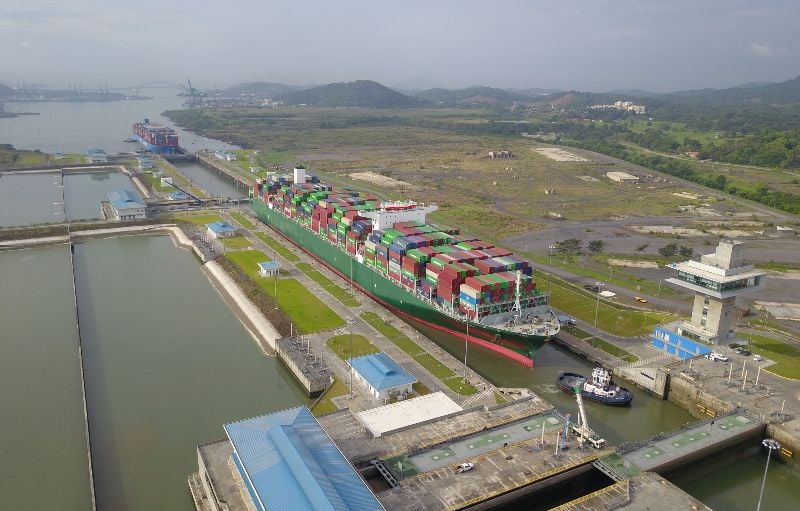
The Panama Canal Authority said Thursday it will cut the number of ships it lets through each day because of drought driven by El Niño, dropping from 36 transits to 34 on Sept. 3 and to 32 on Sept. 15 [1][2][3]. The canal handles about 5% of global maritime trade and roughly 40% of U.S. container traffic, so this is not a weather story with a shipping angle; it is a capacity schedule that freight planners now have to book against [5].
The arithmetic is small and unforgiving. Four fewer slots a day is an 11% reduction in daily throughput [17], or about 120 fewer transits across a 30-day month [18], and the two steps land 12 days apart [22]. The authority attributes the cut to low water in the two artificial lakes that feed the canal, with rainfall in the canal area from May to August down 34% from its historical average and possibly falling further [2][4]. The operator framed the measures as protecting the waterway's "long-term sustainability" against "lower than forecast rainfall in the canal's watershed" [6]. It has already reduced the maximum draft allowed for the largest ships, which cuts cargo per hull rather than hulls per day [7].
The cost concentrates in a thin slice of traffic. Nine of ten ships transit on a reservation booked in advance; the remaining slots are auctioned [10]. At 32 transits, that is roughly three auctioned slots a day [21], and the authority says waiting times for ships arriving without a booking will increase [9]. Auction pricing already shows what scarcity does here: according to AFP, the average winning bid was $135,000 before the Iran war, while in April one shipping company paid $4 million for a slot, about 30 times the earlier average [11][19]. Anyone whose supply chain depends on catching an unreserved transit is exposed to that distribution, not to the average.
There is precedent for worse. In 2023, lake levels forced the operator to cut daily transits from 38 to 22 [8], which leaves the new 32-transit floor ten transits above that trough [20]. The authority says it does not rule out further restrictions depending on rainfall in the coming weeks [12]. Two things make that more than boilerplate: El Niño arrives on average every two to seven years and this year's is shaping up as one of the strongest on record [15], and the lakes that float the ships also supply drinking water to half of Panama's 4.2 million people [14]. When those two claims compete, ships are the discretionary user. Elsewhere in the region, the government of Honduras placed 80% of the country on drought alert on Wednesday [16].
The exposure is not evenly spread. The canal's main users are the United States, China, Japan, Chile and South Korea [13], and the 40% figure for U.S. container traffic means American importers absorb the largest share of any rerouting or bidding [5].
Watch three things. Whether rainfall in September lets the authority hold 32 or forces a fourth step down [12][4]. Auction clearing prices, which are the fastest public read on how tight the remaining slots have become [11]. And draft limits, since further cuts there reduce tonnage without changing the transit count anyone is quoting [7].
Follow any of these and your For You feed starts watching them — no settings page required.
Ranked by verification strength, evidence, and original report placement.
According to the AFP report, before the Iran war the average winning bid in the canal slot auctions was $135,000, but in April one shipping company eager to use the canal paid $4 million.
El Nino occurs on average every two to seven years, and this year's El Nino is shaping up as one of the strongest on record.
The Panama Canal Authority said Thursday that the canal will cut the number of ships passing through it starting next month because of drought caused by El Nino.
Starting Sept. 3, the number of vessels allowed through each day will fall from 36 to 34 because of low water levels in two artificial lakes that feed the canal, the Panama Canal Authority said.
The daily transit limit will drop to 32 starting Sept. 15, the agency said.
In the area of the canal, rainfall from May to August is down 34% from its historical average, the authority said, adding that El Nino could reduce it even more.
Evidence-backed comparisons of source perspectives and observed adoption signals. Read the methodology
Which Builder, Operator, and Investor concerns the observed source mix emphasized—not a truth score.
Evidence, demonstrated adoption, hype gap, incentives, and confidence are assessed independently, each on its own current evidence. How these are measured.
Single wire report, operator-attributed numbers, undated pricing
Every figure in the cluster comes from one AFP-credited item republished by phys.org, with the Panama Canal Authority as the source for the slot counts, dates, rainfall deficit and rationale. Those operational facts are specific and attributable, which is why this is not scored low. But there is no second publisher, no independent hydrological or freight data, the trade-share percentages carry no underlying dataset, the auction bid comparison is undated and unattributed, and the article's 2026 credit line sits alongside past-tense 2023 cuts and an in-progress El Nino, leaving the event year unresolved.
Announced and dated, not yet observed in operation
The restriction is a scheduled operator action with firm effective dates rather than a proposal, and adjacent measures - reduced maximum draft - are described as already in force, which gives it real weight. Precedent from the 2023 cut to 22 transits shows the authority does implement such limits. But no post-effective-date data appears in the cluster: no queue lengths, no observed transit counts, no carrier reroutings and no auction clearing prices after the announcement, so real-world uptake of the constraint is asserted forward rather than measured.
Modest cut framed through the most dramatic available number
The physical facts are stated soberly, but the cluster's centre of gravity - that the auction is where the cut will bite - rests on one undated $4 million bid set against a $135,000 average, a roughly 30x contrast that predates the announced restriction and is not causally linked to it in the source. Meanwhile the actual change is four slots, about 11% of throughput, and the new 32-transit ceiling remains ten transits a day above the 22 imposed in 2023. Scale and price drama are therefore mildly overstated relative to what the evidence establishes, though the operator's refusal to rule out deeper cuts keeps the downside genuine.
Operator is sole speaker on its own rationing and its own auction
Nearly all substantive statements originate with the Panama Canal Authority, which has direct interests in how this is read: it frames the cuts in its own language of watershed shortfall and 'long-term sustainability', it must manage a politically charged competition with domestic drinking water for half of Panama's 4.2 million people, and it is the counterparty that collects auction proceeds on the scarce residual slots. No carrier, shipper, regulator or independent hydrologist is quoted to counterweight that. The publisher is a science aggregator carrying an agency feed, so outlet-level commercial incentive is limited; the concentration is at the source level.
Operational facts firm, commercial and temporal detail soft
Confidence is moderate. The slot counts, effective dates, draft measures, reservation share and rainfall deficit are specific and attributable, and the regional drought context is corroborated by the Honduras alert. Against that, the cluster has one publisher and one source, the auction pricing that drives the story's angle is undated and unsourced, forward effects on queues are operator forecasts, and the article's internal dating is inconsistent - so conclusions about magnitude, timing and market impact should be held loosely.
science
Honduras puts 234 of 298 municipalities on drought alert, and names its own end date1 distinct publisher
science
A named ship and a published timetable turn the Arctic into a bookable lane1 distinct publisher
invest
46.9% full, 21.9 points below norm: Korea puts a number on drought's input cost1 distinct publisher
science
Drought does not simply cut waterborne disease: a framework sorts hotspots from dead ends1 distinct publisher
Distinct publishers with included, body-backed reporting in this cluster.
1 article · August 21, 2026