Invest2 distinct publishers3 min readPublished
The figure is an estimate Nikesh Arora gave on his own earnings call, the beat and the raise are real but unquantified in this account, and the 113% run since April 7 is the part of the story with an audit trail.
The Investor · Invest desk

Compiled by The InvestorSomething wrong?How this is made
A $1 trillion number is worth dividing. Spread across the roughly 2,000 companies Arora says Palo Alto has walked through its Frontier AI Critical Defense Program [8], the debt works out at about $500m each [12], and that is a capital programme rather than a line item in a security budget, one that needs a board sponsor. Spread over ten years instead and it is $100bn a year of global spend [13], and the useful property of that second version is that someone can check it later against reported industry revenue, which is not true of the phrase "cybersecurity debt" on its own.
What the material does not contain is the cash. Palo Alto beat its fiscal fourth quarter and issued a strong outlook for the new fiscal year [4], and that is the whole of the quantitative demand signal here: no revenue figure, no billings, no remaining performance obligation, no conversion rate from those 2,000 diagnostic conversations into signed contracts. Beat and strong are adjectives. The trillion is a chief executive's estimate delivered on his own earnings call [1] and retold on a programme whose host's charitable trust owns the stock [16], so the number is unaudited; that alone does not make it wrong, and Arora said himself that the spending will not arrive at once [15].
The re-rating is easier to measure than the demand. Nine months ago the same investor base was pricing capable AI models as a threat to traditional security software [5], a stretch Arora described as being convicted of near death [6]; the shares are up 113% since April 7 [7], a hair over a double [17], and because the stock was in the red for 2026 before that date [11], every dollar of this year's gain sits on the far side of it [14]. In under five months [18], the narrative flipped from AI eating security's lunch to AI feeding it, on roughly the same facts about what models can do.
The plausible versions differ mostly in whose money moves. One is a genuine multi-year refresh, in which case the duration argument Arora made [15] is the entire thesis and guidance keeps creeping upward. Another is substitution rather than addition: customers consolidate onto one platform, Palo Alto takes share, and industry revenue grows well short of $100bn a year [13]. The third, or rather the more interesting version, is that the urgency is exogenous, since Arora credits Anthropic's Mythos launch with achieving in one event what eight years of his own warnings did not [9][10], which puts part of the sales calendar in a lab's release notes.
This is probably wrong. The price already contains the narrative, while the cash flow statement has yet to show the trillion. Falsify it this way: fiscal 2027 quarters where the beats are traceable to net-new architecture budget rather than bundling, plus a disclosed dollar figure for Frontier-sourced bookings. Until one of those lands, the market has repriced a belief about machine-speed attackers [1] by 113% [7]. That repricing is not a receipt.
Ranked by verification strength, evidence, and original report placement.
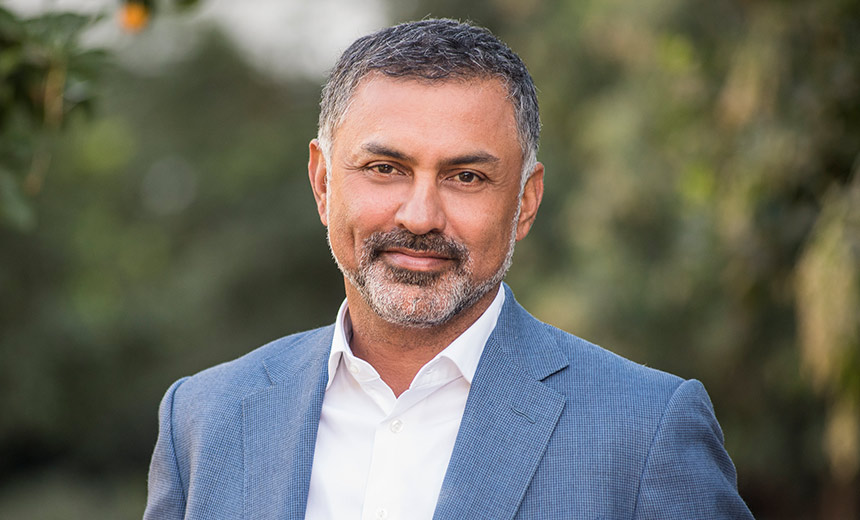
On Palo Alto Networks' earnings call, CEO Nikesh Arora said there is "approximately $1 trillion of global cybersecurity debt that must be modernized to defend against automated threats because they operate instantaneously."
Arora said Tuesday that AI is forcing companies to overhaul roughly $1 trillion of aging cybersecurity infrastructure built for a pre-AI world, telling CNBC's Jim Cramer that nothing deployed seven or 10 years ago is ready to handle AI at machine speed.
CNBC's report on Arora's remarks is dated September 1, 2026, and describes both the remarks and the earnings report as occurring on Tuesday.
Arora said: "You cannot deploy AI successfully if you don't get cybersecurity right."
Palo Alto's earnings report beat fiscal fourth quarter estimates and the company issued a strong outlook for its new fiscal year.
Palo Alto and other cybersecurity stocks came under pressure earlier in the year on fears that increasingly capable AI models could disrupt traditional security software, before the market began to view AI as a growth driver because attackers can weaponise the same technology.
Distinct publishers with included, body-backed reporting in this cluster.
cnbc.com
2 articles · September 1, 2026
seekingalpha.com
1 article · September 1, 2026
Follow any of these and your For You feed starts watching them — no settings page required.
invest
CrowdStrike cleared its own net-new ARR ceiling by at least 15.6%1 distinct publisher
invest
Palo Alto doubled its platformization count to about 220 in a single quarter1 distinct publisher
invest
A twenty-point jump in September hike odds reprices the AI trade the earnings just validated1 distinct publisher
invest
Nvidia's pre-earnings re-rating is a credit story, not a chip story1 distinct publisher
Evidence-backed comparisons of source perspectives and observed adoption signals. Read the methodology
Which Builder, Operator, and Investor concerns the observed source mix emphasized—not a truth score.
Evidence, demonstrated adoption, hype gap, incentives, and confidence are assessed independently, each on its own current evidence. How these are measured.
One newsroom, one witness
Strip out the duplication and this story has a single witness: a Mad Money interview and the earnings call it quotes, both Arora. Seeking Alpha's contribution is CNBC's opening two sentences, printed twice. The trillion, the beat, the outlook and the 2,000 conversations all come from the man selling the remedy, with no filing, analyst figure or customer to check them. The 113% share move is the only number a reader can verify independently.
Conversations, not deployments
Two thousand conversations is a pipeline, and Arora effectively concedes it when he warns nothing lands next quarter. The Frontier program is weeks old in this telling, with no named customer, no contract and no revenue separated out of a quarter whose numbers never appear. What is real is a launch and a queue of meetings; what is missing is anything actually installed.
Trillion-dollar frame, funnel-sized proof
The biggest number in the story is the least examined. A round $1 trillion, produced on the speaker's own call, stretches without friction into $500 million per prospect or $100 billion a year — arithmetic that feels like corroboration and is not. Underneath the frame sits a program introduced in August and a stack of sales meetings. The 113% is genuine; the trillion is positioning.
Everyone in frame is long the thesis
Almost every party here profits from the premise. Arora sizes his own addressable market on his own results call, and does it by crediting a rival lab's model launch with the urgency eight years of his own warnings failed to produce. The venue is Mad Money, and CNBC notes that Cramer's Charitable Trust owns both Palo Alto and CrowdStrike — a disclosure the piece makes and then walks past.
Firm quotes, soft numbers
What was said, when, and by whom is nailed down; whether any of it is true is another matter. One newsroom, one interview, one aggregator echo, and a set of figures that only the speaker can vouch for. We are confident about September 1 and considerably less so about the trillion.