Product1 distinct publisher3 min readPublished
When Picnic closed in May, support for Moto Pizza's two machines stopped the same day. For anyone signing a kitchen automation deal, the thing being underwritten is the supplier's runway as much as the hardware.
The Product Desk · Product desk

Compiled by The Product DeskSomething wrong?How this is made
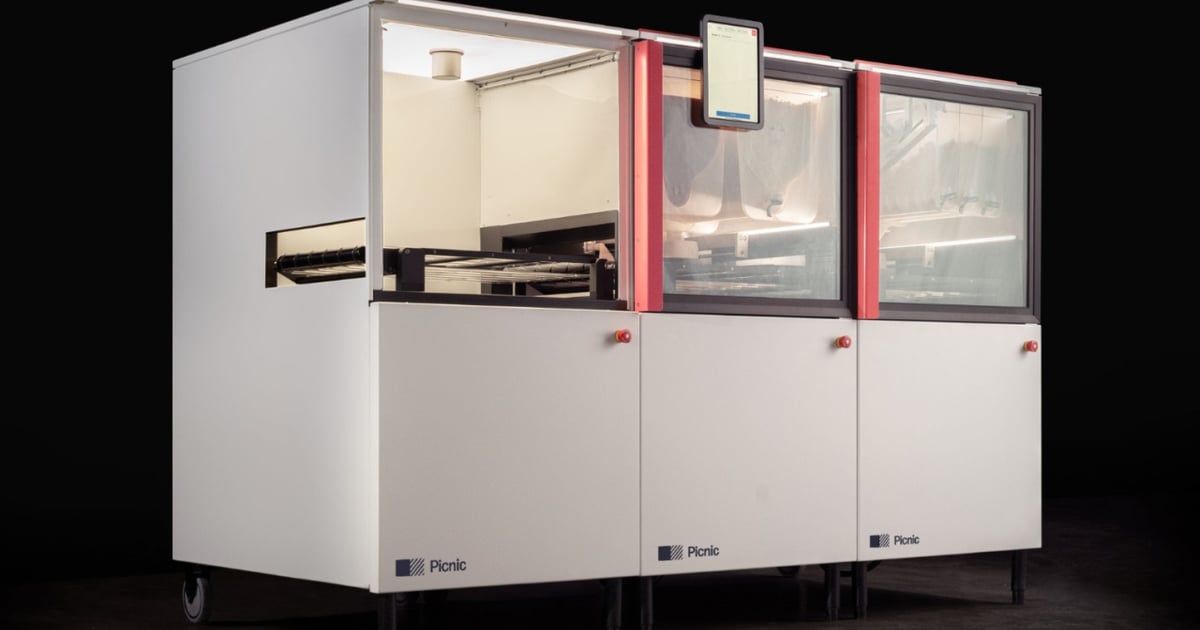
The dough feeder still stands at Moto Pizza, along with the sauce and cheese modules and the pepperoni sprinkler [4]. What disappeared was everything around the metal, not the metal itself: calibration help, spare modules, firmware, the person who picks up when the sauce lands off-centre. Founder Lee Kindell told the BBC that technical support evaporated the moment Picnic did [2], and that the pair went from working line equipment to "basically useless" [1].
Worth separating what these machines are sold as from what they did. At T-Mobile Park, Kindell says a pizza setup that normally took about 10 people ran with 2 once the robots were in [13]. That is 8 people off the make line, an 80 percent cut to that station [21] - except the 8 stayed employed, handing out pizza and promoting it around the stadium [13]. The payback came from output per hour, not from a smaller payroll. Any operator justifying this capex on headcount is describing a different deal from the one Moto Pizza actually ran.
The economics that follow are volume economics. Appetronix, which put a 24/7 unit into Columbus airport for Donatos [14], is chasing a pizza out of the machine every minute [15]. A 60-second cycle means the current 9.5-second sauce deposit [16] eats roughly 16 percent of the whole budget [19]; co-founder Nipun Sharma's "shower head" would take that step to 1.5 seconds, about 6.3 times faster and 8 seconds back in the cycle [20]. That is real engineering, and it only pays where the queue never ends. Sharma is explicit that the target is chain buyers who want identical pizza every time [18]. Bank of America's senior restaurants analyst Sara Senatore, at a bank with holdings in pizza chains including Papa Johns and Domino's [8], puts the counterweight plainly: the success stories have not materialised as expected [7], the bots sometimes drop ingredients in the wrong place, and humans are very efficient at making pizza [9].
So the diligence question is not whether the demo works. Two axes: how much of a shift routes through the machine, and whether a local technician with buyable parts can keep it running without the vendor. Low-share and serviceable is a fine place to experiment. High-share and serviceable is where the payback lives. Low-share and proprietary is an expensive toy. High-share and proprietary is the Moto Pizza quadrant, where a supplier's cap table becomes your Friday dinner service. The forcing function that follows is unglamorous: price the hardware at zero residual value, ask in writing what happens to spares and firmware if the company winds down, and know what the fallback shift looks like before the machine is bolted in.
Kindell's answer to all this is to build his own, a square-pan machine inspired by 3D printers, possibly operational by summer 2027 [10], on an admitted base of no robotics experience [11] and an elbow injury that got him into machines in the first place [22]. He argues the failures at least generated data and moved the technology along [12]. That may be true, but it is also a buyer choosing build risk over counterparty risk, which is a rational trade only if you can actually build.
Ranked by verification strength, evidence, and original report placement.
Kindell says failed pizza robot companies have nonetheless generated useful data and made strides in developing their technology.
Kindell previously used Picnic's robots at T-Mobile Park, home of the Seattle Mariners; he says he would usually need about 10 people to make pizza in such a setup, that with the robots the number fell to two, and that the other eight stayed employed in customer-facing and pizza-promotion roles.
Sharma says of the human-connection question: "What we're going after is a chain market. You want the pizza to taste the same every single time."
In May, the two robots at a Moto Pizza restaurant in Seattle were rendered "basically useless" when their supplier, Picnic, abruptly shut down.
Technical support for the robots evaporated at the moment Picnic shut down, says Lee Kindell, founder and chief executive of Moto Pizza.
Kindell was left wondering what to do with the $160,000 (GBP 118,000) cabinet-like machines and whether buying in pizza bots was worth it.
Distinct publishers with included, body-backed reporting in this cluster.
1 article · August 27, 2026
Follow any of these and your For You feed starts watching them — no settings page required.
invest
SEC's $18.5M insider case shows where a shrunken enforcement docket still bites1 distinct publisher
product
Nebius funds $4.5bn of AI capacity on terms that pay lenders mostly in stock2 distinct publishers
invest
Five buyers now owe Nvidia $44bn of the demand its guidance promised1 distinct publisher
invest
Four banks, one blown-up AI fund, and a subpoena aimed at the lending desks1 distinct publisher
Evidence-backed comparisons of source perspectives and observed adoption signals. Read the methodology
Which Builder, Operator, and Investor concerns the observed source mix emphasized—not a truth score.
Evidence, demonstrated adoption, hype gap, incentives, and confidence are assessed independently, each on its own current evidence. How these are measured.
Named first-hand accounts, single publisher
The core facts are attributed on the record: the operator names the supplier, the shutdown month, the hardware line-up and the $160,000 figure; the vendor CEO gives specific cycle timings; an analyst and two other operators are quoted. But everything comes from one BBC report with no filings, no contract documents, no measured throughput from any deployed unit, and no Picnic statement explaining the shutdown.
Thin, partly reversed deployments
Documented real-world use is small and one instance has already been undone: two machines at one Seattle restaurant now idle, an earlier stadium installation at T-Mobile Park, and one Appetronix unit for Donatos at Columbus airport. Adjacent evidence (Flippy in some US fast food restaurants, Miso buying Zume's patents) shows continued activity but not pizza-robot scale, and four named vendors in the category have exited.
Promises outrunning installed reality
Forward claims are considerably larger than anything measured: a one-pizza-per-minute machine, laser and ultrasound slicing, and a first-time builder with no robotics experience projecting a working prototype by summer 2027. Against that sit a supplier that vanished mid-contract, four exited vendors, an analyst saying no success stories have materialised, and no published throughput from the single live chain deployment. The article itself is sceptical, so the gap sits in the sourced claims rather than in the framing.
Interested parties, one conflict disclosed
Most voices have a stake in the answer. The BBC discloses that the sceptical analyst's employer holds interests in Papa Johns and Domino's. The operator criticising vendors is simultaneously building a competing machine of his own. The vendor CEO is promoting unreleased hardware, and the executive praising Zume's vision now owns its patent portfolio. These positions are visible in the text rather than hidden, which limits the distortion.
Solid on the failure, weak on the forecasts
Confidence is high for the backward-looking core: the shutdown, the stranded $160,000 of hardware, the loss of support and the roster of exited vendors are all on-the-record and internally consistent. It falls away for forward and quantitative claims, which are single-source vendor or operator self-reports with no measurement, and the whole cluster rests on one publisher.