Build1 publisher2 min readPublished
Orca wraps git worktree add in a per-task terminal and preview window
The desktop app creates a real git worktree for every task and launches a CLI agent inside it. The isolation is the same git command you already have. The product is the review loop built around it.
The Engineer · Build desk
What happened
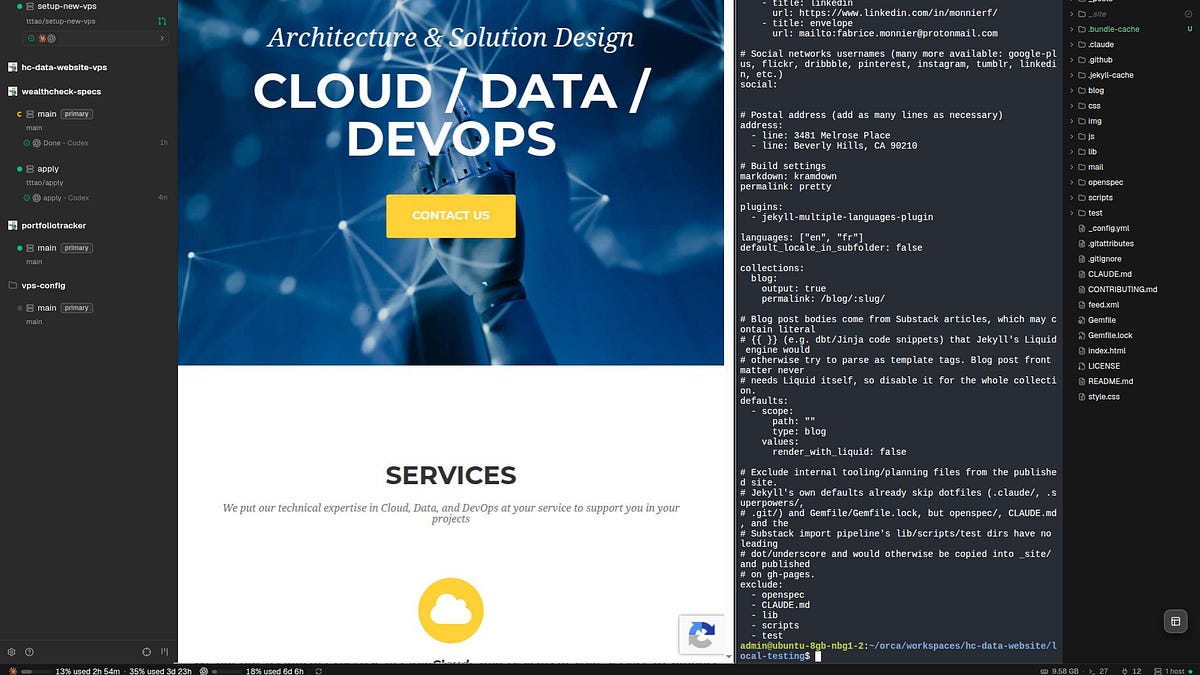
- Orca calls itself an Agent Development Environment, built around supervising several AI agents that write code at the same time, where a traditional IDE is built around one human typing.
- Every task started in Orca gets its own git worktree on its own branch, its own agent terminal, and its own browser tab for previewing the app.
- The docs' first 3-agent session pastes one prompt into three worktrees running Claude Code, Codex and Cursor CLI, then has you review each diff and delete the losers in one click.
- Orca ships preconfigured for eleven named CLI agents, among them Gemini, GitHub Copilot, Goose and Qwen Code, and any other CLI agent can be added.
- Design Mode gives each worktree a real Chromium window, and clicking a UI element sends that element's HTML, CSS and a cropped screenshot to the agent.
Compiled by The EngineerSomething wrong?How this is made
Why it matters
- cost Three agents racing the same prompt spend three subscriptions' quota to produce one merged diff, and Orca puts Claude and Codex usage with rate-limit reset times in the app.
- decision Because Orca launches whatever CLI you point it at, the recurring decision becomes which agent gets which ticket instead of which single agent vendor a team standardises on.
- capability The Orca CLI lets an agent create worktrees, so a supervising agent can fan out its own parallel branches with no human clicking +.
- exposure SSH worktrees move the agent's shell, file edits and git onto a remote host with port forwarding, so what an agent can reach is that host's filesystem and not the laptop's.
A worktree is a folder, not a clone. `git worktree add ../fix-login-race -b fix-login-race` leaves two folders on two branches sharing one git history, with nothing stashed [4]. Orca runs that command when you name a task, bases the new branch on your default branch such as `origin/main`, and starts the chosen agent's CLI inside the new directory [5][6]. They are ordinary worktrees, so you can cd in and use plain git [5].
What the app adds is the loop around that free, already installed isolation layer. There is a diff view where markdown comments on specific lines batch up and go back to the agent as feedback, plus CI inspection, conflict resolution and PR opening without leaving the window [10].
Parallelism at the folder level means doing the setup more than once. One ticket run as a three-way race leaves three working directories, and two get deleted [18]. Each directory starts with only what git tracks, so the dependency install and the build output have to be produced per folder before any agent can run the app [19]. On a repo with a slow install and a large build cache, that lands once per parallel task.
Isolation also ends at the merge. Three branches cut from the same default branch still have to land in one history, and Orca's answer to that is conflict resolution inside the app [6][10].
The dev.to explainer says at the top that it will cover what Orca costs and where it falls short, and the published text breaks off mid-sentence in the Cursor comparison before reaching either [17]. What it does set out is the shape of the difference: Cursor is an AI-first fork of VS Code where you are the main author and the AI assists you in one workspace [16].
In my view the one-task-one-worktree layout is correct past two concurrent agents, and it is separable from the app that packages it. The layout is a git command with a naming convention [4]. The annotated diff review is the part a team would actually be buying [10].
What to watch
- A published price, and the shortcomings section the explainer promises, would make the adoption case arguable.
- Whether agent-created worktrees through the Orca CLI get any cap, since a fan-out an agent starts spends quota no human approved.
- A measured comparison of racing three agents against running one: merged diff quality, or time to green CI.