Build1 publisher3 min readPublished
OpenAI's confirmed NVIDIA footprint is a rack, not a chip; Rubin is still a roadmap
NVIDIA's Q2 2026 earnings transcript names OpenAI on GB200 NVL72 for training and inference. The Vera Rubin evidence is an announcement plus an Azure deployment description, which is a different thing.
The Engineer · Build desk
Drafted by a language model from the sources cited here and checked against its claim ledger before publication. How we use AISend a correction
What happened
- NVIDIA has identified OpenAI as one of its Lighthouse model builders using the GB200 NVL72 rack-scale system at data-center scale for next-generation model training and production inference.
- NVIDIA's Q2 2026 earnings-call transcript names OpenAI among companies using GB200 NVL72 systems for training and production inference.
- The supplied NVIDIA evidence confirms OpenAI's use of GB200 NVL72, not a specific OpenAI deployment of Rubin.
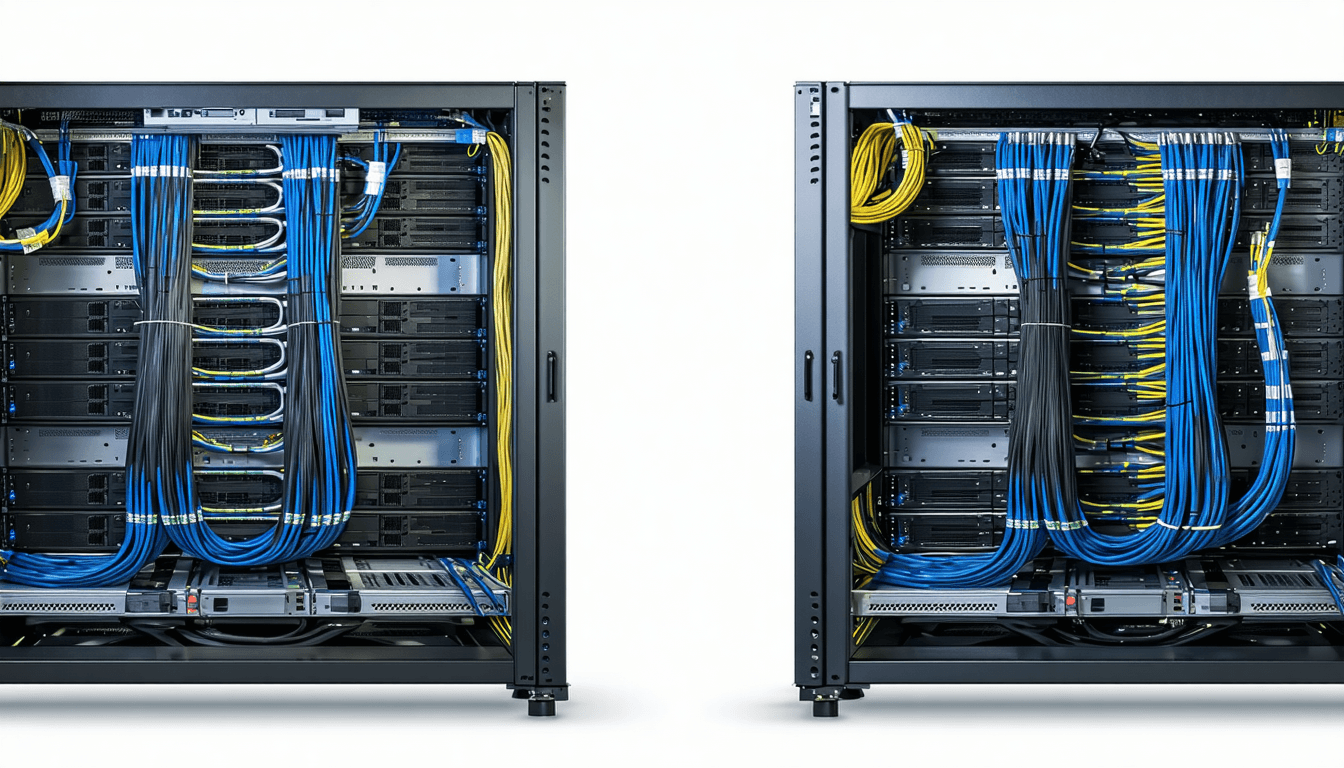
- GB200 NVL72 is a rack-scale system rather than a single GPU product.
- NVIDIA announced the Vera Rubin platform as a rack-scale AI factory architecture.
Compiled by The EngineerSomething wrong?How this is made
Why it matters
NVIDIA's own Q2 2026 earnings-call transcript names OpenAI among the companies using GB200 NVL72 systems for training and production inference [2], and NVIDIA describes OpenAI as one of its "Lighthouse" model builders running the system at data-center scale for next-generation model training [1]. The consequence worth noting is the unit being confirmed: GB200 NVL72 is a rack-scale system, not a single GPU product [4].
That changes what "buying compute" means. Rack-scale design is meant to present a large pool of compute as one coordinated system [11], so the interesting number stops being accelerators per node and becomes how much of the rack a job can actually keep busy. NVIDIA attaches the same system to both jobs at once, associating GB200 NVL72 with next-generation training and with production inference [12]. For anyone doing capacity planning, that points at one fleet serving two workloads rather than a training estate and a separate serving estate.
The Rubin material is a different evidence class, and the source is explicit about it: the supplied NVIDIA evidence confirms OpenAI's use of GB200 NVL72, not any specific OpenAI deployment of Rubin [3]. NVIDIA has announced the Vera Rubin platform as a rack-scale AI factory architecture [5] and positions it across the full lifecycle, from pretraining to agentic inference [7]. Microsoft Azure, separately, has described what it calls "seamless" deployment of Vera Rubin NVL72 racks across its AI superfactories and the integration of Rubin into its platform [8]. So one leg of this story rests on a dated financial disclosure and the other on a vendor announcement plus a cloud provider's own description of its plans [14].
The component detail deserves the same discount. The Rubin parts list in the source is attributed to "supplied research" rather than to NVIDIA's announcement text, and it names NVL72 Rubin GPUs, Vera CPU racks, Groq LPX, BlueField-4 and Spectrum-6 [6]. A list that mixes another company's product name into an NVIDIA rack is a summary, not a bill of materials, and should not be quoted back as one.
What none of this supports is any operational number. The material does not establish performance, cost, energy use or enterprise availability for OpenAI models trained on any particular hardware generation [9], and it is not detailed enough to quantify effects on throughput, training cost, power draw or customer access [10]. A rack generation named in an earnings call tells you where a supplier's volume is going. It does not tell you what a token will cost you next quarter.
The buyer-side reading, per the source, is to judge services on capability, reliability, governance and commercial terms, because hardware announcements alone do not guarantee a model feature, a price cut or a service-level change [13].
Three things to watch. Whether OpenAI on Rubin ever appears in NVIDIA's own disclosure the way GB200 NVL72 did [2][3], which is the difference between a roadmap and a deployment. Whether Azure's Rubin language converts into named regions and purchasable SKUs rather than superfactory description [8]. And whether operators start reporting a single rack-scale pool spanning pretraining and serving, which is the shape NVIDIA is already describing [11][12].