Science1 publisher2 min readPublished
NYC app couriers report 48 injuries per 100 full-time workers in a CUNY survey
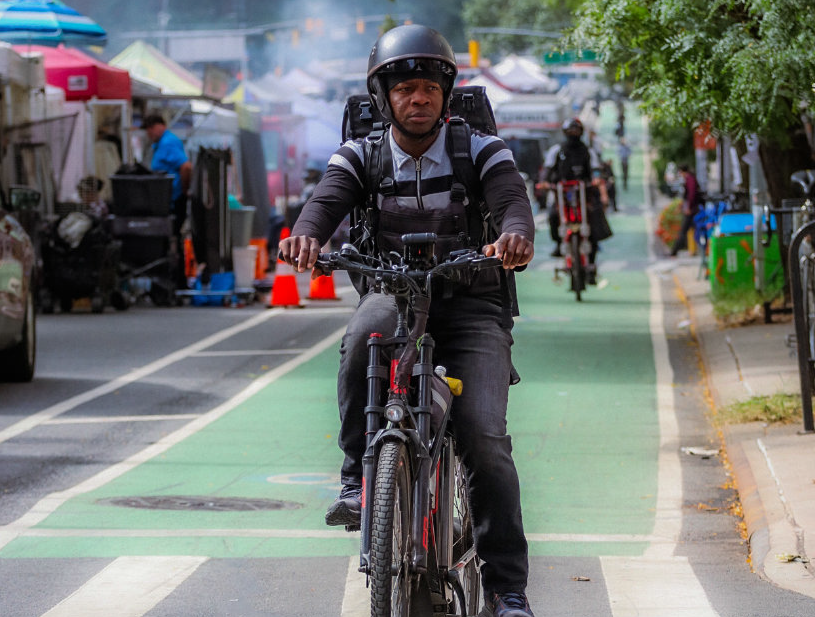
CUNY surveyed 561 New York City app couriers and found 48 injuries per 100 full-time workers, over five times the national rate for delivery messengers. Couriers say they rush and work sick to protect their ratings, so app pressure is a plausible cause, though one survey cannot test it.
The Scientist · Science desk
Drafted by a language model from the sources cited here and checked against its claim ledger before publication. How we use AISend a correction
What happened
- More than 80% of respondents said the apps mostly or entirely decide how fast they must deliver, which routes they take and how many hours they work.
- Forty-six percent reported an injury serious enough to need medical care or to make them miss work.
- Forty percent met the criteria for severe psychological distress, five times the rate among adult New Yorkers and 10 times the national working-age rate.
- Just over half of the couriers, 52%, worried they would be deactivated if they did not deliver fast enough.
- Almost all respondents depend on the work: 96% said app delivery was their only job in the previous month.
Compiled by The ScientistSomething wrong?How this is made
Why it matters
- decision Any app or city that adopts the workers' top request, deactivation cases settled within 24 hours with 14 days' notice, would also be running the before-and-after test this survey could not.
- exposure For the 53% of couriers whose family lives only on delivery income, an injury or a deactivation stops all household earnings at once, and 30% of respondents have no health insurance to absorb the medical side.
- precedent If regulators accept Baron's case that work design deserves the same attention as injuries, app rating and deactivation systems would come under occupational-safety review alongside street hazards.
The headline figure rests on two different numbers. Fifty-three percent of respondents reported a work-related injury [3], roughly 297 of the 561 people surveyed [2]. That is a share of people. The 48 is a rate per 100 full-time equivalent workers [4], and it is the figure the brief compares with the national rate for delivery messengers. Going by the brief's own multiple, the national rate is below 9.6 injuries per 100 full-time workers [1].
The survey was run in 2026 by the CUNY Graduate School of Public Health and Health Policy with the Worker's Justice Project [1]. Ligia Guallpa, the project's executive director, is a co-author [16]. The release does not describe how respondents were recruited or which dataset supplies the national comparison.
Cause is harder to pin down. Fewer than a fifth of respondents work outside heavy app control [3], so the survey has few couriers to compare against. The same workers also face hazards that no algorithm assigns: 36% said they had been physically assaulted while working, and 86% reported theft of equipment or belongings, with losses averaging about $2,100 [8].
What the survey does record is what workers say the ratings push them to do. To keep their ratings high, two-thirds said they rush to deliver on time, 56% said they work in bad weather and 30% said they work even when they feel very sick [5]. Seventy percent had contacted an app about a deactivation problem in the previous month. Only 37% of them said it was resolved satisfactorily [10].
The authors leave the question of what drives the injuries open. "Understanding what drives those outcomes, including how the apps organize and monitor work, is essential to protecting the people who keep this city fed," said Mustafa Hussein, the CUNY SPH assistant professor who led the brief [13]. Sherry Baron, an occupational health physician and one of the senior authors, wants the way the work is organized counted as a hazard in itself. "Intense work demands, little control over how the job is organized, and constant uncertainty about keeping access to work all shape workers' health," she said [15].
I think the brief supports the first half of the claim. It gives app delivery work in New York a measured injury rate that can be set beside national data [4]. Workers' accounts of rushing and working sick make algorithmic control a plausible driver of that rate [5]. The survey does not measure how much of the 48 comes from the apps, and it cannot, because nearly every respondent works under the same app control [2].
What to watch
- Whether the full CUNY brief compares injury rates between couriers under heavy and lighter app control, which would test the causal link directly.
- Publication of how the 561 respondents were recruited and which dataset supplies the national delivery-messenger rate.
- Any app or New York City rule adopting 24-hour deactivation resolution or 14-day notice, which would allow injury rates to be compared before and after.