Product1 distinct publisher3 min readPublished
The quarter came in at $96.2B. The argument that compute must now leave the mega-cluster rests on one analyst's own 30 GW estimate, and on nothing Nvidia itself said.
The Product Desk · Product desk

Compiled by The Product DeskSomething wrong?How this is made
The guide is where the tension sits. $108 billion against $96.2 billion works out to about $11.8 billion of sequential growth, near 12.3 percent [15], and the money behind it is going into monolithic liquid-cooled mega-clusters that hyperscalers are already committed to [13]. A vendor absorbing demand at that rate has little commercial reason to redesign for buildings it cannot yet fill, which is why the distributed-edge case in SiliconANGLE's piece [14] should be read as a forecast about where the next market has to come from, not as a disclosed roadmap.
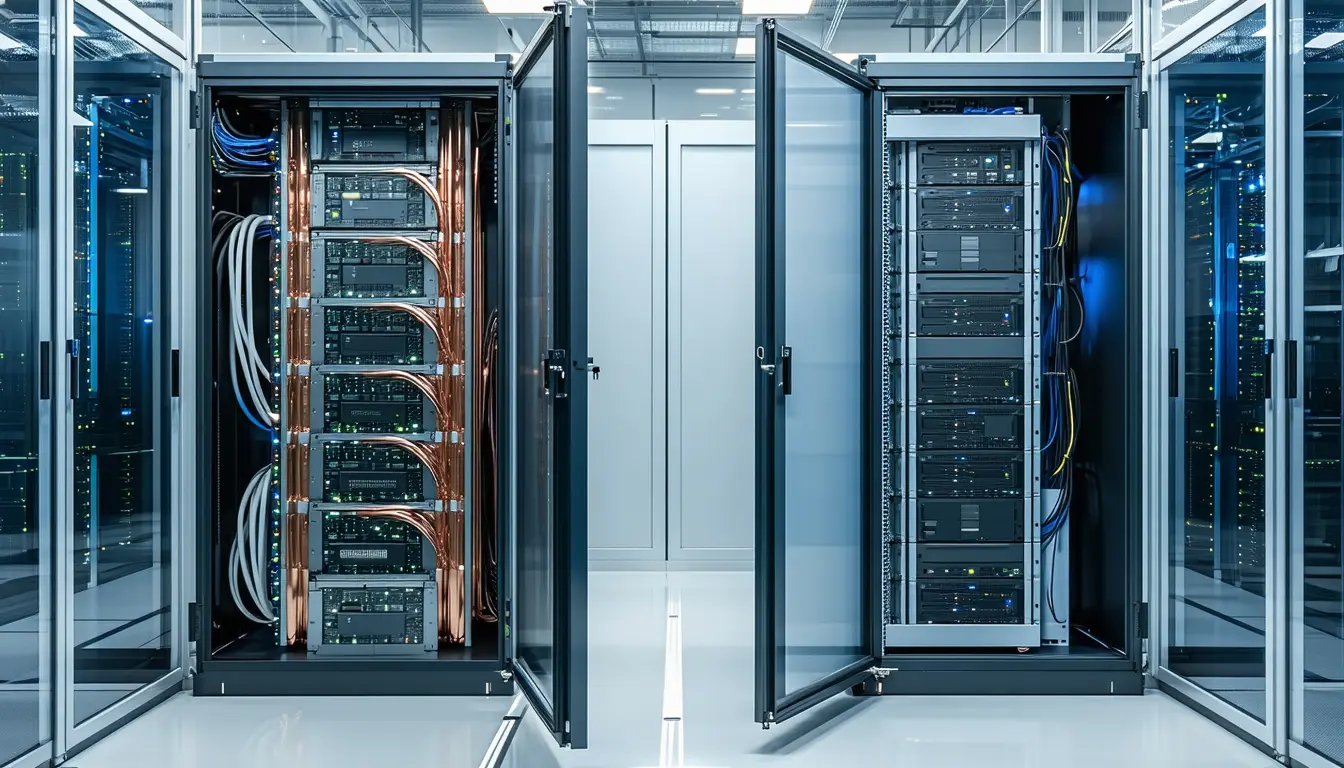
The physics under it is firmer than the market sizing. NVLink-scale racks draw up to 140 kW or more in a single cabinet [5]. A typical telco central office or enterprise hall is capped at roughly 30 kW to 50 kW per rack [6]. Even the most generous edge rack in that range is short by a factor of 2.8, and against a 30 kW cap the gap is about 4.7 times [16]. Attempting the drop-in breaks power delivery and overloads the cooling [12], so the choice is an electrical retrofit or splitting the compute envelope across four or five racks joined by a high-speed scale-up fabric, with optical interconnects carrying the bandwidth that copper cannot at that distance and power budget [9][10].
That is the part worth putting on a roadmap, and it is also the part the source leaves unpriced. There is no latency figure, no cost per optical port, and no statement from Nvidia about edge disaggregation anywhere in the material; the quoted remarks concern the buildout and Vera Rubin reaching full production [17]. The 30 GW of aggregated edge capacity is explicitly the author's own estimate from a year of conversations and data gathering [7], and the two source records supplied here are the same SiliconANGLE article under two URLs, so every figure in the thesis traces to one writer [18]. Distrust the gigawatts before the kilowatts. The 140 kW is a specification; the 30 GW is a guess, and it is fragmented by the author's own account [8].
Scale still tells you something even if the estimate is loose. Thirty gigawatts expressed in 140 kW units is roughly 214,000 rack-equivalents, but delivered in 30 kW increments it is on the order of a million rack positions [19], and the disaggregation trick needs four or five of them adjacent and free in the same facility [9]. Fragmentation is not a footnote on the opportunity, it is the thing that decides how much of the 30 GW is reachable at all.
What survives regardless of the sizing is the ordering of constraints. Once the scale-up domain crosses cabinet boundaries, the fabric stops being a cabling line item and becomes the architecture decision, sitting on the same page as accelerator selection. The compensation is that you adapt the topology to the facility instead of asking a customer to rebuild its electrical system [11], which makes brownfield sites addressable without a construction budget. Huang's framing, that compute is revenue and demand is accelerating [3], is a statement about token output inside facilities purpose-built for 140 kW racks. Extending it to a telco closet is a different engineering problem, and so far only one person has published the number that makes it look like a market.
Ranked by verification strength, evidence, and original report placement.
Nvidia posted $96.2 billion in revenue for the quarter ended July 26.
Nvidia guided for $108 billion in revenue for the current period.
CEO Jensen Huang said: "Compute is revenue, and demand is accelerating."
Huang said in a statement: "AI has reached its inflection point. It's doing useful work. Its tokens are productive and profitable. Now, compute is revenue... The AI infrastructure buildout is at full steam. Vera Rubin, now in full production, was built to power exactly this moment."
Modern NVLink-scale architectures require up to 140 kW or more of power density inside a single physical rack.
A typical telco site or enterprise facility is thermally and electrically capped at roughly 30 kW to 50 kW per rack.
Follow any of these and your For You feed starts watching them — no settings page required.
Evidence-backed comparisons of source perspectives and observed adoption signals. Read the methodology
Which Builder, Operator, and Investor concerns the observed source mix emphasized—not a truth score.
Evidence, demonstrated adoption, hype gap, incentives, and confidence are assessed independently, each on its own current evidence. How these are measured.
Hard on the quarter, thin on the thesis
The earnings figures and CEO quotations are specific and internally consistent across both records, but they arrive via a single publisher with no primary filing in the cluster. The load-bearing claims of the argument - 140 kW per rack, 30-50 kW site caps, a 30 GW fragmented installed base, and architects already disaggregating across four or five racks - are each asserted once, by one author, with the largest of them self-labelled an estimate and none carrying bandwidth, latency or cost figures.
Centralized buildout documented, edge pattern unwitnessed
There are real adoption datapoints for the centralized path: a disclosed quarter of $96.2 billion, a $108 billion guide, and Vera Rubin stated to be in full production. For the story's actual subject - disaggregated 30 kW racks joined by optical scale-up fabric at telco and enterprise sites - the cluster names no operator, no site, no product and no shipment, only unnamed architects said to be doing it.
Market-sizing outruns the evidence
The framing - a next multibillion-dollar market, an architectural breakthrough unlocking three massive market shifts - is materially stronger than what the cluster shows. The physical constraint itself is plausibly stated and arguably underplayed elsewhere, which restrains the score, but the leap from a self-estimated 30 GW to Nvidia's next multibillion-dollar market is made without any Nvidia commitment, any deployment, or any quantified fabric performance.
Analyst thesis published into an earnings news cycle
The article is written by an analyst voice that ties its argument back to the outlet's own published research on Systems of Intelligence and Systems of Execution, and pegs a forward-looking market thesis to same-day Nvidia earnings and a semiconductor conference. That combination - promoting a proprietary research frame while riding a high-attention news event - is a visible incentive to state the opportunity in expansive terms. No vendor sponsorship or financial position is disclosed in the supplied material, so the score is not higher.
Confident on figures, cautious on the argument
Confidence is high that the earnings figures, quotations and per-rack numbers were published as stated, and that the cluster contains one author's work duplicated. Confidence is low on whether the density mismatch, the 30 GW pool or the disaggregation remedy hold up, because no independent source, deployment or measurement is available to test them.
build
NVIDIA books $96.2bn at 75% margins and guides 74%: compute is not getting cheaper4 distinct publishers
invest
Nvidia's August 26 print: 92% of the quarter rides on one segment1 distinct publisher
invest
LG's wheels ship in 2026, its legs get a launch event in 20271 distinct publisher
invest
Nvidia's $20bn Groq buy becomes shipping racks, and the tape reads it as execution risk2 distinct publishers
Distinct publishers with included, body-backed reporting in this cluster.
2 articles · August 26, 2026