Leadership1 publisher3 min readPublished
NSW held up a real photo of a $5,000 mural as an AI-doctored rental listing
NSW announced fines of up to $22,000 for undisclosed AI-altered property images by naming a Leichhardt listing that shows a genuine $5,000 Bondi mural. Enforcement from early 2027 will depend on checking original files before an agent is named.
The Board Room · Leadership desk
What happened
- The NSW government's media release on Friday linked a Leichhardt rental listing as its example of an 'AI-doctored rental listing in Sydney's Inner West'.
- Under the new law, NSW real estate businesses face fines of up to $22,000 for failing to disclose digitally altered or AI-generated property images.
- Minister Anoulack Chanthivong, whose office issued the release, did not answer Guardian Australia's questions directly and sent a statement about protecting renters.
Compiled by The Board RoomSomething wrong?How this is made
Why it matters
- exposure An agency named in a government release can be accused on appearance alone, and then has to disprove it with its own photos from inside the property.
- constraint Because the offence is failing to disclose an edit, proof of a breach lives in the agent's original files. The published ad alone cannot establish it.
- decision Before the rules start in early 2027, the government has to set the evidence it needs before naming or fining an agent. Judging by appearance got its first example wrong.
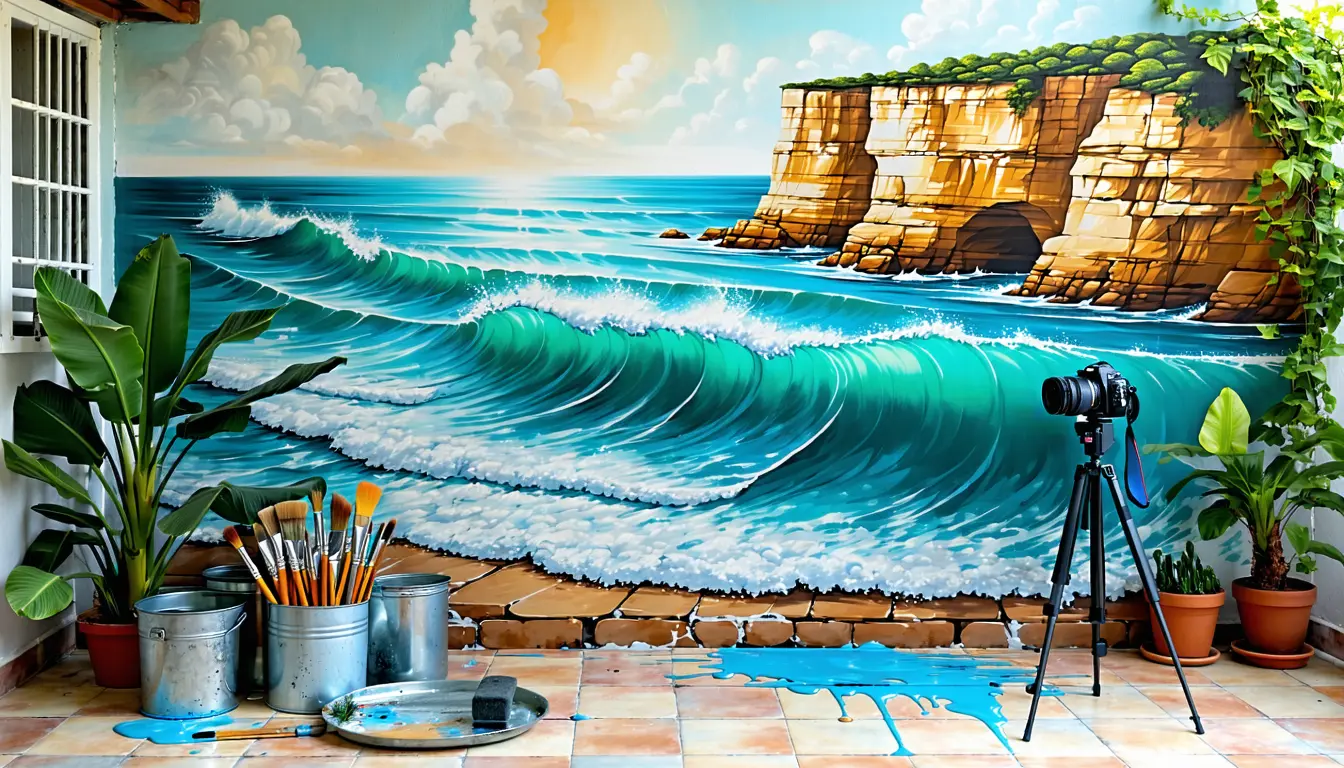
In board-deck form, Friday's launch had everything it needed: a new offence, a penalty of up to $22,000 for failing to disclose digitally altered or AI-generated property images [11], and a named listing to show the harm. The named listing is the part that failed. A beach outlook from a unit in Leichhardt, about 12km from Bondi [5], looks like an edit. According to IB Property, it is a photograph taken through the unit's windows of a Bondi mural on an internal courtyard wall [3], which the landlord commissioned for about $5,000 [7].
As reported, the offence turns on disclosure [11]. To prove a breach, someone has to establish how an image was made, and that history sits with whoever holds the original files. IB Property answered with a flat denial. "We can confirm that the image has not been altered or digitally generated using AI, Photoshop or any other image-editing software," a spokesperson said [4]. The agency then supplied photos taken inside the unit showing the mural still in place [6]. Guardian Australia went to 2/14 Norton Street and could not see the artwork from the street [6], so a check from the footpath would not have settled the question either.
Chanthivong's office, which issued the release [2], did not respond directly to Guardian Australia's questions [9]. His statement stayed on the policy. "These laws are about putting an end to misleading practices and making sure renters get a fair go. We will always stand on the side of renters," he said [10]. As a defence of the law, that holds up. Tim McKibbin, chief executive of the Real Estate Institute of NSW, said of edits that removed trees and telegraph poles that "clearly that is false and misleading" [14]. Stewart Bunn of First National Real Estate cited a 2024 case in which an LJ Hooker branch used AI to generate a listing with nonexistent schools [15].
His statement did not address the choice of example. According to IB Property, the unit was leased in February 2026 and has not been advertised since [8], so the listing the government held up was not in front of any renter when it was named. The cost of the error fell on the agency. It had to rebut a government accusation with its own photographs [6].
Industry's own tests are about what a renter finds on arrival. McKibbin separates staging from deception. "I've seen instances where agents have put furniture into the photographs ... Now, that is merely giving you an indication of what you could do," he said [13]. Bunn's rule is shorter: "The best practice is simple: if a buyer would be surprised by what they see when they arrive at the property, the advertising has gone too far," he said [16]. The statute's test, as reported, is about what was done to the file. A regulator can check that against the originals, but not by looking at the ad. The mural photo passes both tests: nothing was edited, and by the agency's account a renter who turns up will see the same wall [4][6].
Early 2027 is when the rules take effect [12]. The decision before then is the evidence standard for naming and fining: whether the government asks for original files, or visits the property, before an agent appears in a release. Each check adds time to every case. Without them, I'd expect the first contested fines next year to rest on the same kind of evidence that got the Leichhardt listing wrong on Friday.
What to watch
- Whether the minister's office corrects or withdraws the Leichhardt example from its media release.
- The detailed regulations before early 2027, especially whether virtual staging of furniture counts as a digital alteration that must be disclosed.
- What verification step, such as requesting original files or inspecting the property, the government sets before issuing a fine of up to $22,000.