Science1 publisher2 min readPublished
Naples simulations find a non-Gaussian diffusion signature in soft solids near yielding
Simulated compressed emulsions, foams and granular suspensions under slow shear move Fickian in the mean and non-Gaussian in the tails. A Naples group ties that hybrid microscopic motion to yielding.
The Scientist · Science desk
What happened
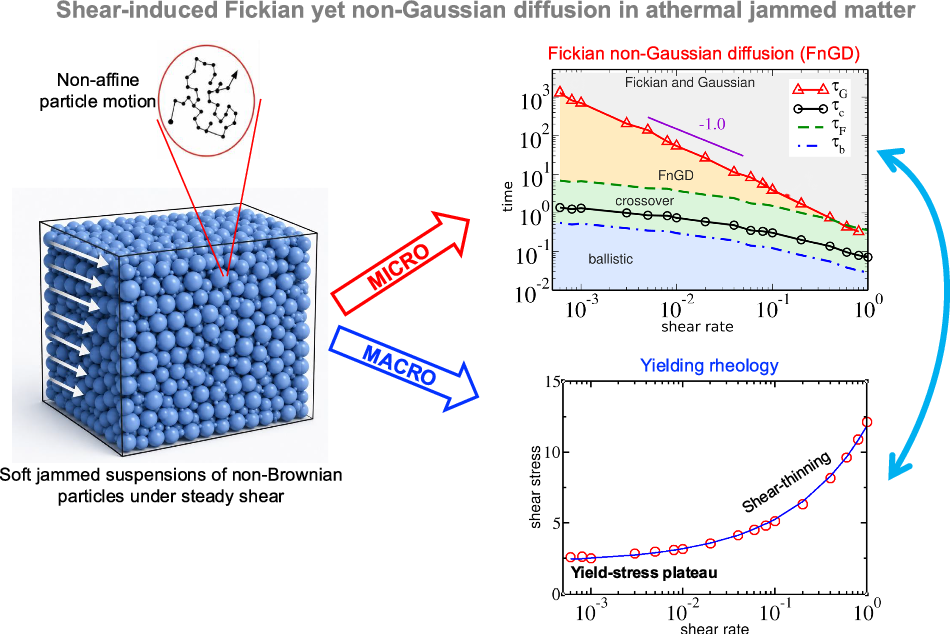
- A study in Communications Physics from the University of Naples Federico II connects the mechanical yielding of soft athermal matter to a hybrid microscopic transport regime, Fickian yet non-Gaussian diffusion.
- In numerical simulations, compressed emulsions, granular suspensions and foams displayed that diffusion once their particle motion was driven by imposed shear.
- At sufficiently low shear rates, and after an initial ballistic stretch, the simulated particles had a mean-square displacement compatible with normal diffusion while their displacement distribution stayed markedly non-Gaussian over extended time windows.
- The team is Raffaele Pastore, Palak Patel, Francesco Rusciano and Francesco Greco, with Patel arriving as a postdoctoral researcher after a PhD at the University of Pune.
Compiled by The ScientistSomething wrong?How this is made
Why it matters
- capability If the link holds outside simulation, particle trajectories would give a second, microscopic handle on how close a jammed sample sits to flowing, alongside the bulk stress measurement.
- constraint A fast rheometer sweep will not surface this signature. Using it as a diagnostic means imaging individual particles under slow drive for long stretches, a heavier setup than the measurement it would supplement.
- precedent Because the phenomenon has been treated as a single-particle curiosity, attaching it to a bulk mechanical response makes it worth hunting for in other driven athermal systems.
- contradiction The strength of the wording, closely connected to the mechanical response near yielding, rests on simulated particles, so a formulator cannot yet treat it as a bench test.
The two behaviours that make up the signature are conventionally associated with different diffusion regimes. A mean-square displacement that grows linearly in time is what ordinary Brownian motion produces; a markedly non-Gaussian distribution of displacements is what usually accompanies anomalous diffusion [6]. Holding both at once is why the phenomenon has drawn attention since it was first reported, in 2009, and it has since turned up in molecular systems and in thermal and active soft matter, mostly where particles move through heterogeneous surroundings [7]. Until now it has largely been read as a fact about single particles, with the link to bulk material response left open [8].
The Naples group worked from the non-affine part of the motion. They stripped out the ordered flow imposed by the shear and analysed the remainder, the stochastic part of each particle's motion [9]. That choice matters for anyone who wants to repeat it: the statistic lives in the residual, so the affine field has to be subtracted before the displacement distribution means anything.
Their interpretation is a minimal model they call the Heterogeneous Persistent Random Walk, in which particles cross an environment made of different domains [11]. Inside a domain a particle travels approximately straight for a characteristic persistence time, then turns at random [12]. By construction, then, how far a particle gets in a fixed interval depends on which domains it happened to pass through.
Raffaele Pastore, who leads the PRIN 2022 project the work sits within, put the question the study set out to answer this way: "The central question is whether FnGD is merely a microscopic detail of particle dynamics, or whether it may have an impact on the macroscopic behavior of a material," he said [2][13]. On the result, he said: "Our study shows that, for these materials, FnGD is not only a microscopic feature of particle dynamics but is closely connected to the mechanical response near yielding" [14].
The evidence behind that claim is numerical. The account describes simulations and the minimal model, not particle tracking in a physical foam or emulsion [19]. The genuinely new part is the setting: these are athermal systems, made of particles big enough that thermal motion plays no part in their dynamics [5]. The 2009 phenomenon was a thermal one, and this extension to athermal jammed matter arrives about seventeen years later [18].
Yielding itself is the ordinary industrial problem here, the point at which a material that resisted deformation like a solid begins to flow like a liquid under sufficient drive [15]. The paper's contribution is a microscopic quantity that moves with that transition in simulation [1].
What to watch
- Whether particle tracking in a real compressed emulsion or foam reproduces the shear-induced FnGD window the simulations report.
- Whether the group publishes a quantitative criterion tying the non-Gaussian window to a measured yield stress or yield strain.
- Whether the Heterogeneous Persistent Random Walk's domain parameters can be fitted to experimental trajectories.