Product1 publisher3 min readPublished
Iowa State mounts an aerosol jet printer on a robot arm to print circuits on curved parts
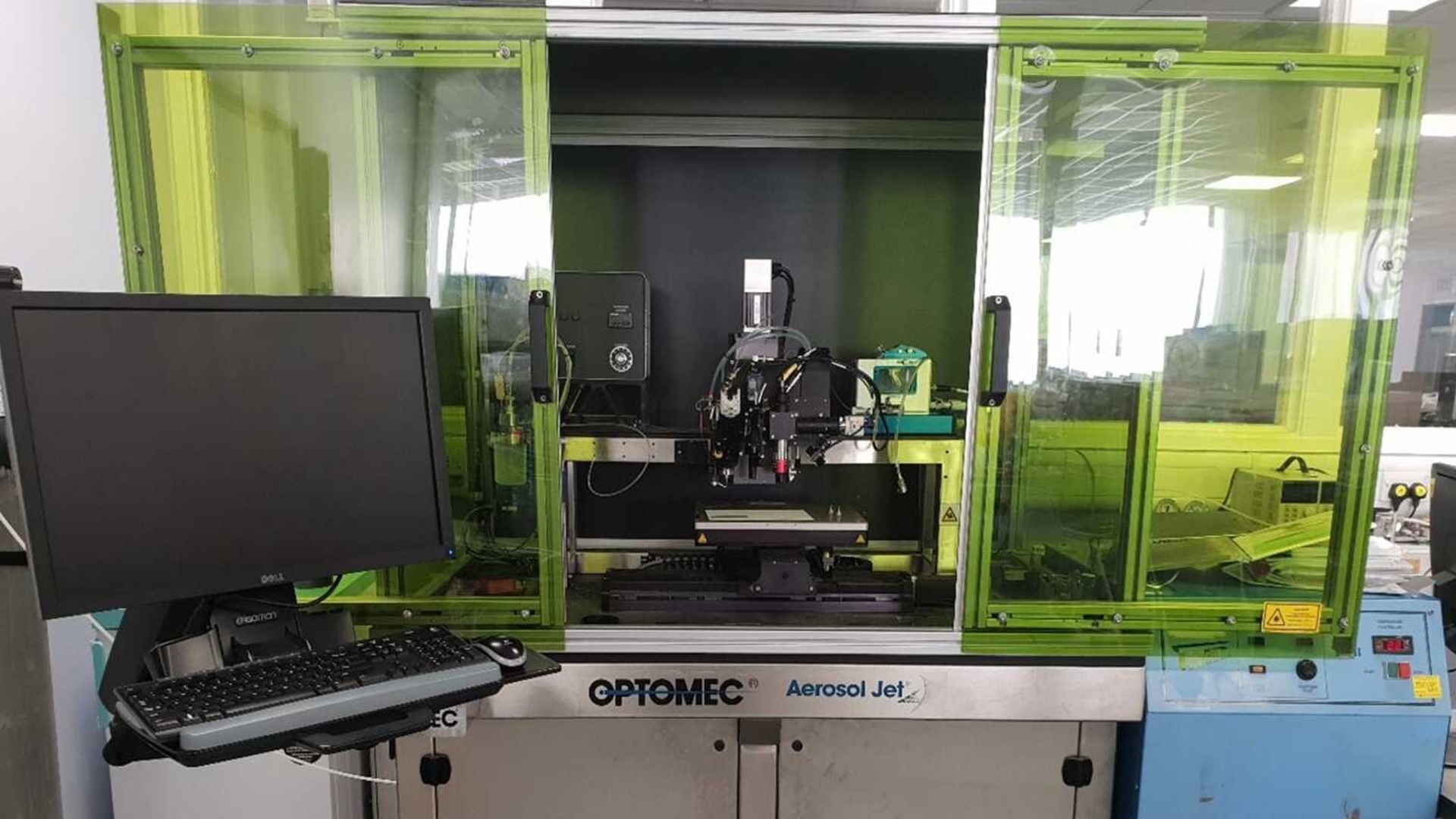
Ethan Secor's group sprays ink as a mist through a nozzle a robotic arm carries over non-flat surfaces, at feature sizes of 10 to 100 microns. NASA has put $150,000 behind commercialising it.
The Product Desk · Product desk
What happened
- A research group at Iowa State has mounted an aerosol jet printer on an articulated robotic arm so the nozzle can follow surfaces that are not flat. Positioning and motion planning become the new problems.
- Contour Circuits, founded by group leader Ethan Secor and former graduate student Jeremy Rurup, has a $150,000 Small Business Technology Transfer contract, with NASA backing the commercialisation.
- The team is also working on depositing several materials in one pass so composition can vary across a printed surface, which Secor likens to moving from black-and-white printing to grayscale.
Compiled by The Product DeskSomething wrong?How this is made
Why it matters
- constraint Accuracy now depends on the arm as much as the printhead. The source names positioning and motion planning as the new difficulty, so the tolerance a flat stage used to guarantee has to be earned by the robot instead.
- capability If the process holds its resolution on a curve, the shape of a part can follow where it has to sit, and the circuit surface no longer has to be flat first. That is the specific opening the researchers claim.
- decision Anyone weighing this against flex-film-and-adhesive has no procurement decision to make yet, because Secor puts applications development at two to three years out.
- precedent With NSF and NASA money attached and extreme-environment operation named in the project summary, the first qualified uses will be judged on whether they survive temperature swings.
The hardware is a nozzle on an articulated robotic arm, and the source names the hard part plainly: positioning and motion planning [3]. Aerosol jet printing atomises liquid ink into a mist, and a gas stream carries it through that nozzle at feature sizes of 10 to 100 microns [2]. The band spans a factor of ten [14]. At the fine end, the arm has to hold its path in three dimensions while the surface curves away from the nozzle.
Secor's group at Iowa State is combining the printing process with robotics, software and real-time monitoring to control how material lands on a curve [15][4]. "Right now, the work that's getting me excited is the conformal printing," said Secor. "For the next two to three years, that's going to be a big effort. We'll be pushing to develop applications for the technology" [5]. So the calendar on offer is applications development, by the researcher's own account. What the report has is the process and the funding. There is no finished part in it and no yield number [17].
Who is paying tells you which applications get built first. The research has a recent grant from the US National Science Foundation, and the team is particularly interested in failures where silicon-based semiconductors connect with larger circuits [8]. Contour Circuits, which Secor founded with former graduate student Jeremy Rurup, holds a $150,000 Small Business Technology Transfer contract, with NASA backing the commercialisation work [9]. Secor is also studying inks meant to survive extreme conditions, including the temperature swings of space [7]. "Electronic systems that can function in extreme environments are highly relevant for energy, infrastructure, aerospace, and space applications," the researchers wrote in a project summary [13].
The group is also trying to print more than one material in a single deposition pass, varying composition across a surface; Secor compares it to going from black-and-white printing to grayscale [11]. He built the printers himself. "Now we build and customize our own hardware. So, while other research groups are playing with a black box, we can open it up, understand how it works and improve on it," Secor said [12].
For a hardware team, the sorting question is which of your curved parts is curved because the function needs the shape, and which is flat inside because the circuit had to be made flat first. The second group is the one this work is aimed at, since the stated path is toward sensors and electronics that conventional flat manufacturing cannot make [1]. Then check where that part fails, because the team's declared research interest is the silicon-to-circuit interconnect [8], and a conformal trace does not fix a joint. Anything shipping in the next two years still gets designed flat and bent afterwards, on the two-to-three-year timeline Secor gave for applications [5].
What to watch
- Whether Contour Circuits publishes a conformal printed part with resistance or yield data attached.