Product1 publisher3 min readPublished
NTU sidesteps seawater's chloride problem by feeding hydrazine to the anode
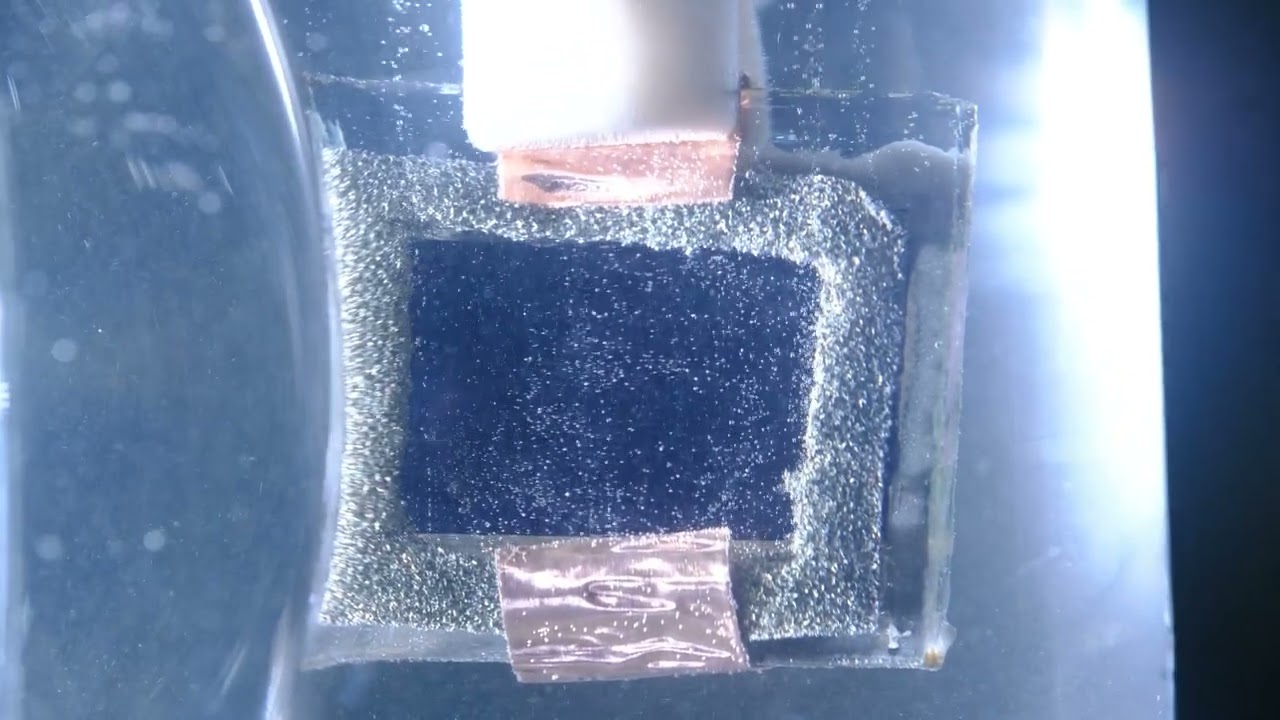
A Singapore team's solar cell ran for more than 72 hours on seawater and pulled hydrazine down to 0.5 parts per billion. The buyer for a unit like that is a site already paying to destroy the stuff.
The Product Desk · Product desk
What happened
- NTU Singapore researchers built a solar-powered device that makes hydrogen from seawater while breaking down hydrazine, and describe it as combining clean fuel production with wastewater treatment.
- The cell ran for more than 72 hours under light equivalent to clear-day sunlight at the Earth's surface, producing 466 micromoles of hydrogen per square centimetre per hour.
- Hydrazine fell from 0.5 M, about 1.6 percent by weight, to 0.5 parts per billion in 30 hours, more than 20 times below the EPA's permissible limit of 10 ppb.
- The sunlight-absorbing cathode is made of lead halide perovskites, shielded by titanium foil and a conductive epoxy loaded with silver and copper particles.
Compiled by The Product DeskSomething wrong?How this is made
Why it matters
- decision If the hydrogen is a credit against a disposal cost, the purchase order comes out of the waste treatment budget, and the delivered price of hydrogen stops being the number that decides it.
- constraint The unit only pays twice where the polluted stream and the hydrogen user sit on the same site; separate them and half the value stays behind.
- capability Destroying the pollutant in the water it arrives in takes a separation stage out of the treatment train, and that saving lands with whoever operates the train.
- precedent With the team extending the catalyst set to other pollutants and to converting waste into fuels and chemicals, the next such devices get specified by what a plant needs destroyed.
Two of the reported figures are one measurement. Twenty-five milliamps per square centimetre, held for an hour, moves 90 coulombs through each square centimetre of illuminated electrode [7]. Divide by 96,485 coulombs per mole of electrons and you get 933 micromoles; at two electrons per hydrogen molecule that is 466 micromoles of hydrogen per square centimetre per hour, the yield the team reports [4][8]. The current and the gas are the same result stated twice, at full Faradaic efficiency.
In grams the rate is modest. 466 micromoles of hydrogen weighs 0.94 mg, so one square metre of this electrode makes about 9.4 g per illuminated hour [1]. A kilogram an hour would need roughly 106 square metres under that light [2]. Across the whole demonstration run, a square metre would have yielded about 680 g [3].
The pollutant side is where the numbers get large. Going from about 1.6 percent by weight to 0.5 parts per billion is a reduction of roughly 32 million times [5], and the cell did it in the water the hydrazine arrived in, with no separation step first [9]. How much hydrazine that consumes per gram of hydrogen cannot be worked out here: the account gives concentrations and per-area rates but not the electrolyte volume [15].
The chloride problem it works around is real. Seawater's chloride ions interfere with electrolysis, and the reaction can throw off corrosive and toxic chlorine compounds that damage electrodes [3]. Professor Lydia Wong's team did not armour the anode against that chemistry. They gave it something easier to oxidise: an iron, cobalt and chromium catalyst that breaks hydrazine into hydrogen and nitrogen [4]. That reaction needs less energy than making oxygen from water, so the hydrogen comes out at a lower energy cost, and the anode clears the pollutant while generating hydrogen of its own [5].
"This dual-function device represents a major leap forward for environmental technology. By efficiently harvesting solar energy to break down a toxic industrial pollutant while simultaneously harvesting clean fuel, we are solving both an energy problem and a pollution problem," said Wong [11]. James Durrant, professor of photochemistry and sustainable energy at the University of Oxford, who was not involved in the research, located the significance in the route: "The breakthrough here lies not simply in producing solar hydrogen but in demonstrating a practical route toward multifunctional photoelectrochemical systems" [12]. The study was published in Nature Communications [14].
Two conditions decide whether any of this reaches a plant. First, a hydrazine-bearing stream on site that somebody is already paid to deal with. Second, a use for hydrogen close enough to pipe it. With both, the gas is a credit against a bill that exists whether or not the cell is bought. With the waste and no offtake, you have installed hydrogen handling for a product you will vent. With the offtake and no waste, you are buying hydrazine as an anode feedstock, paying for a toxic reagent in order to make fuel from it. With neither, this is a catalyst paper to read and nothing to procure.
What to watch
- Whether industrial waste streams actually arrive anywhere near 0.5 M hydrazine, the concentration NTU started from; dilute feed changes both the treatment claim and the anode's hydrogen contribution.
- A degradation rate for the lead halide perovskite cathode and its silver-copper epoxy and titanium shielding, which is what tells a buyer how often an electrode gets replaced.
- Replication by another group in unfiltered seawater, since the reported tests used both simulated and real seawater.