Science1 distinct publisher3 min readPublished
The scaffold carries astrocyte vesicle signals on its own surfaces, and thinning the neutrophil-rich cells it recruited cut new vessel growth, though the Duke summary gives no number for how far motor function moved.
The Scientist · Science desk

Compiled by The ScientistSomething wrong?How this is made
The design choice worth pausing on is chemical rather than surgical. Astrocytes, the star-shaped cells that react quickly to brain injury, signal to neighbouring cells partly by releasing extracellular vesicles carrying proteins, lipids and genetic material [17]. The Duke group grew astrocytes in culture, collected those vesicles, and bonded them to the surfaces of the hydrogel microparticles rather than injecting them into the cavity as free cargo [5]. The stated reason is retention: signals fixed to the particles stay concentrated inside the scaffold, so cells entering the pores are more likely to meet them [5]. The scaffold itself is a set of microparticles that anneal into a porous mass, which is what gives incoming cells a framework to move into [4].
Recruitment alone would only tell you who showed up; the subtraction is what turns it into an argument about cause: when the team reduced the neutrophil-rich immune-cell population, blood vessel formation dropped substantially [9]. That is a loss-of-function test, and it is the strongest piece of evidence in the release. It is also blunter than the headline finding implies, because the reported manipulation thinned a neutrophil-rich population rather than neutrophils alone, and macrophages arrived in the same recruited wave [7]. The defensible reading is that the recruited immune compartment is needed for the new vasculature, with the persistent neutrophils its most unexpected member.
What the summary leaves out is magnitude. The Duke summary reports no group sizes, no effect size for the motor improvement, and no time points for when the vesicle-loaded scaffold was placed or when function was measured [16]. "Improved motor function" in mice [2] is a direction, not a quantity, and it does not say whether the improvement survived the depletion experiment. Nor does the release resolve the timing question it raises: neutrophils are usually associated with inflammation and tissue damage early after a stroke, and the claim here is that at a later point, in the right signalling and material environment, they may instead support repair [8].
The immune reframing rests on that distinction and does not extend beyond it. Suppressing inflammation and recruiting inflammation are not opposites if they happen at different times, and the source draws the line by phase of injury, not by taking a position on acute anti-inflammatory treatment [8]. The clinical gap it aims at is real enough: clot-dissolving drugs and mechanical clot removal can restore circulation and rescue tissue that is still viable, but nothing about reperfusion replaces tissue that has already died [13], and rehabilitation helps surviving circuits adapt without rebuilding the lost region [14]. "Once brain tissue has been lost, restoring blood flow is no longer enough," said Tatiana Segura, the Duke biomedical engineer who leads the work [10][11]. With millions of ischemic strokes a year [12], the cavity is a large untreated target, which is exactly why the reparative-neutrophil result deserves a full accounting of its numbers before it is read as anything about human immune timing.
Ranked by verification strength, evidence, and original report placement.
Biomedical engineers at Duke University created an injectable biomaterial that may help the brain recover from damage left by an ischemic stroke; in mice, the material transformed the cavity created by lost brain tissue into a more favorable environment for healing.
The treatment recruited the body's own immune cells, encouraged formation of new blood vessels, supported changes in neural tissue, and improved motor function in the animals.
Researchers tested the importance of the recruited cells by reducing the neutrophil-rich immune-cell population; when they did so, blood vessel formation declined substantially.
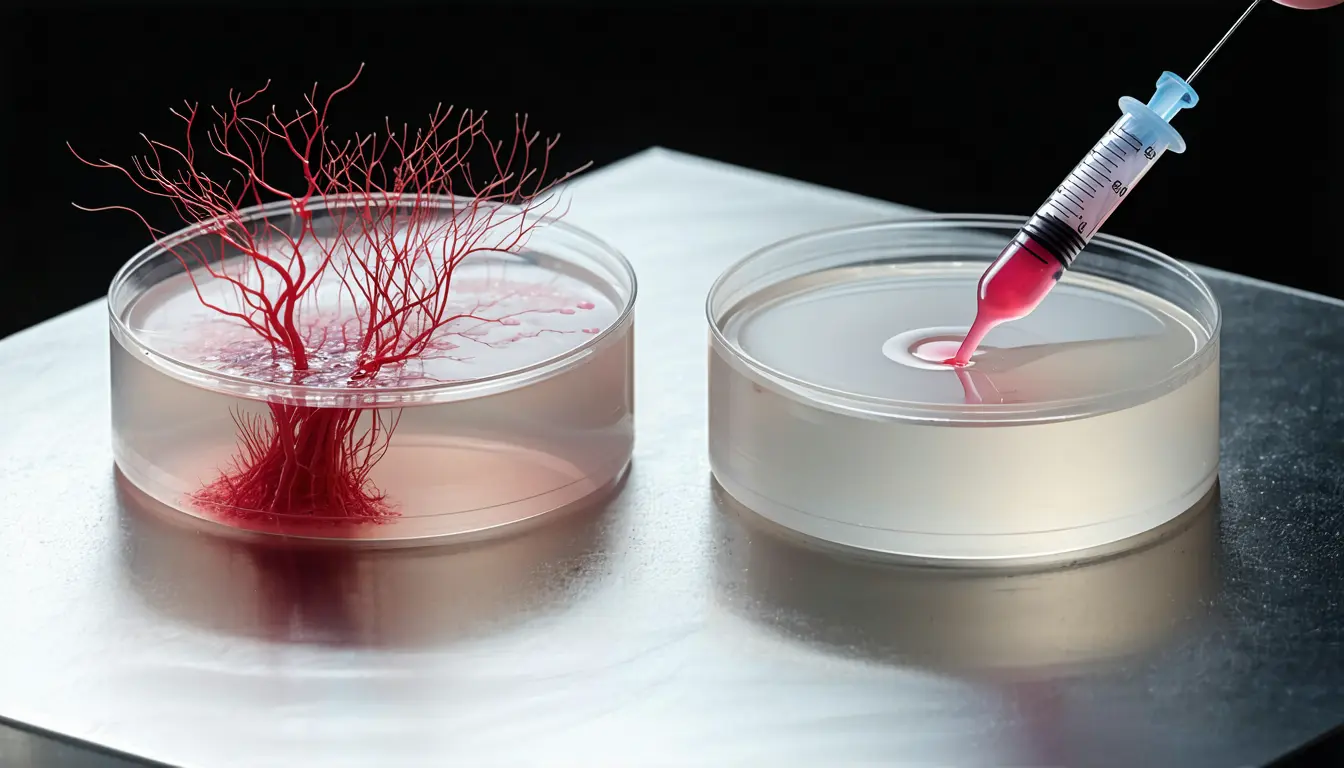
The researchers used MAPS, or microporous annealed particle scaffolds: individual hydrogel microparticles that assemble into a porous structure whose open spaces give cells a framework they can enter and use while rebuilding neural tissue.
Rather than simply injecting astrocyte-derived extracellular vesicles into the damaged area, the scientists chemically attached vesicles collected from lab-grown astrocytes to the surfaces of the hydrogel microparticles, keeping the signals concentrated within the scaffold so incoming cells had a better opportunity to encounter them.
Distinct publishers with included, body-backed reporting in this cluster.
1 article · September 3, 2026
Follow any of these and your For You feed starts watching them — no settings page required.
science
A capped circular RNA and a branched lipid particle take aim at the dosing schedule1 distinct publisher
science
ETH Zurich test revives the 'too hot' climate models and moves policy warming to 3.25C1 distinct publisher
science
An LLM asked only to fix grammar stripped the personality markers out of human prose1 distinct publisher
science
Carotid arteries on a chip turn stroke prevention into a test you run, not a guess1 distinct publisher
Evidence-backed comparisons of source perspectives and observed adoption signals. Read the methodology
Which Builder, Operator, and Investor concerns the observed source mix emphasized—not a truth score.
Evidence, demonstrated adoption, hype gap, incentives, and confidence are assessed independently, each on its own current evidence. How these are measured.
Two real controls, one interested narrator
The mechanism claim is better supported than most press-release biology, because Duke reports the two experiments that could have sunk it: depleting the recruited neutrophil-rich cells cut vessel growth, and vesicles without the scaffold did not reproduce the repair. Against that, everything reaches us through the institution that did the work, the underlying paper is named but never quoted, and the numbers that would let anyone weigh the effects — animals per group, vessel density, injection timing — are not in the account.
One lab, one species
Adoption of this is a mouse cavity in Durham. A journal paper exists and prior MAPS work is referenced, which is more than a conference poster, but nothing in the reporting points to a second group reproducing the vesicle-tethering result, a human protocol, a manufacturing route for the particles, or anyone licensing the platform.
"Rebuild" is doing heavy lifting
"Helps the brain rebuild after stroke" is a headline about people; the work is about rodents, and the release's own hedges — "may help", "may instead help support tissue repair" — sit inside it. The gap is moderate rather than severe because Duke does not oversell the causal story and reports its failed condition. Our own summary line tilts the other way and needs correcting: complaining that no number is given for motor function undersells a release that times the effect at eight weeks and calls treated mice statistically indistinguishable from healthy controls.
Institutional release, relayed intact
ScienceDaily names Duke University as the source and carries its structure, subheadings and quotes through with no reporting added, so the party that benefits from the result being interesting also chose which details appear and which do not. That is the ordinary economics of university science communication rather than anything unusual, but it explains the specific absences: no funding line, no patent, no competing approach, no skeptic.
Internally consistent, externally untested
Nothing in this account contradicts itself, the experimental logic hangs together, and the one tension we found is in our own summary rather than in Duke's. But a single publisher relaying a single institution's release gives no second reading to check against, and the details that would firm this up — group sizes, injection timing, an unaffiliated view of the neutrophil argument — are exactly the ones missing.