Science1 publisher2 min readPublished
Bistrifluron killed 95.7% of drywood termites that could still choose untreated wood
The insect growth regulator blocks the new exoskeleton a molting termite cannot do without. UC Riverside measured mortality in laboratory feeding tests, and the release summary reports the same figure as colonies killed.
The Scientist · Science desk
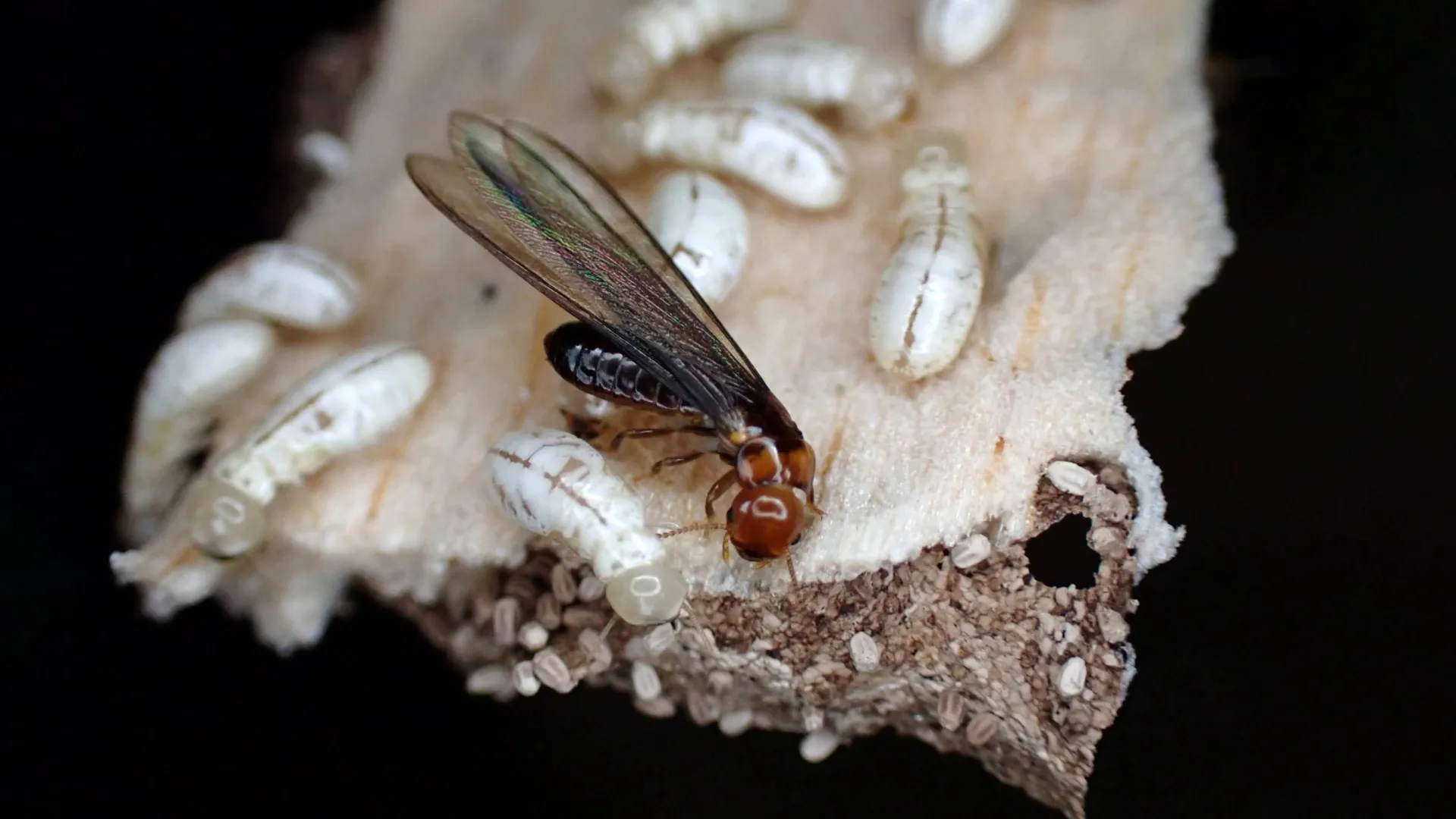
What happened
- UC Riverside researchers reported in the Journal of Economic Entomology that bistrifluron produced 95.7 percent mortality in western drywood termites offered a choice between treated and untreated wood.
- Termites kept continuously on treated wood, with no clean alternative available to them, died at about 99 percent.
- The team compared three chitin synthesis inhibitors, bistrifluron, chlorfluazuron and noviflumuron, and bistrifluron killed fastest at the concentrations tested.
- The treated insects first slowed their feeding and activity, then continued toward the next molt and died failing to complete it.
Compiled by The ScientistSomething wrong?How this is made
Why it matters
- contradiction The release summary reports the result as colonies killed while the experiments counted dead individuals, and which denominator you accept decides whether this is a fumigation substitute or a good assay.
- constraint Mortality accumulated over 60 days in the no-choice test, so an operator using bistrifluron has no way to certify a structure clear on the day of treatment.
- decision Anyone weighing this against whole-structure fumigation is deciding on delivery into galleries nobody can see, and the feeding assays did not put that question to the test.
- capability Because clean wood next door cost only a few points of mortality, treating the timbers an inspector can actually reach becomes a plausible strategy for colonies hidden in framing.
The summary at the top of UC Riverside's release and the body underneath it do not report the same measurement. The summary says the compound killed about 95 percent of colonies in testing [9]. The body reports 95.7 percent mortality among western drywood termites in controlled laboratory experiments in which they could choose between treated and untreated wood [1]. Colony elimination is the outcome a homeowner pays for; individual mortality in a feeding assay is what the experiment measured. A 95.7 percent kill leaves 4.3 percent of the termites in that test alive [2].
The choice test is the useful part of the design. Offer a slow-acting compound alongside clean wood and you learn whether the insects walk away from it. At 0.1 percent, bistrifluron killed about 99 percent of termites given no untreated alternative [3] and roughly 96 percent when an alternative sat next to it [4]. The gap is about three percentage points [1].
Bistrifluron is a chitin synthesis inhibitor: it interferes with the formation of the new exoskeleton a termite needs at its next molt [5]. Drywood termites molt about seven times during their lives [7]. "Once the termites reach a certain stage, they have to molt. They cannot avoid that," said Dong-Hwan Choe, the UCR entomology professor and senior author of the paper [10]. "With a lethal dose of this chemical, they'll try to shed their old exoskeleton but won't have a new one ready to protect them," he said [11].
Death comes late. The researchers first saw activity and feeding fall off, and the termites went on toward the next molt before failing it [15]. The 0.1 percent no-choice result was read at 60 days [3]. Nicholas Poulos, the paper's corresponding author and a doctoral student in UCR's entomology department, said of the compound, "It's specific to insects and can't harm humans" [13]. Chitin is widespread in nature; the release lists fungal cell walls, fish scales and the beaks of squids and octopi among the structures it builds [19]. Humans and other mammals have internal skeletons [18].
The experiments handed the termites treated wood. Finding the wood is the field problem: subterranean termites keep colonies connected to the soil, while drywood termites can live entirely within pieces of wood [17]. "It's been successfully used on subterranean termites, which are also important structural pests," Choe said [16]. The work reported here is laboratory work, and the release does not describe a field trial in an occupied structure [22]. "But native western drywood termites are also important, especially in California," Choe said [21].
What to watch
- A field trial in an occupied structure, reporting colony elimination as the endpoint rather than counts of dead individuals.
- Published numbers behind the release's claim that a few exposed termites can spread a lethal dose through a group.
- Any regulatory label decision covering bistrifluron use against drywood termites, which would determine what operators can actually apply.