Science1 distinct publisher3 min readPublished
Northwestern and Salk researchers report a BLA to mPFC projection that grows more excitable in isolated male mice and less excitable in females, with drinking following each direction.
The Scientist · Science desk

Compiled by The ScientistSomething wrong?How this is made
The result worth holding onto is the direction, not the address. Isolation did not merely perturb the basolateral amygdala projection into medial prefrontal cortex; it raised excitability in males and lowered it in females [4], and intake moved the same way in each sex [10]. A generic stress account would predict the same sign in both, differing only in size. Two opposite signs, with behaviour following each one, is harder to write off as a housing artefact [2].
That makes the female animals load-bearing rather than a compliance box. They show that the projection's activity tracks intake in both sexes [11] while the isolation-induced change in that activity does not point the same way [4]. Pool the sexes in a single group and the average describes neither of them.
The exposure is more modest than the framing implies. Mice got one hour a day with a choice between water and a 15 percent alcohol solution, followed for roughly two weeks [9], which puts the male escalation on the order of fourteen hours of cumulative access [1]. Recordings were taken while the animals moved freely and chose whether to drink [16]. This is an early-intake, voluntary-choice model, and what changed was what the animal picked when both bottles were available, not how much it was made to consume.
On causality, the methods named are the ones that can carry the weight: whole-cell patch-clamp, optogenetics and cellular-resolution calcium imaging [8]. Reesha Patel of Northwestern's Feinberg School of Medicine says a defined pathway "becomes overactive during isolation and directly increases drinking" [13], and the paper in Nature Neuroscience concludes that the pathway reconfigures prefrontal processing to promote intake [12], [6]. The claim to being first is the authors' own, stated by Patel rather than by an outside reviewer [5], and the study is preclinical [1].
The awkward part is the translation. The human end of this story is association: isolation in adults is linked to heavy drinking in people and to higher intake in mice [15], with isolation itself rising and treated as a public health risk tied to substance misuse [14], against a background prevalence the authors put at about seven percent of the world's population over fifteen, citing the WHO [7]. The circuit end is a mouse projection whose response to isolation reverses by sex [2]. Anyone who tries to drug it inherits that reversal. A compound that damps this pathway has a plausible story in isolated males and no stated story in females, where the same isolation drives the pathway the other way. That decision has to be made in the design of the first trial arm, because an averaged readout across sexes would hide exactly the effect the study was built to find.
Ranked by verification strength, evidence, and original report placement.
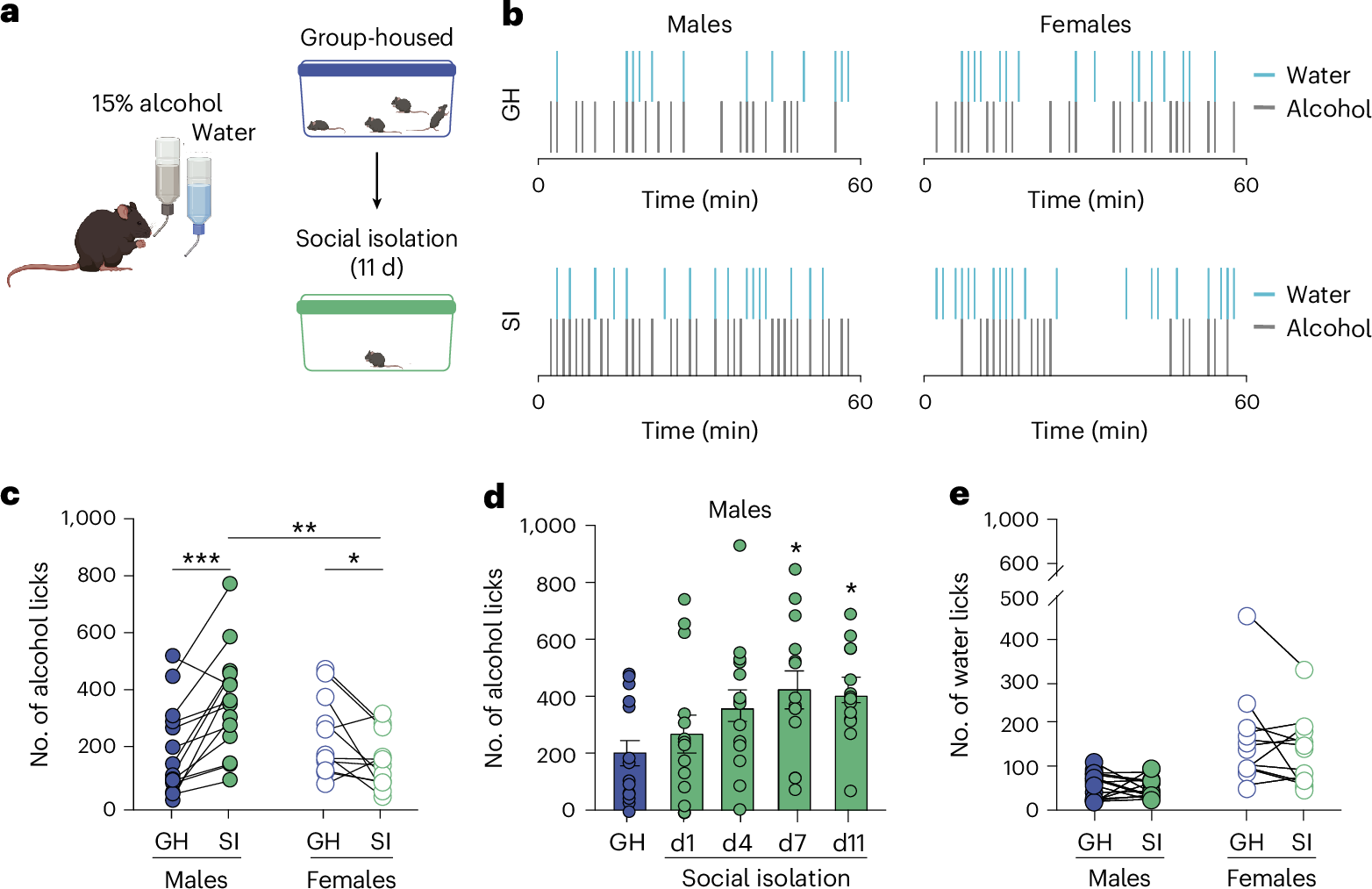
Patel said the work shows "that a defined pathway becomes overactive during isolation and directly increases drinking, and that males and females rely on different neural" substrates.
The researchers found a role for a subpopulation of basolateral amygdala (BLA) neurons projecting into the medial prefrontal cortex (mPFC) in driving alcohol consumption during social isolation.
Experiments showed that isolation increased BLA-mPFC excitability in males but decreased it in females.
Whole-cell recordings revealed that BLA neurons projecting to the mPFC track alcohol intake in both sexes.
The authors conclude that their results identify a BLA-mPFC pathway mechanism through which social isolation reconfigures prefrontal processing to promote alcohol intake.
The scientists recorded brain activity in the BLA and mPFC while the animals moved freely and elected whether to drink alcohol.
Follow any of these and your For You feed starts watching them — no settings page required.
Evidence-backed comparisons of source perspectives and observed adoption signals. Read the methodology
Which Builder, Operator, and Investor concerns the observed source mix emphasized—not a truth score.
Evidence, demonstrated adoption, hype gap, incentives, and confidence are assessed independently, each on its own current evidence. How these are measured.
Converging preclinical methods in a peer-reviewed paper, but no numbers and one reporting outlet
The claims rest on a Nature Neuroscience paper combining whole-cell patch-clamp electrophysiology, cellular-resolution calcium imaging during free-choice drinking, and bidirectional optogenetic manipulation, with physiology and behaviour aligning in direction within each sex. That is a strong preclinical design. Evidence quality is capped because the supplied material reports no sample sizes, effect sizes or statistics, offers no independent expert assessment, comes from a single publisher relaying author quotes, and covers mice only.
No adoption signal beyond publication
The supplied source documents a preclinical result and its journal publication only. There is no evidence of uptake, replication by other groups, clinical translation, tool or reagent distribution, or programme deployment, and the source's own translation discussion is left unresolved. Inferring adoption from a single paper would be a guess.
Mouse circuit result framed as a clearer human treatment target
The underlying findings are modestly stated in the paper's own conclusion, but the surrounding presentation stretches further: 'loneliness can reprogram the brain,' 'first study,' 'major advance for the field,' and 'a much clearer biological target for... eventually treating alcohol misuse.' Against that, the behavioural effect emerged over roughly 14 hours of cumulative access in mice, the sex reversal is admittedly unexplained, the mechanistic control tool is optogenetics rather than anything therapeutic, and human translation is unaddressed. The gap is real but moderate, since the empirical claims themselves are specific and method-backed.
Institution-sourced narrative carried by a life-science trade outlet
The story is told almost entirely through the first author's quotes and the paper's own language, with the named institutions foregrounded, which is a recognizable priority-and-significance publicity pattern for a high-profile journal paper. The publisher is a biotech/pharma trade outlet whose audience rewards translational-target framing. No funding sources, competing interests or external reviewers are disclosed in the supplied material, so the promotional pull is unbalanced within the cluster.
Findings clearly reported, corroboration and quantification absent
Confidence in what was claimed is high: the source is detailed and internally consistent, names the journal, title, first author, methods and protocol. Confidence in the assessment overall is held mid-range because there is one publisher, no independent verification, no reported statistics, and no adoption dimension to measure.
science
Mount Sinai puts a youth protein on aging microglia, and the mice answer1 distinct publisher
product
A blood-draw robot clears the FDA at 1m49s a stick. The missing number is per supervisor1 distinct publisher
science
267 Ubiquitin Receptors, 93 Already Diseased: A Catalog That Gives Variants a Mechanism1 distinct publisher
science
A gene switch wired to a magnetic field turns off within a day of the coil going quiet2 distinct publishers
Distinct publishers with included, body-backed reporting in this cluster.
1 article · August 25, 2026