Science2 distinct publishers3 min readPublished
NASA's SpEED Demon rocket ejected four dropsondes to sample one sporadic E layer in five places at the same instant. The plasma came back uneven and doubly peaked, shaped by turbulence in the surrounding air.
The Scientist · Science desk

Compiled by The ScientistSomething wrong?How this is made
The material is meteor exhaust. Iron, magnesium and other metals survive the entry burn and occasionally gather into dense, cloud-like sheets that reflect radio waves [10]. Those sheets sit near 100 kilometres, about 60 miles up [12], which puts them roughly 40 kilometres above the altitude where the ionosphere begins [17]. It is an awkward band. Balloons cannot reach it and satellites cannot fly that low, which is why sporadic E has belonged to sounding rockets, launched on short notice when a layer appears [12].
A rocket measures along its own trajectory and nowhere else [13]. Aroh Barjatya, the mission's principal investigator at Embry-Riddle, describes that as looking at a scene through a crack in a wall, with no view of what is happening to either side [13][5]. Four ejected dropsondes turned one track into five at the same instant [2], which he calls a picket fence [14], though even a picket fence leaves you looking at mostly gaps. Five tracks are five times the simultaneous in-situ coverage of a conventional single-payload flight [18], and neither published account gives the separations between the probes [19], so the horizontal scale at which the structure was resolved is not in the public description.
The two-peak signature on the descent is where the wording turns careful. "Consistent with modulation by Kelvin-Helmholtz billows" [9] is a resemblance rather than an attribution: a billow origin implies particular wavelengths and a particular relationship to the wind shear, and what has been announced is the match, not a test that excludes other routes to a split layer.
What this does to radio forecasting is real and narrower than it sounds. The picture Henry Valentine, the study's lead author, describes as the usual one, a single sharp density layer [8][6], is also the picture that makes reflection cheap to compute. A layer that is uneven and doubly peaked returns energy from more than one height, and fits that picture worse. The thing neither account tells you is by how much: there is no ionogram comparison, no link budget, no error figure for any named service [20]. Valentine's remark about phone GPS concerns ionospheric plasma in general, with sporadic E named as a contributor to the uncertainty rather than measured against it [16].
The denominator here is one flight: one layer, sampled at five points, on a single mission in August 2022 [1]. That is enough to establish that a sporadic E layer can be curled and split rather than smooth and flat [7], a genuine finding about what the plasma is able to do, but a single flight cannot say how often the cinnamon roll [8] beats the pancake, and the mission's own name calls it a demonstration [1]. The first thing it demonstrated is the method.
Ranked by verification strength, evidence, and original report placement.
Once inside a sporadic E layer, the rocket released four dropsondes that flew away from the main payload and from one another, each measuring plasma along its own track and beaming data to ground stations; together with the main payload they sampled the layer in five places at the same moment.
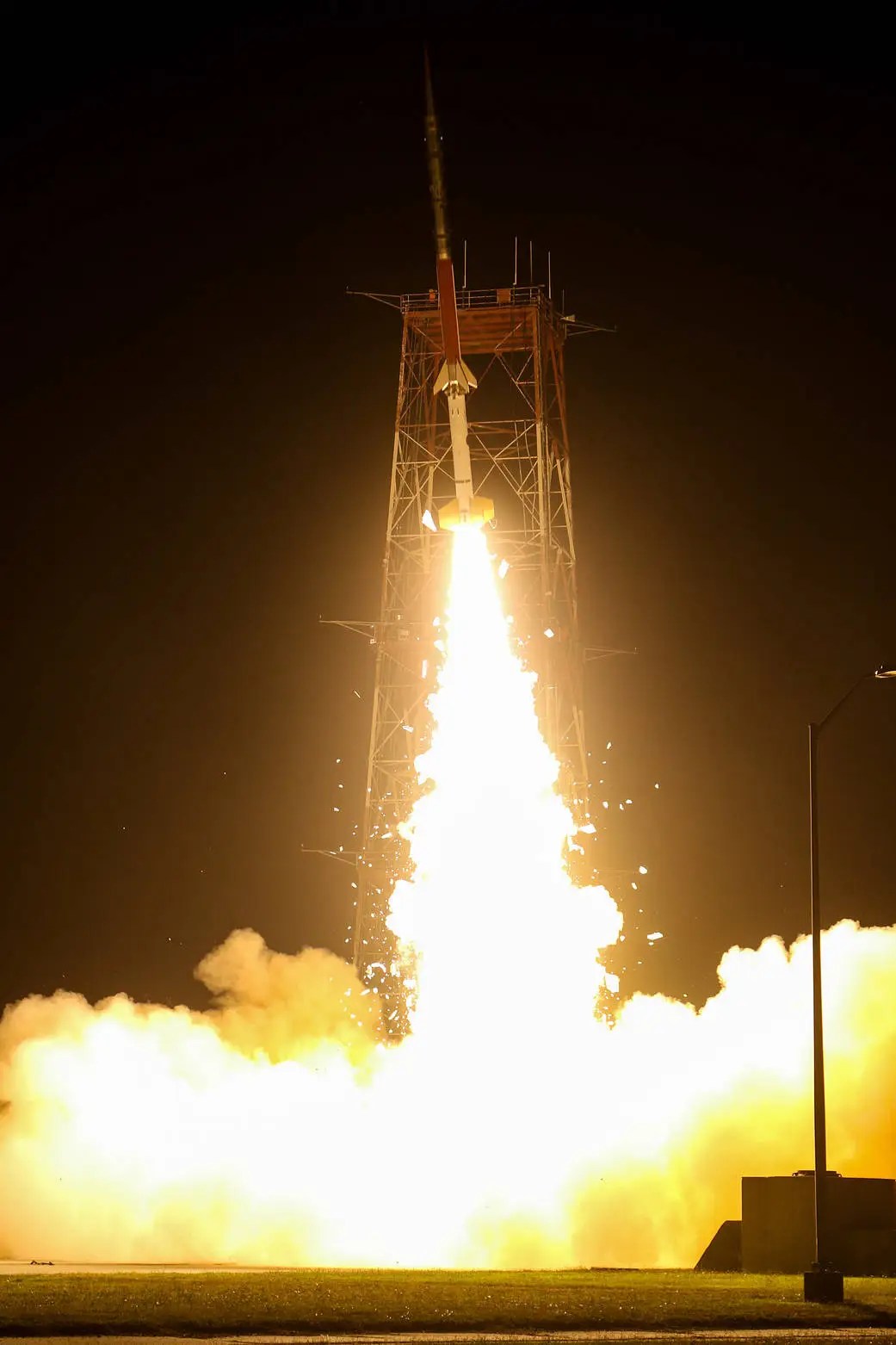
The sporadic E Electrodynamics Demonstration, or SpEED Demon, launched from NASA's Wallops Flight Facility in Virginia on Aug. 24, 2022.
SpEED Demon was the first mission to deploy ejectable probes, called dropsondes, inside a sporadic E layer, and demonstrated the first concurrent multi-point view inside one.
The results, from a team led by Embry-Riddle Aeronautical University, are described in a new study in the Journal of Geophysical Research: Space Physics.
Aroh Barjatya is the mission's principal investigator and a professor of engineering physics at Embry-Riddle in Daytona Beach, Florida, and calls sporadic E layers giant mirrors of radio frequency waves in the sky.
Henry Valentine is the study's lead author; he conducted the work at Embry-Riddle and is now a researcher at the U.S. Naval Research Laboratory.
Distinct publishers with included, body-backed reporting in this cluster.
nasa.gov
1 article · September 2, 2026
phys.org
1 article · September 2, 2026
Follow any of these and your For You feed starts watching them — no settings page required.
science
Two robots in orbit will decide whether satellites stop being disposable1 distinct publisher
product
A five-watt nuclear heater on Blue Ghost turns lunar night into a procurement problem1 distinct publisher
science
GJ 523b gives 'Mega-Earth' a number: 23 Earth masses inside 2.5 Earth radii1 distinct publisher
security
FBI names Nanjing contractor behind 300-victim Check Point Quantum Gateway campaign1 distinct publisher
Evidence-backed comparisons of source perspectives and observed adoption signals. Read the methodology
Which Builder, Operator, and Investor concerns the observed source mix emphasized—not a truth score.
Evidence, demonstrated adoption, hype gap, incentives, and confidence are assessed independently, each on its own current evidence. How these are measured.
One mission office, one journal paper, two near-identical retellings
Every detail that matters here — the August 2022 launch, the four ejected probes, the doubly peaked profile, the cinnamon-roll line — originates in a single NASA Goddard release bylined Miles Hatfield, which Phys.org reprints almost verbatim. Two things keep this well above a hand-out: there is a named peer-reviewed paper in the Journal of Geophysical Research: Space Physics behind it, and the release volunteers its own weak point, stating that the flight could not measure local winds or electric fields and that the billow explanation is therefore plausible rather than confirmed. Two things cap it: no quantities anywhere, and the only citation stub in either version — the one Phys.org adds — is truncated mid-title and credits a different lead author than the study described.
Technique re-flown three times; the resulting papers are not out
This is unusually well-evidenced for a science demonstration: the dropsonde method did not stop at its proof flight. The same group put it on rockets into the October 2023 annular and April 2024 total eclipses, then flew the direct descendant SEED from Kwajalein Atoll in June 2025 to catch sporadic E at lower latitudes. What holds the number down is that adoption is confined to one team and its own disclosure — no other group is reported using it, and every follow-on result is still 'in preparation', four years having already elapsed between the 2022 flight and this paper.
The pastry metaphor earns its place; 'final stretches' does not
Modest overstatement, and it is concentrated in two spots rather than smeared across the piece. The headline promise of a look inside 'radio-disrupting clouds' is cashed out only in anecdote — distant transmissions heard as local, radar ghosts, ionospheric plasma named as the top GPS error term — with no ionogram, link budget or error figure attached to the structure actually measured. And a principal investigator declaring the community 'in its final stretches of fully understanding' these layers is a flourish no measurement in this story supports. Against that, the mission is honestly labelled a technology demonstration, the billow reading is called plausible, and the central finding is genuinely modest: the layer was lumpy where models say sheet.
The agency that funded the rocket also wrote the copy
The originating text is NASA Goddard communications describing a NASA-funded mission, and the only voices in it are the mission's principal investigator and its lead author — no outside ionospheric physicist is asked whether a curled, doubly peaked layer is surprising. The release doubles as advance billing for work still unpublished, naming the eclipse campaigns and the SEED flights whose papers are in preparation. Phys.org's role compounds rather than checks this: republishing the release intact makes one interested account look like two.
Safe on the flight facts, appropriately shaky on the meaning
Split the story in two and the confidence splits with it. The mechanical facts — date, site, four probes, five simultaneous tracks, peer-reviewed paper — are dull, specific and easy to falsify, and nobody has an incentive to get them wrong. The interpretation is a different matter, and the researchers say so first: without local wind and electric-field data, Kelvin-Helmholtz billows remain a good-looking hypothesis. Add a single origin for the whole account and a missing probe-spacing figure, and there is no basis to be confident about the scale or generality of what was seen — one layer, one flight, one August night.