Science1 distinct publisher3 min readPublished
More than half of what NASA handed out in Phase 2 of its LunaRecycle Challenge went to one MIT process that treats Zotek foam as reinforcement rather than as a contaminant to be sorted out of the trash.
The Scientist · Science desk

Compiled by The ScientistSomething wrong?How this is made
The interesting part of the CERBERUZ design is the step it deletes. A sorting stage is a mechanism: it carries mass, it draws power, it needs somebody or something to decide where a laminated pouch goes, and it jams. Grinding the whole stream to a fine powder and using the Zotek foam as reinforcement instead of pulling it out [3] converts a classification problem into a materials problem. That is a trade rather than a free win, and NASA's announcement does not report the properties of the resulting parts, the throughput, or the power draw for any prototype [17].
The money is the clearest signal available. Add up the Phase 2 prizes NASA listed and the total is $1,350,000: $775,000 to the MIT team [2], $225,000 to Terasynth for second in the prototype track and $125,000 to Moon Made for second in the digital twin track, three $50,000 prototype category prizes, two $25,000 digital twin category prizes, and a $25,000 people's choice award that also went to Terasynth, bringing that team to $250,000 [10][11][1][4]. MIT's share of the listed Phase 2 awards is about 57 percent [2], and roughly a quarter of the $3 million the two-phase competition was built around [6][3].
What the awards actually rank is five days of behavior on a bench in Tuscaloosa in August [8]. That run happens at one g, in air, with terrestrial trash, and none of those conditions exercise what usually decides whether a recycler survives a surface mission: abrasive dust ingress, vacuum, thermal cycling, duty cycles measured in months. The digital twin track is NASA's hedge against that gap, since Phase 2 asked for a virtual model of the recycling system alongside the hardware [4][7]. It is a sensible way to buy confidence about conditions you cannot reproduce in Alabama, provided the model gets validated against hardware that has run long enough to break.
One structural detail deserves attention. Phase 1 was open worldwide and drew more than 1,200 registrations, a record across 20 years of NASA Centennial Challenges [13], from which 50 judges picked 17 winning teams out of nearly 200 submissions [14], roughly one submission for every six registrations [5]. Phase 2 was restricted to U.S. teams and required entries unrelated to Phase 1 [7][15]. That rule buys variety of approach and gives up two years of iteration on the Phase 1 ideas, which is a defensible choice for a prize whose product is options rather than a qualified system. Jennifer Edmunson, who manages Centennial Challenges at NASA's Marshall Space Flight Center, described the finale as the culmination of two years of concept-to-prototype work [12].
My read is that NASA has bought a design principle here, not a machine. The number that would move it from principle to plan is a tensile or flexural figure for a molded part made from the mixed powder, set next to the same figure for a part made from sorted single-polymer feedstock. Until that comparison is published, contamination tolerance is a promising hypothesis with a $775,000 vote behind it [2].
Ranked by verification strength, evidence, and original report placement.
NASA named a team from the Massachusetts Institute of Technology the first prize winner for Phase 2 of its LunaRecycle Challenge, which focused on reducing waste during Moon and deep space missions by recycling common materials such as fabrics, plastics, foam and metals.
The CERBERUZ team (Composites for Extraterrestrial Recycling By Engineering the Reuse and Upcycling of Zotek), made up of undergraduate, graduate and doctoral students at MIT, received a total of $775,000 in awards.
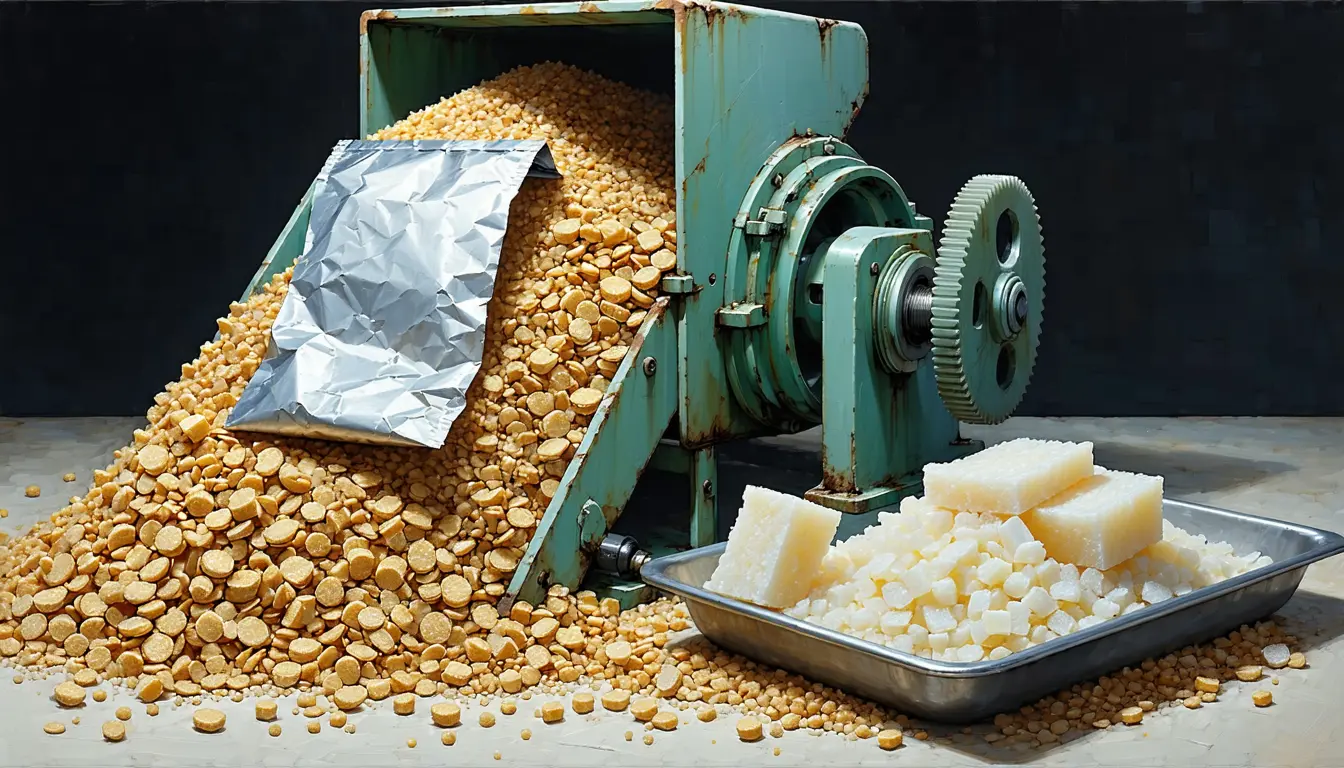
The winning technology grinds mixed trash into a fine powder, repurposing materials such as Zotek foam as reinforcement rather than treating it as contamination that needs to be sorted out; the powder becomes feed for injection-mold finished parts or 3D-printing filament.
The MIT team won in both the competition's prototype development track and the track focused on developing digital twins, virtual models of recycling systems.
NASA's announcement gives the $775,000 as a total across the awards and does not split the amount between the prototype and digital twin tracks.
LunaRecycle is a $3 million, two-phase competition run in partnership with The University of Alabama Lee J. Styslinger Jr. College of Engineering.
Distinct publishers with included, body-backed reporting in this cluster.
1 article · August 28, 2026
Follow any of these and your For You feed starts watching them — no settings page required.
science
NASA engineers put crewed Mars transit at 335 days. The hard part is where to test the reactor.1 distinct publisher
science
Saarland's metallic-glass team buys five days of weightlessness to measure a melt1 distinct publisher
science
JWST's brightest red dot looks like a star wrapped around a 100,000-sun black hole1 distinct publisher
product
A five-watt nuclear heater on Blue Ghost turns lunar night into a procurement problem1 distinct publisher
Evidence-backed comparisons of source perspectives and observed adoption signals. Read the methodology
Which Builder, Operator, and Investor concerns the observed source mix emphasized—not a truth score.
Evidence, demonstrated adoption, hype gap, incentives, and confidence are assessed independently, each on its own current evidence. How these are measured.
Airtight on the money, mute on the machine
Two different questions get two different answers here. Who won and what they were paid comes straight from the organization that wrote the cheques, itemized to the dollar, and there is no better source for that. How well the technology works is simply absent: no strength figures for parts made from CERBERUZ's powder, no throughput, no power draw, and no criteria behind awards named Highest Mass Efficiency and Most Trash Types Recycled. The provenance is excellent for the half of the story NASA chose to tell.
Five days on a demonstration floor
The entire operational history of this technology is a judged demonstration in Tuscaloosa. Nothing has flown, nothing is under contract, and NASA names no follow-on order or manifest for any of the ten paid teams. Phase 1's 1,200-plus registrations show appetite among engineers, not uptake by anyone who would run the hardware.
The verbs run ahead of the numbers
NASA's factual claims are modest and checkable; the lift comes from its framing. Edmunson's 'concept to prototype and digital twin demonstrations' invites a reader to hear maturity, and 'record-breaking interest' does work that a submission count would undercut — nearly 200 entries from more than 1,200 registrations is about one in six following through. The gap is small because the release never claims the machines work well, only that they exist and were judged.
The judge is also the press office
Everyone quoted has a stake in this program looking like a good use of $3 million: NASA's own Centennial Challenges manager, and Chris Frangione of Amentum, the contractor NASA pays to run the challenge, with the host university as the third partner in the frame. That alignment cuts both ways — an issuer is precisely the entity you trust for a prize roster — but it also means no one in this story has any reason to ask whether the winning recycler actually performs.
One source, and the arithmetic holds
Single-publisher stories usually earn a low mark; this one recovers because the publisher is the payer and the internal numbers reconcile — ten listed prizes sum to $1.35 million, which is what makes the 57 percent concentration on one MIT team visible at all. Confidence is capped by what cannot be resolved from here: the split of the $775,000 across the two tracks, and any claim about whether the process produces usable parts.