Science1 publisher3 min readPublished
Activated hydrogen travels hundreds of nanometres beyond the plasmonic hot spot that made it
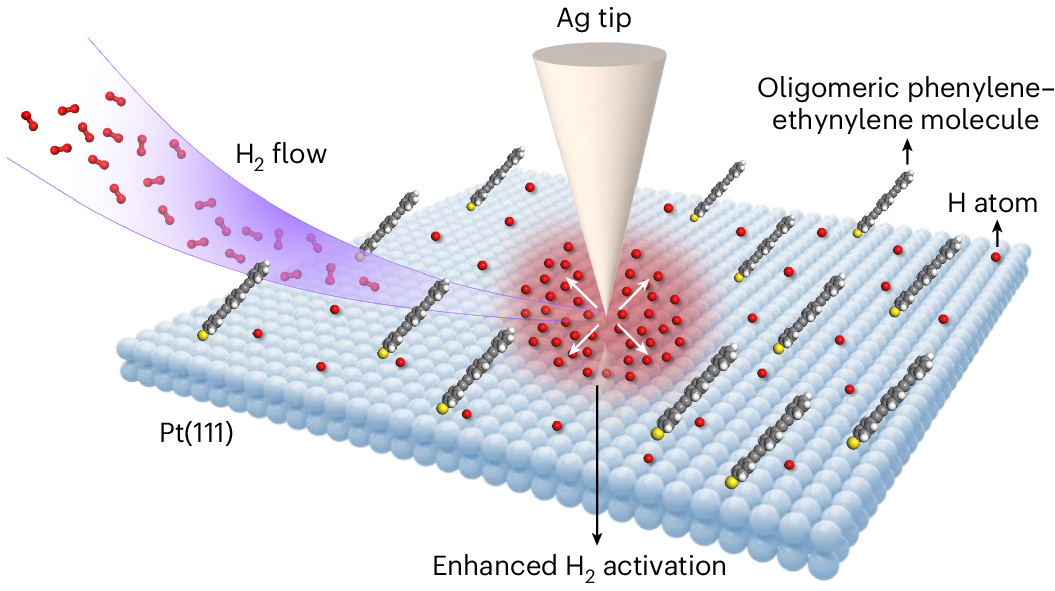
Tip-enhanced Raman imaging of one silver tip over a platinum crystal finds about 20% more hydrogen activation in a band 180 to 300 nanometres out, with the mechanism attributed to hot electrons rather than plasmonic heat.
The Scientist · Science desk
What happened
- Tip-enhanced Raman spectroscopy followed H2 activation on Pt(111) at room temperature under visible light, reading it indirectly through hydrogen-assisted desorption of an oligomeric phenylene-ethynylene thiolate reporter monolayer.
- Hyperspectral imaging found roughly 20% enhancement in the 180 to 300 nm region around the near field, rather than only inside it.
- Quantum calculations attributed the dissociation to hot electrons generated in the near field, transferring into H2 by an indirect mechanism.
- Activated hydrogen atoms propagated hundreds of nanometres past the near field, which the authors attribute to a collective crowd effect.
Compiled by The ScientistSomething wrong?How this is made
Why it matters
- decision If carriers rather than heat do the chemistry, the engineering lever for light-driven hydrogenation becomes carrier transfer geometry between antenna and catalyst, not how much optical power you dump in to raise a temperature.
- capability A single hot spot that decorates a patch hundreds of nanometres across means the reactive area per illuminated site can exceed the optical spot, which changes how densely plasmonic antennas would need to be packed.
- constraint Because the observable is monolayer desorption, this line of work can say where hydrogen went but cannot yet be turned into an energy cost comparison against thermal hydrogenation.
- precedent Swapping the ensemble average for one imaged nanocavity sets the standard of evidence other plasmonic systems will be held to when they claim a hot-carrier mechanism.
The enhanced band is about 120 nm wide, and treating its outer edge as a radius, the disc it encloses covers roughly 0.28 square micrometres [17][18]. The paper's own framing puts the activated hydrogen atoms beyond the near field [6], so the reactivity was mapped outside the volume where the field is concentrated. The location, more than the magnitude, is what the experiment is about.
The observable is indirect: an oligomeric phenylene-ethynylene thiolate monolayer leaving Pt(111) when atomic hydrogen reaches it, rather than H2 splitting itself, followed in situ by tip-enhanced Raman spectroscopy [2]. That is a clean reporter choice: desorption removes a strong Raman signature from a defined spot, so a map of where the monolayer thinned is a map of where H atoms arrived. What it does not give is a rate or a yield for anything a reactor would produce.
Pt-catalysed hydrogenation usually needs 350 to 500 K for sufficient activity [7], because the H-H bond holds 4.6 eV [8]. Room temperature, call it 298 K, sits about 52 K below the bottom of that window [22]. Whether visible light closes the gap by warming the metal or by injecting carriers has been the unsettled question; the paper's introduction says the relative contributions of hot carriers and photothermal effects are still not well understood [10]. The two mechanistic claims here do not rest on the same kind of evidence. Heating was excluded by spectroscopic evidence together with finite element method simulations [4]. The hot electron comes from quantum calculations showing indirect transfer into H2 [5], a mechanism inferred from the spectra rather than confirmed by counting electrons directly.
The propagation result carries the most weight for anyone thinking about reactors, and the abstract explains it least, attributing the hundreds-of-nanometre spread to a collective crowd effect [6] without spelling out the model. If H atoms made in one hot spot reach that far, the usable area of a light-driven Pt catalyst is not set by how tightly the light can be focused.
This stays a bench result for reasons of hardware. The antenna is a scanning probe tip, and the same tip is the microscope; earlier demonstrations of plasmonic H2 activation used the plasmonic metals themselves, Au nanoparticles and Ag nanocrystals [12]. Getting Pt into that picture means antenna-reactor architectures of the sort the paper cites, Al-Pd heterodimers and Au@AgPt core-shell particles, in which the plasmonic component funnels light into the adjacent catalytic one [13]. Single-hot-spot work also buys its precision at a price: the abstract quotes about 20% with no spread and no count of nanocavities sampled, because it sampled one nanocavity instead of the ensemble averaging that earlier studies used [9].
The authors claim only that the findings suggest future opportunities for energy-efficient catalytic hydrogenation [19]. The version that can be tested next is geometric: space plasmonic antennas a few hundred nanometres apart on a Pt surface and see whether the enhancement survives without a tip.
What to watch
- Whether the hundreds-of-nanometre propagation survives at reactor-relevant H2 pressures instead of ambient single-crystal conditions.
- A direct probe of the hot-electron transfer, such as wavelength or isotope dependence, to replace the computational inference.
- Whether the full paper gives the collective crowd effect a quantitative model rather than a name.