Loading today’s stories
Science1 distinct publisher3 min readUpdated
Four languages, 13 years: a brain-age gradient that arrives without a paper
A conference presentation puts multilingualism on a cognitive-reserve scale. The rungs are uneven, and the whole effect rests on a test group of 144 people.
The Scientist · Science desk
What happened
- Research presented at the Federation of European Neuroscience Societies (FENS) Forum 2026 found that people who speak more than one language may have brains that appear younger than expected for their age.
- The work was presented by Dr Lucia Amoruso of the Basque Center on Cognition, Brain and Language in San Sebastian, Spain, with collaborators at the Latin American Brain Health Institute (Universidad Adolfo Ibanez, Chile), the Cognitive Neuroscience Center (Universidad de San Andres, Argentina) and the Global Brain Health Institute (Trinity College Dublin).
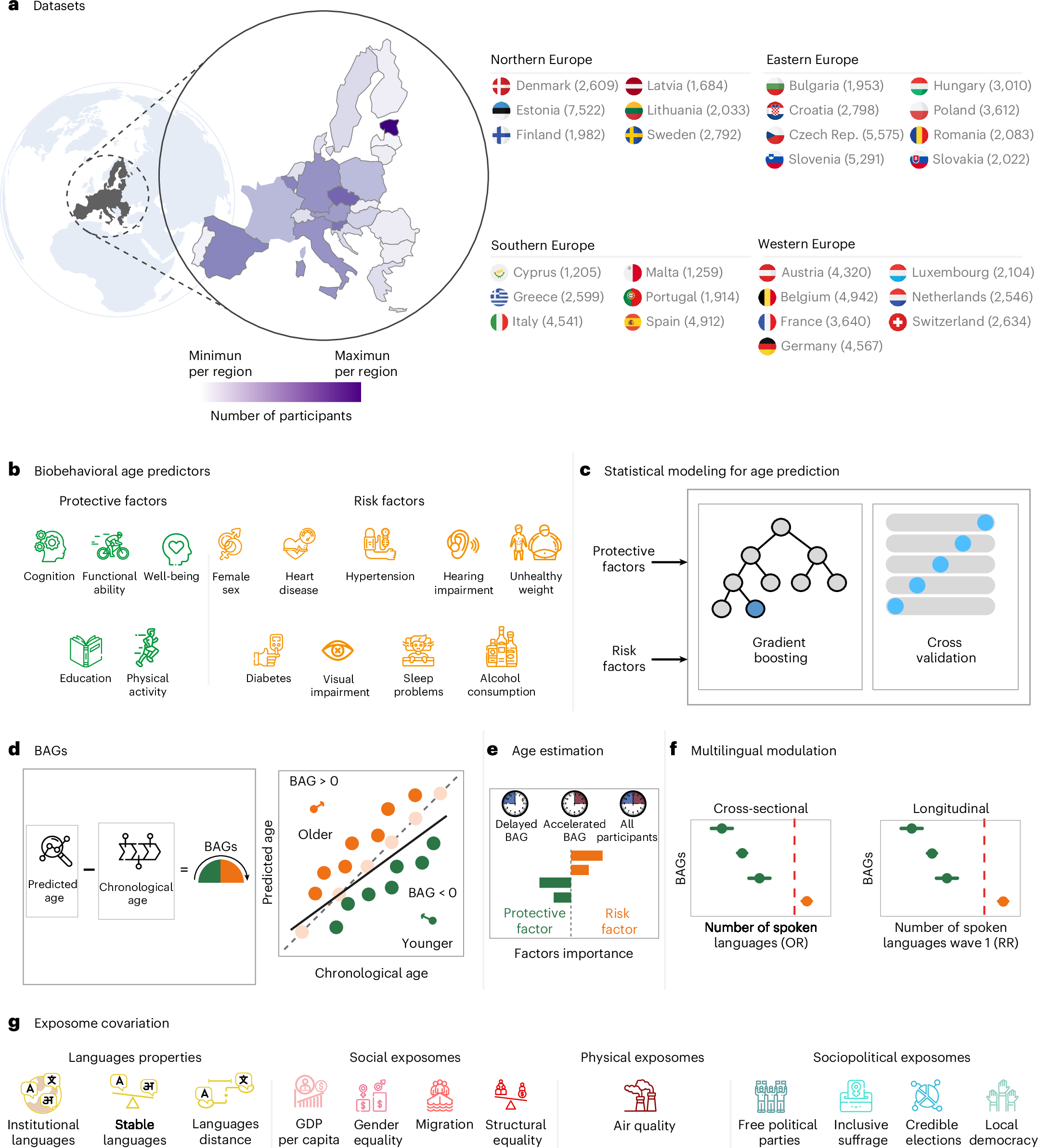
- Participants were people from the Basque region of Spain who spoke between one and four languages, using different combinations of Spanish, Basque, French and English.
- To measure brain ageing the researchers first studied 728 people and built a 'brain aging clock' using magnetoencephalography, which detects the faint magnetic fields produced by active brain cells; artificial intelligence was used to analyse activity patterns across people of different ages and estimate typical connectivity at different points in life.
- The clock was then applied to a separate group of 144 people to estimate each person's brain age.
Compiled by The ScientistSomething wrong?How this is made
Why it matters
The ladder does not climb evenly. Moving from one language to two is worth about six years of apparent brain age in this dataset [6]. The third language adds roughly one year on top of that; the fourth adds another six [15]. A curve with a flat middle rung and a steep top one is not what a straightforward "more switching, more reserve" mechanism predicts. It is, however, what you get when the top group is small and selected.
Which raises the arithmetic the release skips. The brain-age clock was trained on 728 people scanned with magnetoencephalography, with machine learning fitting connectivity patterns to chronological age [4]. It was then applied to a separate group of 144 [5], drawn from the Basque region and speaking one to four languages in combinations of Spanish, Basque, French and English [3]. Divided by language count, that averages 36 people per rung [16], and no per-group numbers are reported. The 13-year figure is a contrast between the two ends of a sample whose ends are, on any plausible split, its thinnest parts. The training set is about five times the size of the set the result comes from [17].
The confound structure matters more than the confound list. Age, sex and education were adjusted for, and the researchers say lifestyle and social engagement could also be contributing [10]. The deeper problem is that whatever makes a person acquire and keep four languages cannot be separated, in a cross-sectional design, from the cognitive effect of having done so. The team's earlier published work was at country level, finding slower ageing where multilingualism is common [11], which has the same difficulty one scale up.
The part that survives the sample-size worry is Amoruso's framing rather than her headline number. Earlier acquisition and higher proficiency also tracked with delayed brain ageing, which she describes as a gradient of depth and duration rather than a bilingual-or-not distinction [9]. That is what makes language history usable as a reserve variable: age of acquisition and proficiency are continuous, measured per person, and do not depend on how many people happened to land in the four-language cell.
Two follow-ups are planned, and one of them can fail informatively. The group wants to look at people with neurodegenerative conditions such as Alzheimer's [12], where reserve is the whole question. The other is a genuine prediction: that closely related languages produce a stronger effect, because managing competing words and systems demands more control [13]. If closely related pairs turn out to protect less, the control-demand account is in trouble, and the reading shifts toward selection.
Christina Dalla of the National and Kapodistrian University of Athens, who chairs the FENS Forum communication committee and was not involved, notes that many things influence brain health with age, not smoking among them [14]. That is the right register for now. This was presented from a conference stage [1], and 13 years is best read as the largest number the data could produce, not the number it will settle on.
Loading topic controls
Loading related stories