Product1 publisher3 min readPublished
Hunter WOLF meets the 82nd Airborne, and the question is subtraction, not payload
The Army is putting BLADE's 2,800-pound-payload robot in front of a division that deploys in 18 hours. The useful result is not whether it hauls, but whether anything comes off soldiers' backs.
The Product Desk · Product desk
Drafted by a language model from the sources cited here and checked against its claim ledger before publication. How we use AISend a correction
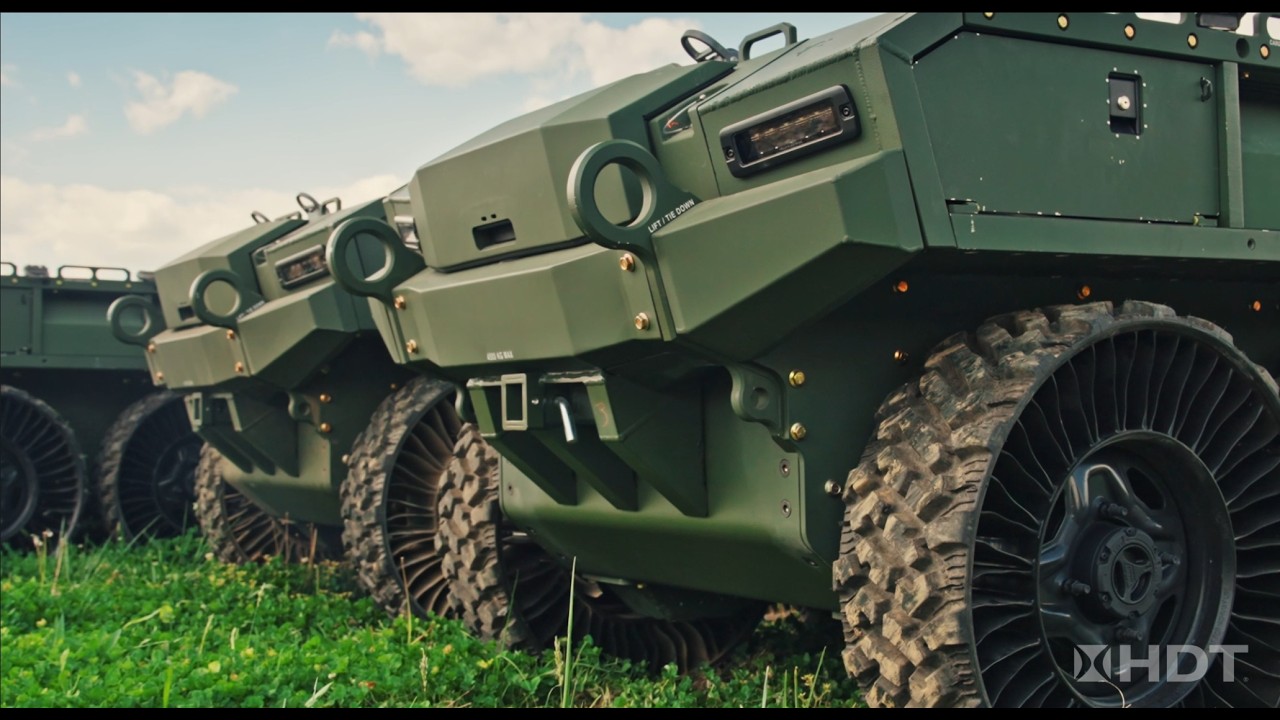
What happened
- The U.S. Army will put BLADE's Hunter WOLF robotic vehicle through field evaluation with the 82nd Airborne Division in a training event scheduled for August 20 at Fort Polk, Louisiana.
- Hunter WOLF has a 2,800-pound payload capacity.
- BLADE plans to configure Hunter WOLF for several roles during the exercise, including tactical communications, equipment transport and casualty evacuation.
- The vehicle will carry five Universal Battery Chargers and two AN/VRC-158 tactical radios.
- A 15-kilowatt power system will provide 120/240-volt AC electrical output.
Compiled by The Product DeskSomething wrong?How this is made
Why it matters
The Army has scheduled a field evaluation of BLADE's Hunter WOLF unmanned ground vehicle with the 82nd Airborne Division at Fort Polk, Louisiana, on August 20 [1]. The vehicle's advertised capacity is 2,800 pounds [2], but the outcome that matters is whether that capacity subtracts weight from dismounted soldiers or simply adds a platform that a light infantry company now has to move, power and maintain.
The configuration list for the exercise is specific. BLADE plans to set the vehicle up for tactical communications, equipment transport and casualty evacuation [3]. It will carry five Universal Battery Chargers and two AN/VRC-158 tactical radios [4], and a 15-kilowatt power system will provide 120/240-volt AC output [5]. Extended cargo rails are meant to widen what it can carry [6]. The platform was designed around light infantry needs, with the aim of substantial carrying capacity without depending on conventional vehicles [7], and it can operate at a distance from the troops it supports [8].
Read that list closely and the interesting part is the electrical load. A robot carrying chargers and radios and generating 120/240-volt AC [4][5] is not only a cargo mule; it becomes the squad's power node, which means the squad's power plan now has a single point of failure with tracks on it.
The audience is the hard case. The Army describes the 82nd Airborne as a rapid-response force capable of worldwide deployment within 18 hours [9], and BLADE's vice president of business development, John Conway, said the division's emphasis on rapid movement and mobile infantry operations offers a distinct perspective [10]. That is precisely where a ground robot earns or loses its keep. Nothing in the announced configuration set addresses how the vehicle gets to a drop zone [11], and an 18-hour force that has to wait for its logistics tail to catch up has not been unburdened.
This is not the first look. Earlier trials involved the 3rd Brigade of the 10th Mountain Division and the 101st Airborne Division [12], making the 82nd at least the third formation to handle the system [13]. Tom Van Doren, BLADE's president of robotics, said unit feedback remains central to the evaluations and that "every event helps validate the flexibility of the platform" [14], adding that trials can reveal ways to reduce soldiers' workload and exposure to danger [15]. Validating flexibility is a vendor's metric. A brigade's metric is pounds per soldier and hours per day.
Three things to watch after August 20. First, whether any reported result is expressed as load removed from dismounts rather than load carried by the vehicle; the stated design intent is to carry heavy loads without adding that burden to troops [16], and that claim is measurable. Second, whether casualty evacuation survives contact with a unit that will ask what happens when the robot is the only lift available and it is somewhere else. Third, whether the feedback loop BLADE describes [14] produces a changed configuration for the next evaluation, or the same three roles presented to a fourth formation. Repeated demonstrations across formations [12][13] are evidence of interest, not of adoption; a requirement written by one of these divisions would be.