Invest1 publisher3 min readPublished
Microsoft's not-yet-commenced leases grew $132.5 billion in a single quarter
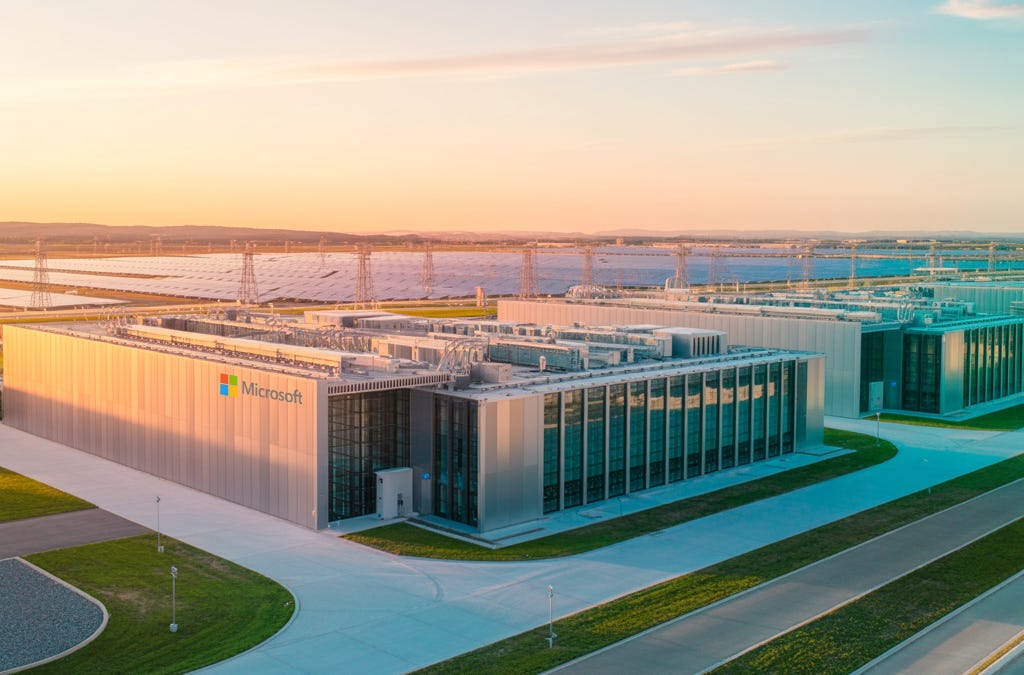
Microsoft's fiscal 2026 filing puts $329.1 billion of leases into a queue that starts in fiscal 2027. The 38 gigawatts Bloomberg reported for 2032 would need a slower build than Satya Nadella has guided to.
The Investor · Invest desk
What happened
- Bloomberg reported on September 10 that Microsoft plans more than 38 gigawatts of data center capacity by 2032, up from roughly 12 today, citing people familiar with the plans.
- Capital expenditure including finance leases reached $41 billion in the June quarter, up 69 percent from a year earlier.
- Nadella said the company added 31 data centers across five continents in the quarter, taking the fiscal year total to 88.
Compiled by The InvestorSomething wrong?How this is made
Why it matters
- contradiction Reuters places capacity rented from smaller specialist cloud providers outside the 38 gigawatts, while Data Center Dynamics counts third-party leased capacity inside it and names CoreWeave, Nscale, Lambda, IREN and Nebius; the two readings describe different companies.
- exposure Taking AI-specific chip capacity from about 2 gigawatts to a third of 38, roughly 12.7, multiplies it about 6.3 times, so the target rests on the demand of a single workload class holding for six years.
- constraint Some of the $329.1 billion commences only if contractual conditions are met, and commencement runs to fiscal 2033. The timing of both the capacity and the expense sits with counterparties.
- decision The useful-life change shifts where future leases land. Anyone modelling fiscal 2027 earnings now has to split the $329.1 billion between operating and finance lease treatment before the depreciation line means anything.
Microsoft disclosed $329.1 billion of not-yet-commenced lease commitments at June 30, against $196.6 billion three months earlier [16]. The $132.5 billion increase [1] is about 3.2 times the $41 billion of capital expenditure including finance leases booked in the same quarter [15][2]. Microsoft said the leases are primarily data centers, that some are subject to contractual conditions being met, and that they commence between fiscal 2027 and fiscal 2033 with terms of one to 20 years [17].
The two capacity numbers disagree, and the confirmed one is the faster. Nadella said on the July 29 call that Microsoft added a gigawatt of capacity in the quarter and remains on track to roughly double overall capacity in two years [11]. That takes roughly 12 gigawatts to roughly 24, about 6 a year [22]. Bloomberg's 38 gigawatts by 2032 averages about 4.3 a year [21]. Put the two end to end and the back half of the decade thins. Twenty-four gigawatts in 2028 leaves 14 to add over about four years, roughly 3.5 a year [5], some 42 percent below the pace guided for the next two [6].
Divide the disclosed leases by the reported increment of 26 gigawatts and you get about $12.7 billion a gigawatt [3][4]. Treat that as a ceiling. The 38-gigawatt figure covers company-owned facilities as well as leased ones [6], and the lease disclosure covers property Microsoft describes as primarily, not only, data centers [17].
Fiscal 2026 capital expenditure was approximately $145 billion, and Amy Hood guided to more than $50 billion in the first quarter of fiscal 2027 [19][20]. Four quarters at that rate is more than $200 billion, about 38 percent above fiscal 2026 [7]. Hood also said Microsoft will extend the estimated useful life of office and data center buildings from 15 years to 25, and that the change moves more future leases into operating lease classification [18]. She said demand continues to exceed available capacity and gave no estimate of when that changes [14].
None of the gigawatt figures come from Microsoft. The company has not confirmed 38 gigawatts [3], and Reuters said it did not respond to a request for comment [2]. Bloomberg's report puts no capital figure and no first-phase date on the plan [4]. Bloomberg's sources cautioned that the projections could change with customer demand, new technology and long construction timelines [9].
One reading is that 38 gigawatts is a planning floor set by what power interconnects can be secured six years out, and the true 2032 number is higher. Another is that the doubling guidance is a pull-forward, with fiscal 2026's signings landing early and the 2029 to 2032 tail correspondingly thin. I lean to the second, and the test arrives quarterly. Another hundred-billion-dollar increase in the not-yet-commenced balance while capex holds above $50 billion says the pipeline is still growing. A balance that flattens as commencements begin in fiscal 2027 says the June quarter was the peak of signing.
What to watch
- Whether Microsoft names a gigawatt target and a capital figure on its next earnings call, or leaves 38 gigawatts to Bloomberg's sources.
- The next quarterly disclosure of not-yet-commenced leases: another large increase and a balance that starts converting mean very different things.
- Azure's growth rate against the 43 percent it printed in the June quarter, the demand series behind the AI-chip third of the reported target.