Product1 publisher3 min readPublished
The ChromeOS and Android merger goes on sale across five laptop brands
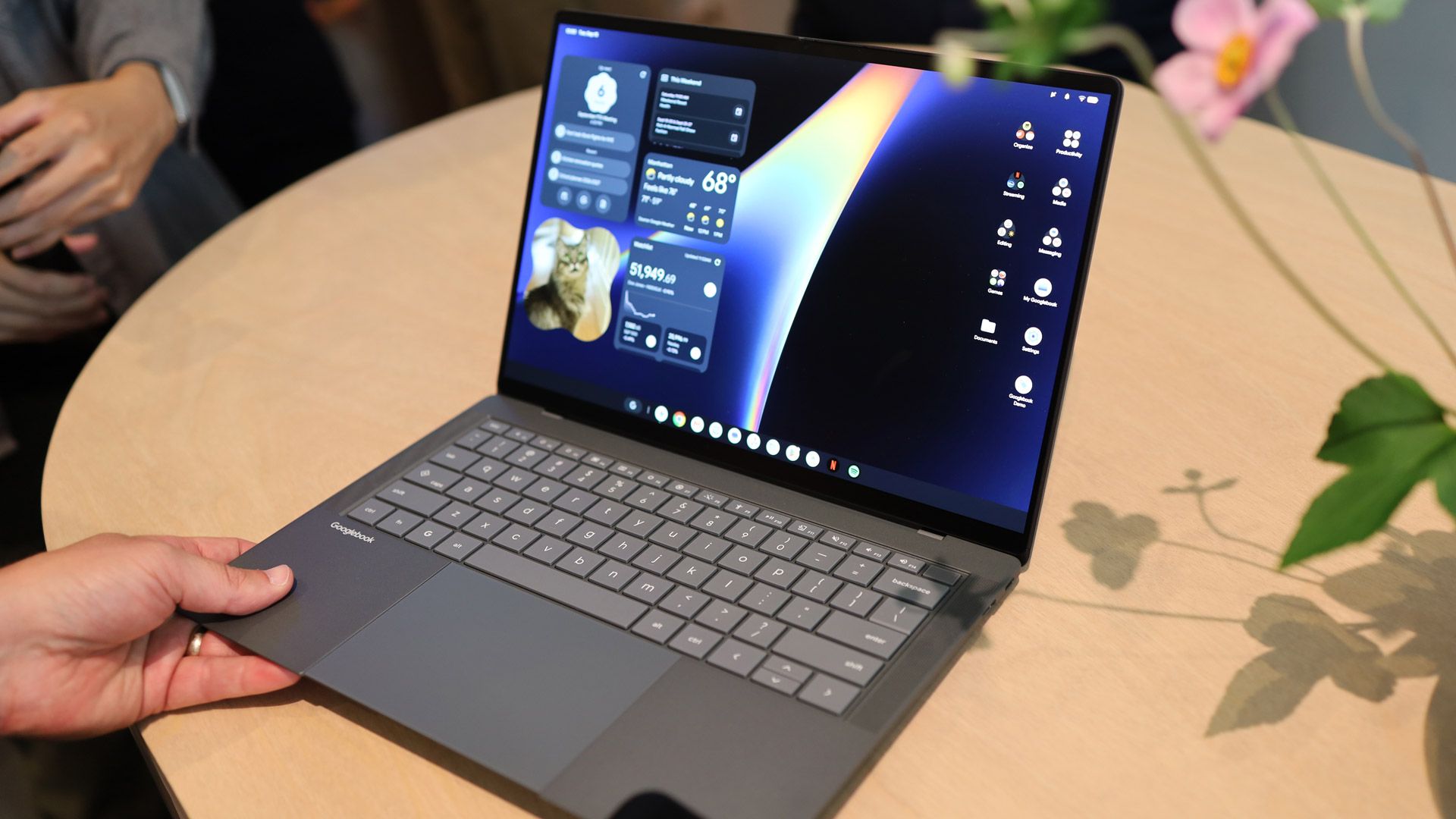
Pre-orders opened for Googlebooks from Asus, Acer, Lenovo, Dell and HP, with units shipping October 5. The continuity Google demonstrated moves a draft from an Android phone to the laptop, one direction only.
The Product Desk · Product desk
What happened
- Googlebooks from Asus, Acer, Lenovo, Dell and HP opened for pre-order and start shipping on October 5, running Googlebook OS, which TechRadar describes as the first hybrid of ChromeOS and Android.
- Sameer Samat, Google's president of Android ecosystem, told TechRadar in July 2025 that the company was going to combine ChromeOS and Android into a single platform.
- The platform uses a single sign-on that treats the phone and the laptop as one user rather than two devices with two accounts.
- Processors span the Intel Core Ultra line, Qualcomm's Snapdragon X Elite and MediaTek, and TechRadar reports the CPUs can handle up to 45 TOPs for local AI work.
- Apple's MacBook Neo, which TechRadar calls new and quite popular, sells for $699 in the US and £699 in the UK.
Compiled by The Product DeskSomething wrong?How this is made
Why it matters
- capability A phone-first workflow can be built on a Google laptop today, as long as the handoff runs from phone to laptop.
- decision With the software and the memory floor identical on all five brands, the buying decision reduces to weight, screen size, silicon and which biometric the user gets.
- cost A UK buyer comparing entry models against the MacBook Neo absorbs a premium about 14 points wider than a US buyer does for the same machine.
- constraint Teams that deferred a ChromeOS-versus-Android endpoint decision now face a dated product, and the admin, update and licensing answers have to come from Google directly.
The draft you started on an Android phone turns up as a small phone icon in the Googlebook's dock, and clicking it opens the email in the laptop's Gmail app [15]. TechRadar reports the same trick does not yet work in the other direction [15]. Any workflow built on it starts in someone's hand and finishes at their desk.
All five machines carry the same software and the same signature hardware. Each has the Glowbar on the lid, which lights up to show that Gemini is working or to show charge status [8]. TechRadar asked whether the bar would report battery level on an unplugged laptop and was told it is charge status only [9]. Each also has a large haptic touchpad, a G key for Google features, a Caps Lock key that opens text add-ons like emojis, and the magic cursor you jiggle to hand Gemini whatever is on screen [10]. Memory starts at 16GB, which Samat said was the "right amount of RAM" [11]. What differs is the body and the biometrics: Samat said he wanted five partner brands instead of two to show breadth, with facial recognition on some units and a fingerprint reader on others [5]. The line includes a 2.2lb Asus, a 15-inch Lenovo and pen-supporting Acer convertibles [6].
Against the MacBook Neo comparison TechRadar raises, the Googlebook entry point is $899 in the US and £999 in the UK [18]. That is $200 more, about 29 percent [20]. In sterling it is £300 more, about 43 percent [21], roughly 14 percentage points wider than the dollar gap [22].
TechRadar asked Samat about Apple-level interoperability, using the example of an authentication code that arrives on an iPhone and appears on a MacBook Air. Samat said the unified messaging system will allow this, and that Google would have demoed it on stage that day but wanted to keep the presentation lean [16]. Of an ecosystem where it all just works, he said: "That's the dream" [17].
The demo covered the desktop side too. Search ran across files on both the laptop and the phone, and the system could look inside files with unhelpful names [13]. The platform has a dock, a full file system, Android apps, prompt-built widgets, and online and offline access to Canva, Netflix and Adobe [12]. TechRadar's account says nothing about device management, admin controls, update policy or business licensing [23].
Whether this is a different purchase from a Chromebook for the people you buy for depends on whether they carry an Android phone signed into the same Google account, because the single sign-on [14], the phone-to-laptop handoff [15] and the cross-device file search [13] all assume they do. It also depends on whether they need apps that run locally and offline [12], or whether a browser has been enough all along. Units ship October 5 [4].
What to watch
- Whether the laptop-to-phone direction of continuity ships, and on which Android versions.
- Whether Google publishes management, update and licensing terms for Googlebook OS before the October 5 units land.
- Whether the unified messaging Samat described carries authentication codes on shipping hardware.