Science1 publisher2 min readPublished
Eight seawater strains break down fucoidan by splitting the job two ways
Andreas Sichert and Otto Cordero report in Nature that more than 453 fucoidan enzyme genes reduce to two functional roles, and that a model built on those two categories predicted degradation by communities it was never trained on.
The Scientist · Science desk
What happened
- Fucoidan resists microbial breakdown, and that resistance lets it sink deep into the ocean carrying carbon that may be stored there for long periods.
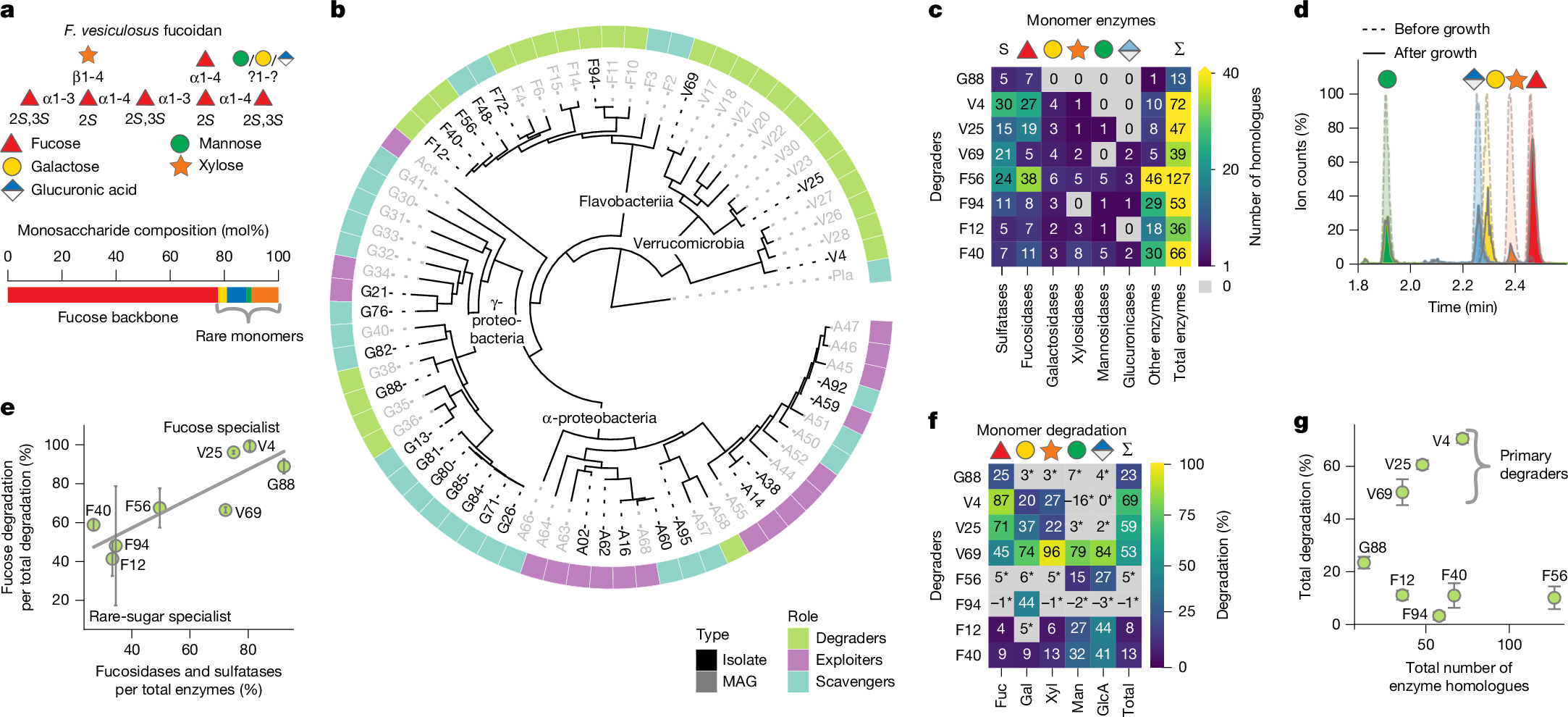
- A team led from MIT and ETH Zurich enriched a fucoidan-degrading community from coastal seawater and isolated eight strains, none of which could break the molecule down completely on its own.
- A rapid mass spectrometry method showed the strains fell into two specialisms: consuming the fucose-rich backbone, or removing side branches built from rarer sugars such as xylose and galactose.
- Pairing strains from both groups produced degradation above what their individual activities predicted, and the most complementary pairs came close to breaking the polysaccharide down entirely.
- The model trained on one- to three-strain communities predicted degradation by up to seven strains and also held across nine structurally different fucoidans from other algae.
Compiled by The ScientistSomething wrong?How this is made
Why it matters
- constraint How hard a molecule is to cut stops being sufficient input for a sequestration estimate. Which specialists are present becomes a second variable, and that one is local.
- capability A crude two-category model that works at seven strains means forecasting the fate of other carbon-rich polymers may not require a full census of enzymes and structures first.
- precedent The obvious next experiment is a manipulation: drop one specialist role out of a community and see whether the fucoidan survives longer.
Individual bacteria that chew pieces off fucoidan have been known for years. The unanswered question was whether a community could take the molecule apart completely, and how [23]. So the group grew the degrading community out of coastal seawater first, and only then pulled single strains out of it [5]. Those eight isolates carried more than 453 genes for enzymes that act on fucoidan between them, an average of about 57 genes per strain [6][19].
The model that came out of the experiment is deliberately crude: two sugar categories, fucose from the backbone and the rarer sugars from the side chains [15]. Two categories are enough because the size of the synergy scales with how complementary a pair's sugar preferences are [11]. Trained on communities of one to three strains, the model predicted degradation in communities of up to seven, about 2.3 times the largest community it learned from [15][16][20]. "A predictive understanding of a complex system need not come from characterizing each of its parts," Cordero said, "but from finding the right simplification" [14]. In my view that transfer, and not the teamwork result, is the part other systems will borrow, and the authors say the same approach may apply to other complex carbon-rich materials whose chemistry and enzymes are only partly known [21].
"The breakdown of one of the ocean's most abundant carbon pools rests on a division of labor," Cordero said, "not between particular strains, but between functional roles" [13]. The group proposes calling the reverse case diversity-limited degradation: where the right combination of complementary specialists is missing, fucoidan lasts longer instead of being broken down [18].
The field support offered for that is co-occurrence. Bacteria with complementary capabilities often turned up together in ocean samples [17]. Co-occurrence is a pattern in who lives near whom. Every degradation number here comes from cultures fed fucoidan, so the step from these results to a sequestration budget still needs measured rates on particles as they sink. What the study does change is the shape of the question. Fucoidan's reputation as a long-lived carbon carrier has rested on its chemistry, on linkages and branching patterns that differ from one algal species to the next [2]. That chemistry is now one of two inputs, and the other one is biological and local.
What to watch
- Whether a follow-up measures fucoidan degradation rates on sinking particles alongside the community composition present there.
- Whether the two-category simplification holds for other recalcitrant marine polysaccharides beyond the nine fucoidans tested.
- Whether ocean carbon-cycle models begin carrying a term for community composition.