Science1 publisher3 min readPublished Updated
MIT team uses electricity to cut heat and energy needed to extract hydrogen from ammonia
By coupling a palladium membrane to a molten hydroxide electrolyte, the Nature paper gets hydrogen out of ammonia already pure and keeps the reaction moving, though the account of it reports neither an operating temperature nor an energy cost.
The Scientist · Science desk
What happened
- MIT researchers report an electrochemical route that releases hydrogen from ammonia and, in the same step, separates and concentrates it into a high-purity stream.
- Conventional cracking needs temperatures above 500C to reach high reaction rates and conversion, which is the heat load the new approach is meant to cut.
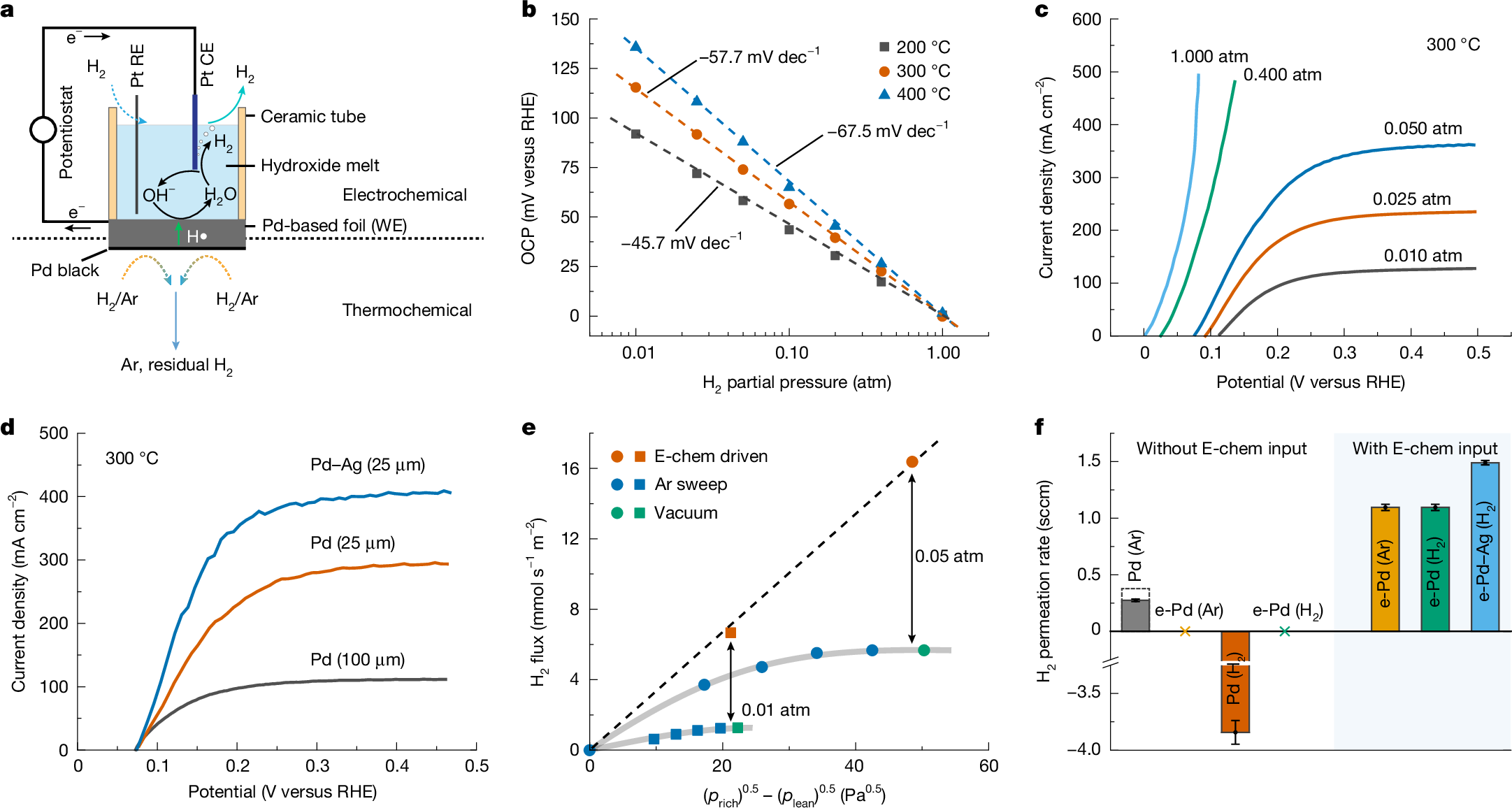
- The cell couples a palladium-based separation membrane to a hydrogen-generating electrode through a molten hydroxide electrolyte, with a ruthenium and cesium catalyst doing the initial dehydrogenation.
- The gradient across the membrane acts as a vacuum for hydrogen, splitting it into protons and electrons that travel by separate paths and recombine as gas at a second electrode.
- The paper is published in Nature, with MIT chemist Yogesh Surendranath as corresponding author and former MIT postdoc Rui Zeng, now at Harbin Institute of Technology in Shenzhen, as lead author.
Compiled by The ScientistSomething wrong?How this is made
Why it matters
- capability A carrier chain that needed a cracker plus a separation train behind it could in principle be served by one vessel, so only one unit would need to be sited and maintained where the hydrogen is consumed.
- cost The input swaps from fired heat toward electricity, so whether this route is cheap depends on a local power tariff rather than furnace duty, and the size of that trade is not quantified here.
- constraint With no membrane flux or lifetime reported, no one outside the group can size or price a unit, which means this cannot yet be compared on cost against pressure-swing purification.
- precedent Showing that an electrochemical pull can drive an uphill dehydrogenation makes membrane-integrated cells a template other equilibrium-limited reactions will now be tested against.
Ammonia is a candidate hydrogen carrier for an unglamorous reason: it is already made and shipped over long distances, while hydrogen gas itself does not travel efficiently unless it is compressed or liquefied [13][14]. The awkward part has always been the far end of the trip.
Cracking is both slow and equilibrium-limited, and industrial practice attacks both limits with one instrument, heat. This cell attacks the second limit differently. Withdrawing hydrogen from the reaction zone as it forms helps push the dehydrogenation forward, which the researchers report as one effect of continuous extraction [12]. Purity falls out of the same arrangement: the only hydrogen reaching the collection electrode is hydrogen that crossed the membrane, so it never has to be sorted out of nitrogen and unreacted ammonia the way a conventional product gas does [9][5].
The pumping is not free. Surendranath describes the system as actively pumping hydrogen from a low concentration to a high concentration [11], and moving a species up a concentration gradient costs work, paid here in electricity. The account says the approach lowers both the temperature and the energy needed [2]. It does not say by how much, giving neither an operating temperature nor an energy figure per kilogram of hydrogen [15]. Direction without magnitude is exactly where carrier economics usually stall.
One bound is visible in the design itself. A molten hydroxide electrolyte has to be molten, so the cell sits above the melting point of the hydroxide salt, and how far above is not stated [16]. "Cooler than a conventional cracker" and "near ambient" are very different propositions for hardware meant to live at a fuelling station or a fab, and only the first is supported here.
What a unit would have to be is the missing piece here. Hydrogen flux per unit of membrane area sets how much palladium you buy, and how long the membrane holds that flux with ammonia on one face sets how often you buy it again; neither figure appears, nor does the ruthenium loading behind the catalyst [17]. Those numbers matter more to a plant weighing a purchase than to a paper establishing a mechanism.
Surendranath's own framing is about generality rather than economics: he says the group has shown electrochemistry can drive thermodynamically uphill and kinetically difficult dehydrogenation reactions, that ammonia and a liquid organic molecule were chosen for their importance as carriers, and that translating the concepts to other dehydrogenations is under way [10]. Read as a research result, that is the interesting part, and it is separable from any claim about delivered cost.
What holds up from this work is narrow and real: the separation and the reaction can be made the same operation, which removes a downstream purification step from the ammonia chain, conditional on a palladium membrane that keeps its flux long enough to pay for itself.
What to watch
- The full Nature paper's supporting data, specifically an operating temperature, a cell potential and an energy cost per kilogram of hydrogen.
- Whether the palladium membrane holds its hydrogen flux over long runs with ammonia and nitrogen on the feed side.
- Whether an independent group reproduces the concentrated hydrogen stream at a larger membrane area.