Science1 distinct publisher2 min readPublished
The trigger keys on the polymer backbone rather than an engineered chain end, which is why crude commercial resin and million-dalton material both come apart. The abstract does not name the operating temperature a plant would need to price the process.
The Scientist · Science desk

Compiled by The ScientistSomething wrong?How this is made
The whole design turns on where the chain breaks. The earlier low-temperature routes installed a labile group at the chain end and unzipped inward, which is why polymer made by ATRP depolymerizes at 170 C [8] and RAFT-made material at around 120 C [9], and also why those systems need polymer synthesised for the purpose and do poorly on very long chains [10]. Abstracting a hydrogen from the backbone instead puts the scission event anywhere along the chain [1]. That is the most plausible reading of why material above a million daltons comes apart at all here [6], and why resin bought as-is works with no end-groups preinstalled [3]. The ends themselves don't have to be anything in particular.
The paper's own comparators bracket the temperature question without answering it. Pyrolysis of all-carbon backbones sits near 450 C [7] and RAFT depolymerization near 120 C [9], a span of 330 degrees [16]. The abstract places this work at "relatively low" temperature without naming a value, and reports no N-hydroxyphthalimide loading and no reaction time [15]. Those are the numbers a process engineer costs the line with.
The yield matters just as much. About 90% isolated monomer [2] means roughly 100 kg of every tonne of feed leaves as something other than monomer [17]. On a bench that is an excellent result. In a plant it is a stream somebody has to characterise, and purity is precisely where the incumbent route fails: the high temperature of pyrolysis brings side reactions and odorous by-products that contaminate recovered monomer [7].
How the chemistry behaves on waste is a separate question the study doesn't answer. "Crude commercial polymers" means polymer as supplied [3], not post-consumer sheet carrying pigment and additives, and the source makes no claim about that feed [19]. Scope is polymethacrylates [18]. Chemical recycling back to monomer is already commercialised for polyesters such as PET, and much harder for vinyl polymers whose all-carbon backbones lack a heteroatom to attack [12], which is why the alternative for these plastics has mostly been mechanical reprocessing into lower-quality product [13]. A hydrogen-atom-transfer trigger tuned to the methacrylate backbone is not evidence about other all-carbon backbones [18].
My read, with its conditions stated: this is the first version of the chemistry a plant engineer could sketch without demanding that the polymer have been made specially, and it drops the two features that kept the same group's previous route in the lab, the chlorinated solvent and the light [11]. Plant plausibility turns on the temperature and reagent loading, numbers the abstract does not disclose [15].
Ranked by verification strength, evidence, and original report placement.
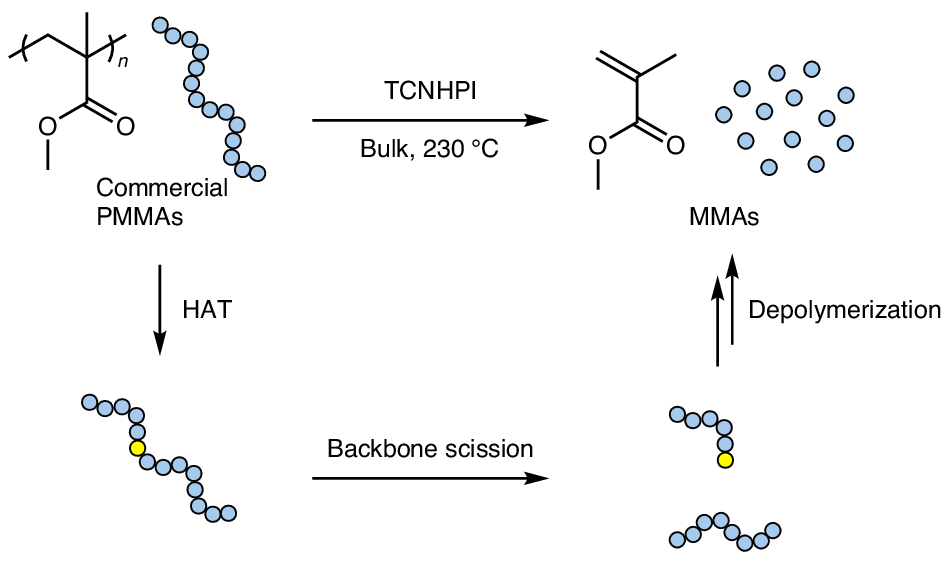
Researchers publishing in a Nature title report a bulk main-chain scission pathway in which the presence of N-hydroxyphthalimides triggers a hydrogen-atom-transfer reaction on the polymer backbone, followed by rapid and near-quantitative depolymerization of polymethacrylates.
The method enables direct isolation of pristine monomers in high yields of approximately 90%.
The strategy can be applied directly to crude commercial polymers and does not rely on preinstalled end-groups or sacrificial co-monomers.
The reaction operates at relatively low temperatures in the absence of light irradiation and precludes the use of a solvent.
The methodology is compatible with polymethacrylates synthesised by anionic, free radical or controlled radical polymerization.
The method can also be applied to ultrahigh-molecular-weight materials above 10^6 Da.
Distinct publishers with included, body-backed reporting in this cluster.
1 article · September 1, 2026
Follow any of these and your For You feed starts watching them — no settings page required.
science
A pole-on magnetar hands vacuum birefringence its first astrophysical candidate1 distinct publisher
science
A phage kinase with no target list: EMBL finds one enzyme that breaks several bacterial defences1 distinct publisher
science
HIPAA Covers Less Than You Think, And "Anonymized" Is Not A Legal Shield1 distinct publisher
science
Malva indexes public single-cell archives by nucleotide sequence instead of by gene1 distinct publisher
Evidence-backed comparisons of source perspectives and observed adoption signals. Read the methodology
Which Builder, Operator, and Investor concerns the observed source mix emphasized—not a truth score.
Evidence, demonstrated adoption, hype gap, incentives, and confidence are assessed independently, each on its own current evidence. How these are measured.
Peer-reviewed, single-origin, one number short
The chemistry arrives through a Nature journal with the mechanism, the substrate scope and the isolated yield all stated plainly, which is a stronger footing than a press announcement. It is still one document from one group: the ~90% figure, the claim about crude commercial resin and the million-dalton result have no outside check. And the paper's own habit of quoting competitors' temperatures to the degree makes the absence of its own temperature, additive loading and reaction time conspicuous rather than incidental.
Nothing yet to observe outside the lab
There is no pilot, licence, offtake agreement or industrial partner anywhere in this reporting, and no batch size to infer scale from. The closest thing to a real-world signal is the feedstock choice, and crude commercial resin is a purchasing decision, not a waste stream. We are not going to manufacture a deployment number out of that.
Overstated by omission, not by adjective
The paper does not oversell in the usual way — it makes no market claim and concedes what its own earlier solvent route could not do. The tilt comes from a single phrase. 'Relatively low temperatures' sits in a text that has just established 450 C, 170 C and 120 C as landmarks, and a reader will naturally place it at the bottom of that range. Slot it at 230 C, where the chain-end precedent operated, and much of the practical advantage narrows to the removal of solvent and light.
A priority race, with its own prior paper as the foil
The introduction reads as a map of who is ahead of whom — Sumerlin twice, Matyjaszewski, Diao, and two competing co-monomer strategies published on the same day. In that setting, framing matters, and the work the new result most directly supersedes is the group's own chlorinated-solvent photochemistry. Academic priority is a milder incentive than a funding round, but the authors are both the source of the claim and the party that benefits from its being read as a step change.
Believe the chemistry, withhold on the process
We would bet on the mechanism and the yield holding up: peer review, a coherent scope argument and honest handling of prior art all point that way. We would not yet bet on anything a plant cares about. With no independent account, no operating temperature and no waste-stream test, the confident half of this story is the flask and the uncertain half is everything after it.