Science1 publisher3 min readPublished Updated
UCD historian finds the Norman castle of Roebuck still standing under a Victorian building's plaster
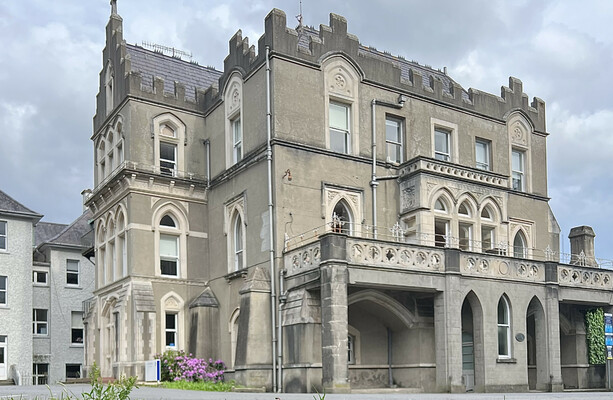
Tadhg O'Keeffe dated the oldest fabric inside University College Dublin's Roebuck Castle to the early 13th century after matching medieval features under its plaster against Gabriel Beranger's watercolours of the ruins from about 1765.
The Scientist · Science desk
What happened
- Tadhg O'Keeffe, a medieval architectural historian at UCD's School of Archaeology, identified surviving walls and other medieval features of the castle of Roebuck beneath the plaster of the university's present building.
- His research dates the oldest parts of the castle to the early 13th century, which would likely make it the oldest standing building on an Irish university campus.
- Its recorded occupants include a medieval Lord High Chancellor of Ireland and, by tradition, the deposed James II, said to have stayed there in 1689.
Compiled by The ScientistSomething wrong?How this is made
Why it matters
- constraint Roebuck's exterior is Victorian and the medieval walls sit behind interior plaster, so a documentary record saying a structure was cleared away cannot settle what a building's walls actually are.
- capability Comparing an 18th-century topographical watercolour against features visible through later finishes produced a structural history. An owner with a documented ruin on site can run that comparison before anything is opened up.
- exposure UCD now knows there is medieval fabric inside a building it uses, and any future work touching those walls has to be planned around it.
- precedent The hunt for south Dublin's other lost castles now has a place to start: standing buildings whose later owners enlarged around older fabric instead of pulling it down for stone.
O'Keeffe worked from what is still legible through later finishes. "The medieval features are still there. They're hidden under plaster but they can be made out," he said [6]. The corroborating evidence came from a painter. Gabriel Beranger visited the ruins around 1765 and recorded them in a series of watercolours [13]. "Beranger's depictions of the ruined castle are really fascinating," O'Keeffe said. "He captured the basic form of the building, as you would expect, but thankfully he also captured some of those small details, which are the clues needed to work out the building's structural history" [14]. The report does not say how much of the castle's fabric survives, or whether any of it was opened up for inspection [20].
"From the outside, the present building looks to be entirely Victorian. Inside, though, the walls of the old castle are preserved," O'Keeffe said [5]. He credits the people who remodelled the property: "We are incredibly lucky that the Georgian and Victorian modernizers of the property simply built around the medieval castle rather than demolish it. And we are also lucky that they built very little else on the site. The courtyard at the back of the house today is actually the medieval castle courtyard!" [7]
Historical sources put the castle's construction within living memory of the Norman invasion of Ireland in 1169, with several alterations during the Middle Ages [9]. Take the oldest fabric at an early-13th-century date and the first build went up roughly 30 to 60 years after the invasion [18]. It guarded one of the approach roads into medieval Dublin [10]. Its occupants included a medieval Lord High Chancellor of Ireland and, according to tradition, the deposed James II, reputed to have stayed there in 1689 [11]. By the 18th century it was a ruin and was believed to have been cleared away in later redevelopment of the site [12]. Beranger therefore drew it around 550 years after the earliest parts were built [19].
The campus ranking is O'Keeffe's own claim and it rests on that early-13th-century date. "UCD can now claim to have the oldest standing building on any university campus in Ireland," he said [8]. The research is published in Archaeology Ireland magazine [3].
One identification is not a rate. Few medieval castles survive in south Dublin, and many were demolished in the 17th century with their stonework recycled into more comfortable residences [15]. "The passage of time has been unkind to the castles that were built across south Dublin in the Middle Ages," O'Keeffe said [17]. Roebuck came back because three things lined up: a documented ruin, an 18th-century artist who drew its details, and later owners who built around it. How often that combination occurs elsewhere is not something a single case can measure. "Lost buildings are lost historical records. They leave gaps in our knowledge," O'Keeffe said [16].
What to watch
- Whether UCD commissions a fabric survey, or opens plaster, to measure how much of the medieval castle stands.
- Whether O'Keeffe's oldest-on-campus claim is tested against dated fabric in buildings on other Irish university campuses.
- Whether the structural sequence published in Archaeology Ireland changes the recording conditions attached to any works on the building.