Invest3 publishers3 min readPublished
LG wins a multiyear order to cool 5 gigawatts of North American AI data centers
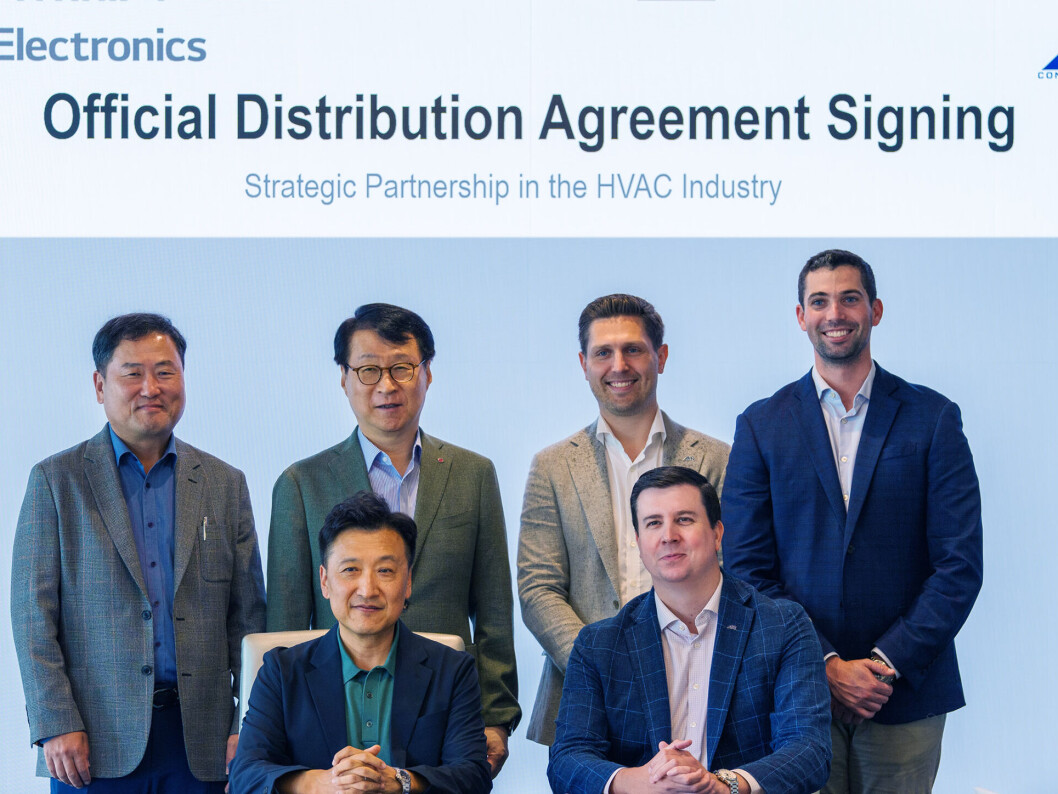
LG Electronics will supply chillers for 5 gigawatts of North American AI data centers under a multiyear deal it values at several billion dollars. The Virginia contractor buying them makes LG its standard chiller ahead of individual project bids.
The Investor · Invest desk
Drafted by a language model from the sources cited here and checked against its claim ledger before publication. How we use AISend a correction
What happened
- LG did not formally disclose the contract's value or a detailed delivery schedule, and the several-billion-dollar figure came from a company spokesperson.
- LG and AIR are discussing adding coolant distribution units, which regulate coolant in liquid-cooled systems, though that expansion has not been finalized.
- LG began supplying and installing cooling equipment this year for a large North American AI data center project it won last year.
Compiled by The InvestorSomething wrong?How this is made
Why it matters
- exposure LG has tied several years of North American chiller revenue to how fast one contractor's operator clients build, so a slowdown in AI construction would show up as delayed phases.
- constraint Until the CDU talks conclude, LG supplies the chillers on AIR's projects while the liquid-cooling hardware nearest the chips can still go to another vendor.
- contradiction The Korea Herald reports more than 5 gigawatts where the JoongAng Daily reports 5, and any capacity above 5 lowers the implied price per gigawatt.
Take "several trillion won" at two trillion, the low end of the spokesperson's range [2]. On that reading the contract is twice the 1 trillion won annual chiller revenue target LG expects to reach before its end-2027 deadline [13]. It is also about 3.3 times the AI cooling orders LG booked in the first half [20]. Spread across 5 gigawatts, each billion dollars of value comes to $200 million per gigawatt, or $200,000 per megawatt of data center load [21]. That money buys chillers and other cooling equipment, shipped in phases [4].
The buyer is a contractor, or more precisely a network of them. AIR Control Concepts, based in Norfolk, Virginia, runs a group of HVAC, electrical, service and controls companies [17]. Through its AIR Mission Critical unit it builds data centers in the US and Canada for major operators [5]. LG said the agreement gives it a steadier pipeline beyond individual project bids [7]. "LG's high-efficiency chiller technology gives us a proven platform we can deploy with confidence across our AI data center portfolio, and this agreement positions AIR to support our customers' growth for years to come," said Brad Hobbs, AIR's chief executive [15].
According to the Korea JoongAng Daily, cooling is one of the main constraints on building AI data centers. GPUs give off far more heat than conventional servers, and overheated chips slow down or fail [8]. That is a constraint of physics. Neither report includes lead times or prices showing chillers in short supply. What the evidence shows is a contractor standardizing on one vendor for years; it does not show buyers paying up to secure a scarce input.
The 5 gigawatts can be read three ways. If the volumes are firm, as LG implies when it says the contract guarantees large volumes [6], the deal alone could take cumulative cooling orders to the several trillion won the company expects by year-end [12]. If the figure is a ceiling set by how fast AIR's clients build, phased delivery [4] means LG collects only as those buildings go up. The third path runs through liquid cooling, which operators add as rack density rises [9]. The coolant distribution units that liquid cooling needs are still under discussion between the two companies [10]. I think the second reading fits the terms best. The case against it is LG's own word, guarantees, and a year-end order tally that counts the full contract would prove the second reading wrong.
Omdia expects worldwide data center power capacity to grow by 108 gigawatts in a single year, from 226 gigawatts in 2026 to 334 gigawatts in 2027 [11]. Five gigawatts is about 4.6% of that one year's additions [22], and LG's deal spreads its share over several years in two countries [18].
The hyperscale credential is LG's own claim, and it rests on the volume guarantee [6]. LG's efficiency figure is about 30% less annual energy than a waterside free cooling system. It comes from an internal simulation of one unit at full cooling capacity in Seoul-area climate, and the Korea Herald notes that actual savings vary by installation and operating conditions [14].
What to watch
- Whether LG and AIR finalize the coolant distribution unit supply, putting LG on the liquid-cooling side of the same projects.
- A published delivery schedule or first-phase volume for the 5 gigawatts, showing how much of the contract is firm.
- A second multiyear chiller contract from another North American contractor or operator, which would show whether AIR's deal is a buying pattern or a single platform choice.