Product1 distinct publisher3 min readPublished
VCF 9.1 pushes rarely used pages onto NVMe flash while DRAM stays expensive, and a customer at VMware Explore told Broadcom the switch saved up to $70,000 a server. Whether that number holds on your own hosts is something you can check yourself.
The Product Desk · Product desk

security
A vCenter bug patched on July 29 is already a ransomware chain, not a ticket1 distinct publisher
product
Broadcom folds private AI into an integrated VMware Cloud Foundation stack1 distinct publisher
security
Eclypsium counted 1,051 AI-infrastructure vulnerabilities across 12 vendors in 38 days1 distinct publisher
build
H200s reach China at 2.5% of the order book, and Hong Kong holds the rest2 distinct publishers
Compiled by The Product DeskSomething wrong?How this is made
The person signing the next refresh order is the one who has to decide whether the cold half of a host's memory is genuinely cold. Broadcom's Mark Chuang gave the mood of the buying market on stage: "It's just crazy nowadays; a stick of memory is like the cost of a car" [10].
Tiering pays in proportion to how much of an allocation sits idle. The mechanism only relocates pages that are accessed less often, and active data stays in DRAM [1], so the gap between provisioned memory and touched memory across your estate is what decides whether the bill falls by 45% or by 5%. A host whose workload walks its entire allocation every hour has no cold tier to sell.
Capacity plans often flag the cluster as memory-bound, but the counters on that same cluster tell a narrower story: memory gets allocated, and allocation reflects what was reserved rather than what actually got used. Before a pilot is worth scheduling, the number to pull is consumed against provisioned memory per host over several weeks, including the week the finance system closes the month.
The vendor figures then become arithmetic you can check. Chuang said a customer at VMware Explore ran the numbers and found up to $70,000 in savings per server against a pure-DRAM build [4]. If that saving represented the full 45% ceiling, the DRAM-only configuration behind it cost roughly $156,000 [9]. The source does not say the two numbers describe the same machine, which is the first thing to put to the account team.
Density carries its own consequence. Doubling the VMs on one host roughly halves each VM's share of DRAM, with flash carrying the remainder [7]. Contention that used to appear on cores now has a second place to surface.
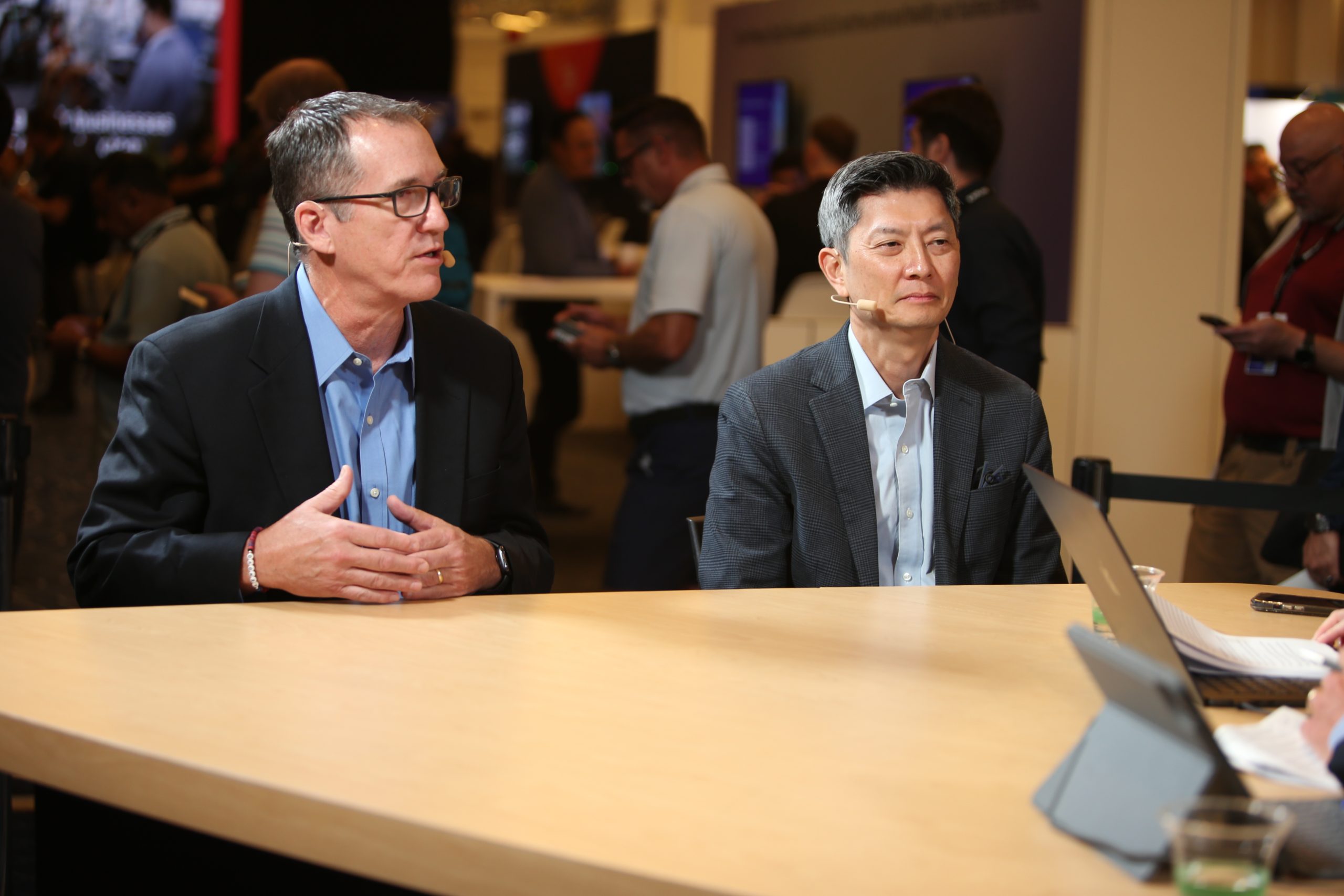
Provenance is worth stating plainly. The claims were made in an interview at VMware Explore on theCUBE, a paid media partner for the event, with Broadcom sponsoring the coverage and the disclosure noting that sponsors hold no editorial control [8]. Broadcom and Lenovo have validated the capability on ThinkAgile VX V4 hardware [2], Lenovo's Stuart McRae repeated the 45% figure himself [12], and the VX line item includes VCF factory-integrated with validated firmware and drivers plus lifecycle management [13]. That does not make 45% wrong; it makes the figure a ceiling built on a workload mix that has not been published.
A grid you can fill in on two axes you already measure. Down one side, the share of provisioned memory that is cold in an ordinary week. Across the other, whether the workload's users feel tail latency. Cold-heavy and latency-tolerant is the quadrant where Lenovo's number is plausible and where a pilot cluster belongs. A hot working set with latency-sensitive users is where you queue for DRAM at current prices and pay for it [11]. The mixed quadrants are the interesting ones, and the only test that settles them is your own before-and-after on VMs per host and response time under real load.
Ranked by verification strength, evidence, and original report placement.
Lenovo reports that memory tiering can lower infrastructure acquisition costs by up to 45% while doubling virtual machine density and retaining more than 90% of performance.
Mark Chuang, head of product marketing for VMware Cloud Foundation at Broadcom, said a customer he spoke with at VMware Explore calculated savings of up to $70,000 per server configured with tiering versus going pure DRAM.
Chuang said: "It's just crazy nowadays; a stick of memory is like the cost of a car."
Stuart McRae, executive director of Lenovo's Enterprise Storage, Software and Solutions Offering Group, said memory tiering lets customers tier what would normally sit on DRAM to high-performance NVMe flash and "can save up to 45%".
In VMware Cloud Foundation 9.1, memory tiering shifts less frequently accessed pages to lower-cost NVMe flash while keeping active data in DRAM.
Broadcom Inc. and Lenovo Group Ltd. have validated the memory tiering capability on Lenovo ThinkAgile VX V4 systems.
Distinct publishers with included, body-backed reporting in this cluster.
1 article · September 2, 2026
Follow any of these and your For You feed starts watching them — no settings page required.
Evidence-backed comparisons of source perspectives and observed adoption signals. Read the methodology
Which Builder, Operator, and Investor concerns the observed source mix emphasized—not a truth score.
Evidence, demonstrated adoption, hype gap, incentives, and confidence are assessed independently, each on its own current evidence. How these are measured.
Vendor stage, no independent numbers
Every quantity that matters here comes from the two companies selling the capability, on a stage one of them sponsored. Lenovo's 45%, the doubled density and the 'more than 90% of performance' arrive without a workload, a configuration or a test; Chuang's $70,000 is a customer's own spreadsheet, unnamed and unshown. What is solidly established is narrow: the feature exists in VCF 9.1 and has been validated on VX V4 hardware.
Validated configuration, one unnamed prospect
Real but shallow: there is a shipping, jointly validated hardware target in ThinkAgile VX V4, which is more than a slideware feature. Against that, the only customer in the story is an unnamed attendee doing arithmetic at a conference booth. No deployment count, no named reference, no production usage disclosure appears.
Ceilings quoted as outcomes
The gap is not invention, it is compression. 'Up to 45%' and 'more than 90% of performance' are separate best cases quoted side by side until they read as one guaranteed trade — about 4.5 points of cost for every point of performance, which is a suspiciously clean bargain for a change that pushes memory pages onto flash. Add a $70,000 anecdote with no disclosed baseline and the story sounds settled while the measurement is still missing.
Sponsor, vendor and channel aligned
Broadcom sponsored theCUBE's coverage of the event where this was filmed, theCUBE says it is a paid media partner for VMware Explore, and the two people supplying every figure run product marketing and an offering group for the companies that sell the software and the servers. The disclosure is explicit and to SiliconANGLE's credit sits right in the piece — but disclosure documents the alignment rather than dissolving it. Selling NVMe-heavy configurations while DRAM is scarce is directly in both vendors' interest.
Clear on who said it, thin on whether it holds
We can be quite sure of the attribution: the quotes are direct, the speakers are named, the sponsorship is on the record. Confidence drops on the substance, because a single sponsored interview with no second source and no test data leaves the central economic claim unfalsifiable from where a reader sits. Any operator with a memory-bound host can settle it faster than this reporting can.