Build1 publisher3 min readPublished
A biosafety evaluator went to the bench, and the hard part was the plasmid design
An LLM biosafety evaluator with no bench experience spent a week making fluorescent GLP-1 fusions in a community wet lab, and the account puts most of the difficulty before Day 1, in ordering DNA that works.
The Engineer · Build desk
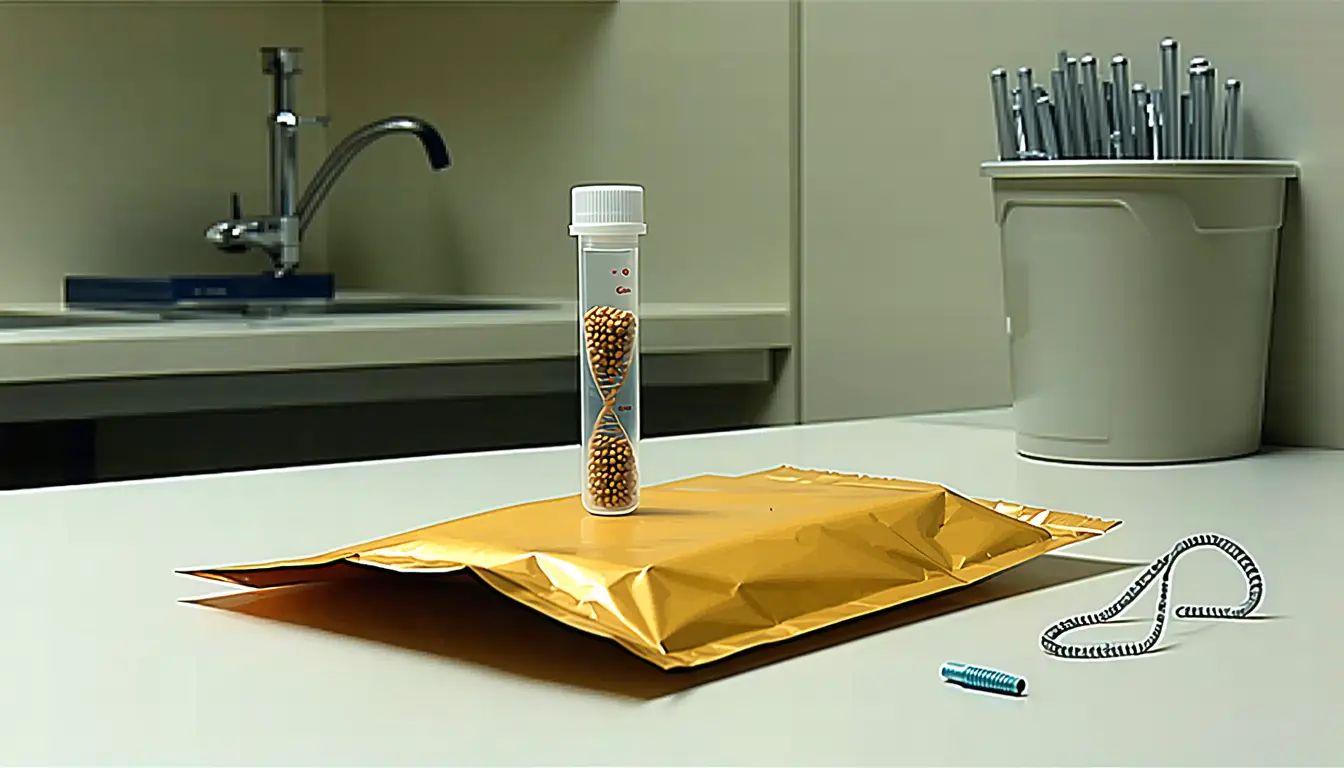
What happened
- A researcher who writes biosafety evaluations for large language models had never worked in a wet lab, and spent a week in one to fix that.
- The venue was a community wet lab on the 8th floor of Frontier Tower, costing $190 a month for tower access plus $160 a month for membership of the nonprofit running the floor.
- The project with two experienced biologists was to fuse GLP-1 with fluorescent and bioluminescent proteins, and the author invites readers to decide for themselves whether an LLM could do the same.
- The published account breaks off in Day 2, with the chosen colony going into a shaker set at an angle.
Compiled by The EngineerSomething wrong?How this is made
Why it matters
- constraint Lead times of six days to weeks and a month of actual waiting on one order mean any capability question about model-assisted protein work is gated on a supply chain the model does not control.
- exposure If DNA ordering is about as easy as shopping online, the screening burden sits with synthesis vendors and shipping rules, well upstream of whatever a chatbot will or will not say.
- decision Eval writers now have a concrete test to build: score whether a design's origin of replication is unique in the construct and matches enzymes a specific lab actually stocks.
- contradiction The account opens by locating the hard part in feel and motor skills, then spends its longest section on plasmid design constraints that are written down.
Read the Day -30 section and you find constraints. The plasmid has to carry an upstream promoter to switch the gene on, and the author gives AOX1, which is turned on by the presence of methanol, as the example [4]. It needs downstream tags such as His tags and antibody tags so the protein can be fished back out of E. coli soup later [5]. It needs an antibiotic resistance gene, so the thing can be grown on dishes where nothing else survives [6]. It needs an origin of replication whose sequence appears nowhere in the gene or elsewhere, and that is compatible with the restriction enzymes actually on hand, so the enzyme cuts the plasmid there and not in random places [7].
Then multiply that by expression systems. Yeast plasmids are typically amplified in E. coli first, before going into the yeast for final protein expression [8]. That can mean resistance genes for both systems [9], or one agent like Zeocin that kills prokaryotic and eukaryotic cells alike. Zeocin cannot be shipped to a residential address because it is essentially poison [10].
The author's own framing of the design step is the sentence worth keeping: "It's sort of like designing a mini computer program, except you only get one shot to run it" [11].
Most of that is written-down knowledge with a verification problem. A model can emit a promoter, a tag, a resistance marker and a cut site. Whether the combination is self-consistent, whether the origin's sequence is unique in your construct, and whether the enzymes are in your freezer are all checks against a specific bench, and the account describes them as things you get one shot at [11].
The tacit-knowledge claim is stated up front: the author writes that a lot of what biologists carry in their heads "just boils down to feel, motor skills, and common sense reasoning about the 3D world and physical items" [3]. The bench narrative supports the smaller version of that. Streaking the plate is a motor skill with a purpose, which is diluting the culture logarithmically so that single bacteria end up far enough apart to grow into separate colonies [15]. Picking one colony with an inoculation loop is a judgement call, and the criterion the author used was the brightest, juiciest colony [17]. The shaker was set at an angle [18]. Some colonies came up pale and the response was to trust they were late bloomers [16].
Access ran $190 a month for the tower plus $160 a month for membership in the nonprofit running the floor [2], which is $350 a month total [19]. DNA can be ordered online about as easily as shopping on Amazon [12], with lead times from six days to weeks and pricing usually a couple hundred dollars per design, varying with size, protein complexity and expression system [13]. The team ordered live BL21 E. coli carrying the fusion proteins and a kanamycin resistance gene, and it took about a month to arrive [14].
The published text stops partway through Day 2, at the shaker [18], so the account does not report whether the fusions expressed. The author leaves it to the reader: decide for yourself whether LLMs can do the same [20]. On the evidence here, an eval that only scores protocol recall is scoring the part the vendor catalogue already answers.
What to watch
- Whether the author publishes the rest of the week, including whether the GLP-1 fusions actually expressed and glowed.
- Whether biosafety eval sets move past protocol recall to scoring plasmid self-consistency against a named inventory of restriction enzymes.
- Whether DNA synthesis vendors' design checks become the screening layer that gets audited, ahead of model refusals.