Build1 publisher3 min readPublished
Lanyon AI raises $10.6M to make proofs, not plausibility, the acceptance test for AI code
A plasma-physics team is betting that aerospace and nuclear buyers will pay for machine-checkable proofs. The proof still stops where the specification stops.
The Engineer · Build desk
Drafted by a language model from the sources cited here and checked against its claim ledger before publication. How we use AISend a correction
What happened
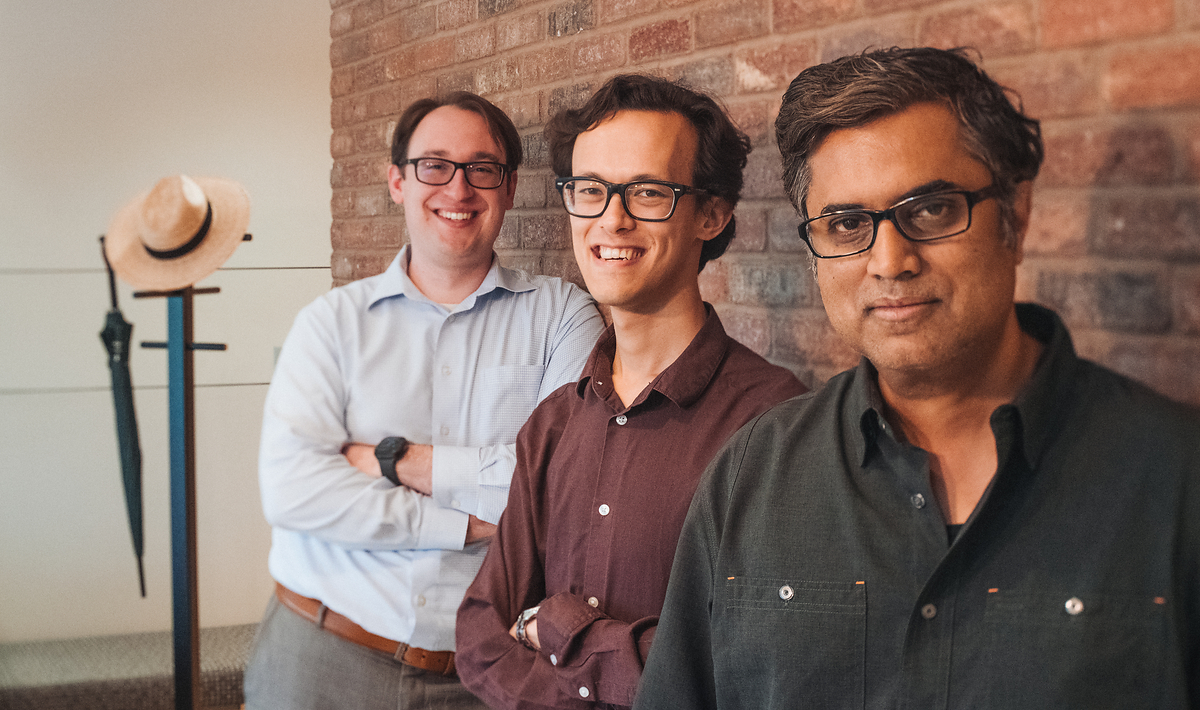
- Jonathan Gorard, Ammar Hakim, and James "Jimmy" Juno disclosed a $10.6 million initial fundraising round for Lanyon AI on Aug. 17, backing their attempt to make AI-generated scientific software prove that it does what its specification requires.
- Dimension led the financing, with Industrious Ventures participating, according to Lanyon AI's announcement.
- The Princeton, New Jersey research lab is targeting aerospace, propulsion, nuclear energy, physics simulations, GPU optimization, and AI inference, where a plausible answer can still be a dangerous one.
- Gorard, Lanyon AI's CEO, previously worked on automated theorem proving and quantum computing at Wolfram Research and co-founded the Wolfram Physics Project with Stephen Wolfram.
- Hakim, Lanyon AI's CTO, is a Princeton lecturer and principal research physicist whose work includes fusion, space plasmas, tokamak turbulence, and machine learning for partial differential equations.
Compiled by The EngineerSomething wrong?How this is made
Why it matters
Jonathan Gorard, Ammar Hakim, and James "Jimmy" Juno disclosed a $10.6 million initial fundraising round for Lanyon AI on Aug. 17, backing an attempt to make AI-generated scientific software prove that it does what its specification requires [1]. Dimension led the financing with Industrious Ventures participating, according to Lanyon AI's announcement [2], and the target markets are aerospace, propulsion, nuclear energy, physics simulations, GPU optimization, and AI inference, domains the Princeton, New Jersey lab describes as places where a plausible answer can still be a dangerous one [3].
The team is unusual for a coding-agent company. Gorard, the CEO, worked on automated theorem proving and quantum computing at Wolfram Research and co-founded the Wolfram Physics Project with Stephen Wolfram [4]. Hakim, the CTO, is a Princeton lecturer and principal research physicist working on fusion, space plasmas, tokamak turbulence, and machine learning for partial differential equations [5]. Juno, the chief scientist, is a Princeton Plasma Physics Laboratory researcher and a core developer of the Gkeyll plasma simulation framework [6]. That is a credentialed customer as much as a founding team.
Their premise is that general-purpose agents begin in the wrong medium. "Why are agents still reasoning and coding in imperfect human languages?" Gorard asked in the Aug. 17 announcement [7]. Lanyon AI wants its agent to reason in a condensed formal language built for mathematics, physics, and scientific computing [8]. Architecturally, a language model proposes a formal specification in that domain-specific language, and a symbolic compiler expands the specification into implementation code and a machine-checkable proof at the same time; if the specification cannot be proven, the company says the system withholds the code and tries again [9].
The failure this is designed against is worth naming. A conventional agent can write code and then produce a Lean proof that type-checks while describing a different implementation, a mismatch Lanyon AI calls misformalization [10]. Deriving code and proof from one source is meant to stop the certificate from drifting away from the artifact it certifies [11].
The evidence is currently in-house. In company-run benchmarks published in July, Juno tested frontier models on linear advection and Maxwell equation solvers using three trials per model and both detailed and terse prompts [12]. Lanyon AI reported that its reference linear-advection solver took about seven seconds and roughly 800 output tokens to generate, and its Maxwell solver about 23 seconds and roughly 600 tokens [13]. Note that the Maxwell run took roughly 3.3 times as long while emitting about a quarter fewer tokens [20], which is what you would expect if proof search, not text generation, is the cost centre. The tests were designed, executed, and graded by Lanyon AI, and independent replication has yet to establish how the approach performs across a wider set of engineering work [14]. Six solver repositories are on GitHub, covering advection-diffusion, Maxwell, general relativistic Maxwell, Burgers', compressible Euler, and the electrostatic Vlasov equations, in C and Lean [15].
The honest limit is the specification. Formal verification establishes that an implementation conforms to a formal specification; it cannot establish that the specification captures the user's scientific intent, physical assumptions, or deployment conditions [16]. Gorard drew that line himself in the July introduction, separating the syntactic guarantee that code, proof, and specification agree from the semantic problem of translating a natural-language request into the right specification, which the company called an open research area [17]. A proof can certify a solver and say nothing about whether the engineer chose the correct governing equations, boundary conditions, material properties, or failure thresholds [18]. The product risk therefore sits at the interface between the engineer and the formal language [19].
Watch for a benchmark someone else runs, and for whether the six repositories attract outside auditors who read the Lean rather than the README.