Build1 distinct publisher3 min readPublished
Bloomberg reports the AI cloud provider is negotiating up to $3 billion at $12 billion or more, roughly 4.8 times a September 2025 Forbes estimate, ahead of a possible 2027 listing.
The Engineer · Build desk

Compiled by The EngineerSomething wrong?How this is made
Lambda's disclosed funding history before this comes to roughly $2.3 billion: a $320 million Series C in February 2024, a $480 million Series D later that year, and more than $1.5 billion after that [7]. The proposed round on its own would be larger than all of it put together [14]. It would also be about 1.2 times the entire company as Forbes valued it in September 2025 [17]. That ratio, not the headline valuation, is the thing worth staring at: the cheque needed to keep buying capacity has outgrown the equity base it is being bought against.
The 4.8x step-up [13] is a comparison of unlike quantities. Forbes was estimating from outside, on a business with about 15,000 paying customers [4]. Bloomberg is reporting a price still under negotiation, with no lead investor named [1][3]. The publisher says as much: the timing and terms of the two valuations differ [5]. So the multiple describes the gap between an outside guess and a term sheet, and the term sheet is what has to be paid for.
What it buys, on Lambda's own account, is 3 gigawatts of AI compute under management by 2030 [10]. That is a target, and Lambda has not put an independently verified figure for capacity under management beside it [10]. Between a reported round and a 2027 listing, the number that converts the target into a valuation input is contracted, delivered capacity, and it is the one number absent from the record.
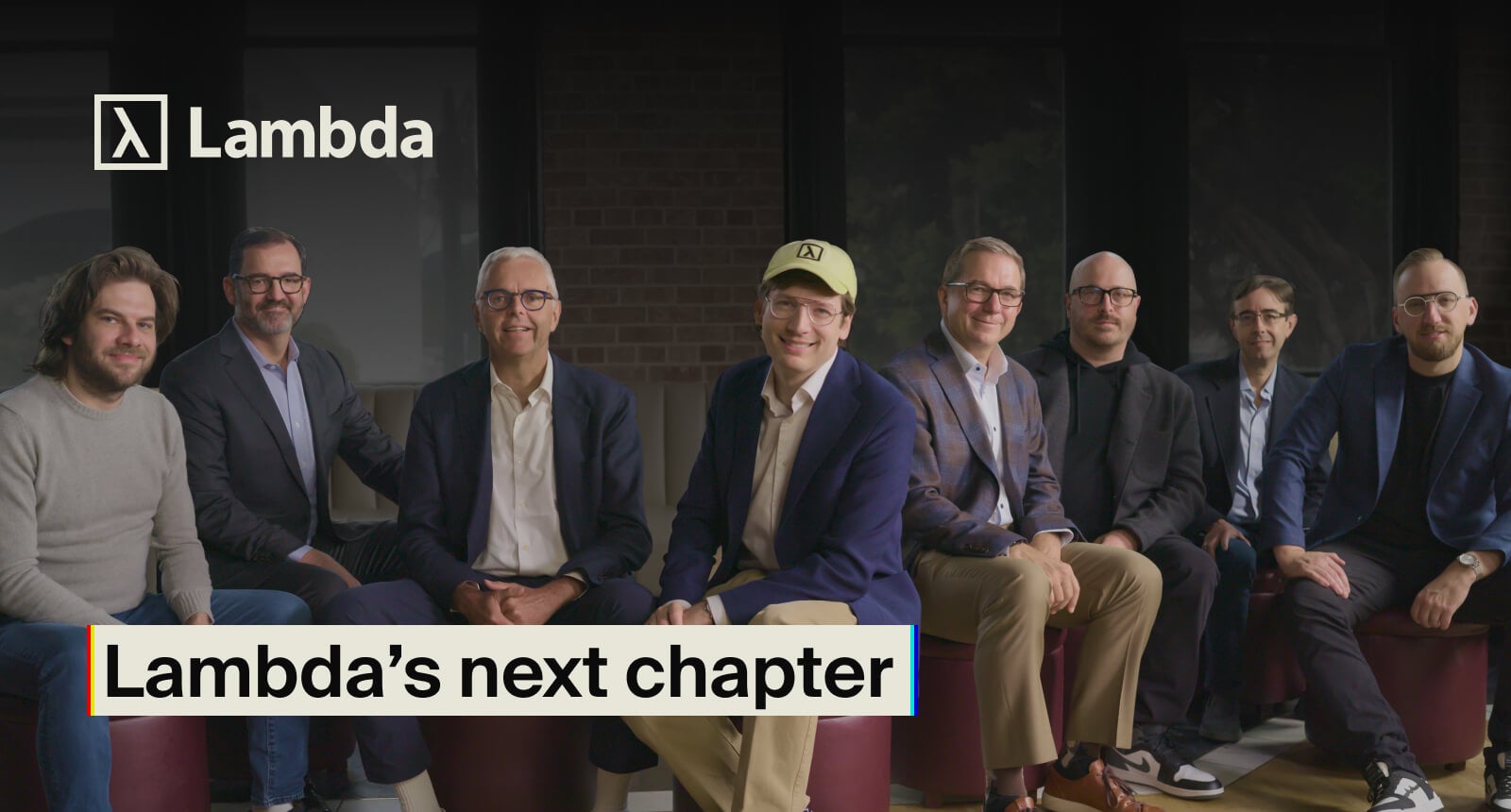
The hiring tells you which problem the founders think is binding. On May 5, 2026, Stephen Balaban moved from chief executive to CTO, Michel Combes became CEO, and John Donovan took the chair [8]. Combes ran Sprint, Alcatel-Lucent and SoftBank Group International; Donovan ran AT&T Communications [9]. Those are careers spent financing construction against long-lived assets, not selling compute hours. The source frames the CEO's job in the same terms: financing construction, expanding financial controls, and convincing investors that GPU fleets earn a durable return after depreciation, replacement and borrowing costs [12].
There is a distance here worth measuring. Lambda started because two engineers found AWS too expensive, worked out that $60,000 of owned equipment could displace most of the recurring bill, and cut that bill by 95% [16]. The company now describes itself as serving AI developers, enterprises, hyperscalers and frontier-model labs, at scales from a single GPU to hundreds of thousands [15]. The arbitrage that started it was between owning hardware and renting it. At 3 gigawatts, the arbitrage is between the cost of capital and the useful life of a GPU, which is a telecom problem wearing a compute label, and it is why the telecom operators are now running the company [9][10].
Ranked by verification strength, evidence, and original report placement.
Bloomberg reported on August 24 that Lambda is weighing up to a $3 billion financing at a valuation of $12 billion or more.
The proposed terms remain under negotiation, Bloomberg did not identify a lead investor, and Lambda has announced neither an IPO filing nor a formal timetable.
By September 2025, Lambda had approximately 15,000 paying customers and an estimated valuation of about $2.5 billion, according to Forbes.
The reported $12 billion-plus valuation is almost five times the earlier Forbes estimate, although the timing and terms of the two valuations differ.
Stephen Balaban and Michael Balaban founded Lambda, a San Francisco AI cloud infrastructure provider, in 2012.
Lambda raised a $320 million Series C in February 2024, announced a $480 million Series D in 2024, and followed with more than $1.5 billion in a later financing.
Follow any of these and your For You feed starts watching them — no settings page required.
Evidence-backed comparisons of source perspectives and observed adoption signals. Read the methodology
Which Builder, Operator, and Investor concerns the observed source mix emphasized—not a truth score.
Evidence, demonstrated adoption, hype gap, incentives, and confidence are assessed independently, each on its own current evidence. How these are measured.
Single-publisher relay of a Bloomberg scoop, with company releases for everything else
The headline terms rest entirely on one outlet's retelling of Bloomberg's August 24 report; the cluster contains no second independent publisher and no primary confirmation from Lambda or an investor. Supporting detail — prior rounds, leadership changes, debt pricing, the 3GW target — comes from Lambda's own announcements, which are verifiable as statements but not independently audited. The publisher's own caveats (terms under negotiation, no lead investor named, no IPO filing) keep the record honest but also cap how much the reported valuation can be treated as fact.
Real paying customer base and closed capital, but no revenue or capacity verification
There is concrete commercial traction: roughly 15,000 paying customers as of September 2025, a self-described customer mix spanning developers to frontier labs, and lenders willing to underwrite $1B of revolving capacity plus a $926M investment-grade-rated term loan against GPU collateral and contracted compute cash flows. What is missing is anything that sizes the business — no revenue, utilization, contract length or delivered megawatts — and the only forward capacity figure is Lambda's own 3GW-by-2030 target.
Valuation and capacity narrative outrun disclosed operating evidence
A roughly 4.8x valuation step-up in under a year, a possible 2027 listing, and a 3GW-by-2030 compute goal are all forward-looking assertions resting on an unclosed round and one customer-count datapoint. The publisher partially offsets this by labeling the 3GW figure a target, noting timing differences between the two valuations, and stating that no IPO filing exists — which is why the gap is moderate rather than severe.
Fundraising-adjacent sourcing throughout
Every number in the story serves someone's raise. Leaked terms during an open negotiation benefit the issuer and existing holders by anchoring price; the 3GW target and leadership announcements are Lambda's own marketing ahead of a possible listing; the debt releases are issuer statements about issuer paper. The cluster also notes Bloomberg Beta among Series C participants while Bloomberg Technology is the primary source for the reported round, a relationship the article does not address. No investor, banker or independent analyst is quoted to counterbalance.
Directionally credible, numerically provisional
That Lambda is raising large sums at a sharply higher valuation is consistent with the disclosed sequence of equity rounds, secured debt and telecom-grade executive hires, so the direction is well supported. The specific $3B/$12B figures, the 2027 listing and the 3GW target are each single-sourced or self-reported and could move materially before any close, which holds confidence below the halfway mark.
product
Lambda's answer to $917m of GPU-backed debt is up to $3bn of equity before the IPO1 distinct publisher
product
Anthropic's answer to a 2 percent stake: hand the founders extra votes1 distinct publisher
product
Nebius funds $4.5bn of AI capacity on terms that pay lenders mostly in stock2 distinct publishers
invest
H100 rentals are back to $2.35 an hour, and your AI cost model is stale1 distinct publisher
Distinct publishers with included, body-backed reporting in this cluster.
1 article · August 24, 2026