Invest1 publisher3 min readPublished
Korea's venture investment jumped 54%. One robot listing is worth eight times all of it.
AI-led ICT and bio took about 38 percent of Korea's record 8.87 trillion won half. Unitree closed its Shanghai debut up 460 percent, at an implied 1,200 times earnings.
The Investor · Invest desk
Drafted by a language model from the sources cited here and checked against its claim ledger before publication. How we use AISend a correction
What happened
- New venture investment in the first half came to 8.8676 trillion won, up 54.3% from the first half of last year and a record high.
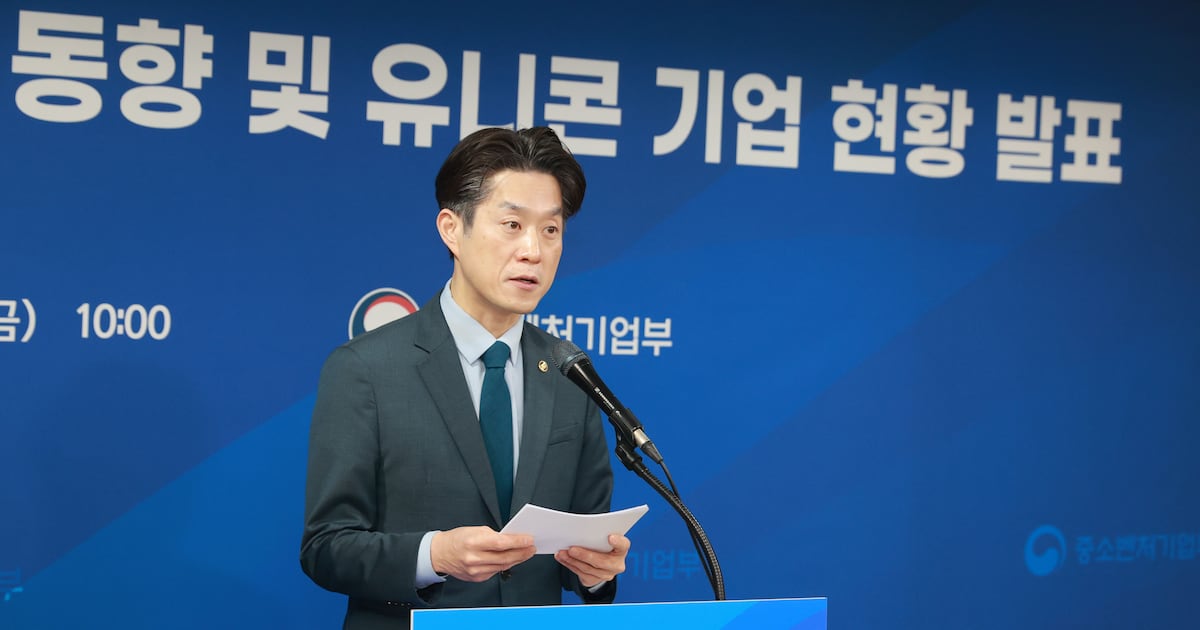
- The figures come from the "2026 First-Half New Venture Investment and Venture Fund Formation Trends" report released by Korea's Ministry of SMEs and Startups on the 19th.
- 1.86 trillion won, or 21% of total investment, went into the AI-led ICT services sector.
- 1.5359 trillion won went into electronics, machinery and equipment.
- 1.5041 trillion won went into bio and medical.
Compiled by The InvestorSomething wrong?How this is made
Why it matters
Korea's new venture investment hit 8.8676 trillion won in the first half, up 54.3 percent year on year and a record, according to the Ministry of SMEs and Startups report released on the 19th [1][2]. On the same day, Chinese humanoid maker Unitree closed its Shanghai debut at 845 yuan, up 460.34 percent from a 150.8 yuan offering price, with a market capitalisation of 341.7 billion yuan, or roughly 71.29 trillion won [11][13]. That single listing is worth about eight times everything Korean venture funds deployed in six months [8].
The sector split is where the interesting part sits. AI-led ICT services took 1.86 trillion won, or 21 percent of the total; electronics, machinery and equipment took 1.5359 trillion won; bio and medical took 1.5041 trillion won [3][4][5]. The two headline sectors, ICT and bio, come to about 37.9 percent between them [3]. The top three together are about 55.3 percent [2]. So this is a plurality forming, not a monoculture: the second and third sectors are within roughly a third of a percentage point of each other in share terms [4]. The ministry's own framing pushes the other way, noting growth spread across companies under three years old, non-capital-area firms and overseas investment [10].
Fund formation is the part that decides whether next year looks like this one. New venture fund formation rose 33 percent to 8.4366 trillion won, the second-highest first-half figure on record, driven by financial institution contributions up 54.9 percent to 2.6061 trillion won [6][7]. Those institutions now supply about 30.9 percent of all fund formation [6]. Note the arithmetic: deployment ran about 431 billion won ahead of formation in the half [5]. Kim Bong-deok, director general of venture policy at the ministry, stressed the private sector's role and said performance would trend upward in the second half [8]. Yoon Kun-soo, CEO of DSC Investment, was more conditional, citing large fund formation but naming KOSDAQ activity as the variable [9]. Exits, not commitments, are the constraint.
Which is what makes the robotics listing rush worth reading carefully rather than enviously. Unitree priced at a price-to-earnings ratio of 219.23 times, about six times the robotics industry average of 38.56 times, and some observers already called that a burden [16]. At the closing price, the implied multiple is roughly 1,228 times, about 32 times the industry average [7]. The company plans to raise 6.099 billion yuan, about 1.28 trillion won, for robot production, which is about 1.8 percent of its closing market value [12][9]. Founder Wang Xingxing's 33.36 percent stake was valued above 100 billion yuan on the opening price, with Sunwei Capital and DeepSeek founder Liang Wenfeng sitting on estimated unrealised gains of 15.2 billion yuan and 1.1 billion yuan [14][15]. The source itself flags that commercialisation is at an early stage even as rivals queue up to list [17].
The Korean robotics firms in the same report are behaving like companies that have to sell things. Angel Robotics reorganised management in the first half, adding finance, sales and quality executives, and is expanding exports to Thailand, Malaysia and Vietnam while preparing US and European entry [19]. CMES Robotics created a CFO post in February; Klobot brought in Presidents Ryu Jung-hoon and Son Jun-bae plus sales staff [20]. Meanwhile physical AI across robots and CCTV is spreading into factories, roads and defence sites, with domestic NPU supply deals following [18].
Watch three things: whether KOSDAQ reopens enough to clear the exit backlog, whether second-half fund formation keeps pace with deployment now that it is running behind, and whether the robotics cohort hiring CFOs starts reporting revenue that justifies any multiple at all.