Invest1 distinct publisher3 min readPublished
The $1.165 billion Sandisk owes Kioxia arrives in installments between 2026 and 2029, four years before the extended term begins, which is what a NAND buyer pays to stop renegotiating access annually.
The Investor · Invest desk

Compiled by The InvestorSomething wrong?How this is made
Read the fee against the calendar and the structure carries the story: the installments run 2026 through 2029 [4] while the five incremental years they buy run 2030 through 2034 [2], so every dollar reaches Kioxia before the first day of the term it pays for [3]. Divide the money two ways and you get two different deals. Against the payment window it is roughly $291 million a year of cash leaving Sandisk during the life of the existing agreement [1]. Against the years actually purchased it is $233 million per incremental year of availability [2], or under eight tenths of a percent of the single market year David Goeckeler pointed to in the announcement [4].
What that money buys is manufacturing services and continued availability of supply [4], and the release puts no wafer volume, no exabyte figure and no pricing mechanism against those words [7]. For a buyer downstream, that distinction is the whole thing: the deal buys continuity of access through 2034 while leaving what bits cost in 2034 unresolved, and Sandisk has fixed its place in the queue without, on this disclosure, fixing its price.
The counter-reading sits in Kioxia's own quote. Nobuo Hayasaka framed the agreement as recognising the value of Kioxia's manufacturing operation and strengthening its profitability through economies of scale at what he called the world's largest flash memory manufacturing facilities [6], which is the language of a re-cut transfer price between partners of more than 25 years [8] rather than the language of newly bought capacity. This is probably the more interesting version of the story, and it is testable: if a later filing shows Sandisk's share of joint investment at the two plants falling, or its output entitlement unchanged, then the $1.165 billion is rent on an existing position and the 2034 date is housekeeping.
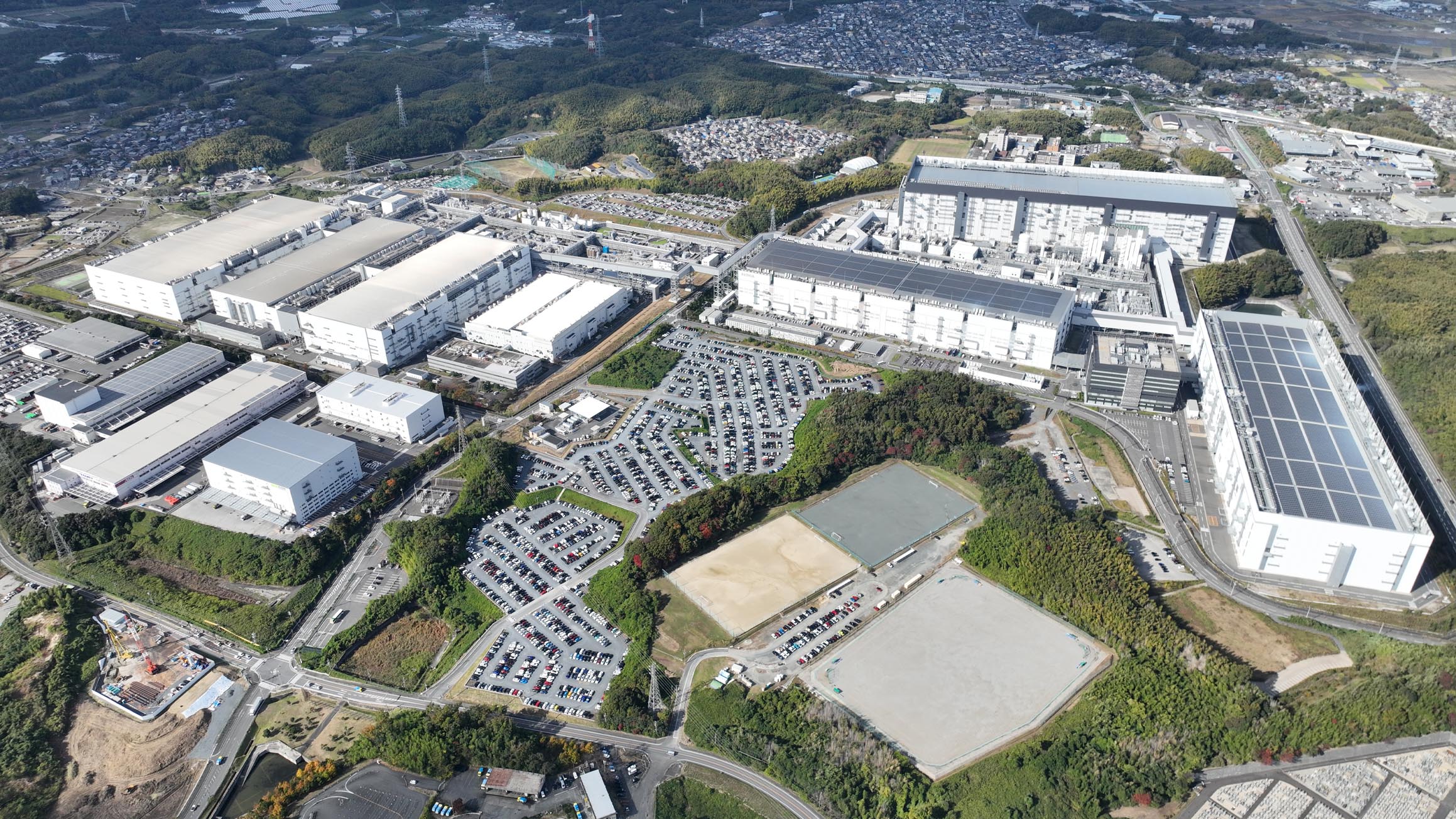
A third path is financing. The two say they remain committed to co-development of 3D flash memory and joint investments aligned with market trends [10], and the prepayment lands squarely inside the window in which those investments would need funding, which makes a services fee paid four years early look a lot like working capital for a fab owner whose predecessor was carved out of Toshiba in April 2017 [9]. Where the money goes matters as much as where it doesn't. Its route to five more years of advanced 3D flash, the product both companies tie to generative AI demand [11], runs through Kioxia's Yokkaichi and Kitakami plants [1][3] rather than anything Sandisk owns outright, and every dollar of the $1.165 billion sits with Kioxia instead of funding a second source.
The thesis, then, is that NAND access for the AI buildout is now being contracted in decade blocks with cash up front rather than annually. What would break it: a comparable fee turning up in the next JV cycle without any extension attached, which would mark this as a recurring toll on the partnership rather than the price of nine years of certainty [5]. For now the only quantity disclosed in the deal is the money.
Ranked by verification strength, evidence, and original report placement.
Kioxia Corporation, a subsidiary of Kioxia Holdings Corporation (TOKYO: 285A), and Sandisk Corporation (NASDAQ: SNDK) announced on January 29, 2026 the extension of their joint venture agreements at Kioxia's Yokkaichi Plant for an additional five years.
The Yokkaichi joint venture agreement was originally set to expire on December 31, 2029 and will now run through December 31, 2034.
The joint venture agreement for Kioxia's Kitakami Plant is aligned with the Yokkaichi agreement through December 31, 2034.
Under the renewed agreement Sandisk will pay Kioxia USD 1.165 billion for manufacturing services and continued availability of supply, in cash installments made over the years 2026 to 2029.
The announcement states the fee amount, the payment years and the term dates, but does not disclose wafer volumes, exabyte commitments or pricing terms for the supply it covers.
The companies describe the partnership as spanning more than 25 years.
Distinct publishers with included, body-backed reporting in this cluster.
1 article · August 28, 2026
Follow any of these and your For You feed starts watching them — no settings page required.
invest
Half a book in two memory names: what Situational Awareness's 67% month actually shows1 distinct publisher
product
The 1GB flash drive did not die of neglect. It died of bill-of-materials arithmetic1 distinct publisher
invest
SanDisk guides three years of near-peak margins and prices NAND as an AI input, not a commodity1 distinct publisher
invest
Citadel cleared $4bn of a rescued AI book in three weeks. The discount was the trade.1 distinct publisher
Evidence-backed comparisons of source perspectives and observed adoption signals. Read the methodology
Which Builder, Operator, and Investor concerns the observed source mix emphasized—not a truth score.
Evidence, demonstrated adoption, hype gap, incentives, and confidence are assessed independently, each on its own current evidence. How these are measured.
Exact on money and dates, mute on supply
Two dates and one nine-figure sum are stated with contract-grade precision, and both are checkable against the document that created them. Everything a reader would need to judge whether $1.165 billion is a good price — wafers, bits, allocation, per-unit cost — is absent, and no filing or third party in our coverage fills the gap. Precise is not the same as verifiable.
A signed contract at two real fabs, uncounted
This is not a pilot or an intention — it is a term extension on production lines that have run for more than two decades, and the money moves starting this year. What keeps the number from going higher is that the operational scale sits in a quote: 'hundreds of exabytes' with no measurement behind it, and no volume commitment attached to the extension itself.
Generative AI wrapped around a supply-access invoice
Strip the framing and this is a buyer paying to stop renegotiating fab access every few years. The release instead reaches for generative AI demand and a $150 billion market — a sizing that turns out to be 128 times the fee it is being used to justify. The gap is moderate, not egregious: the concrete terms are real and stated, it is the surrounding narrative that runs ahead of what anyone has shown.
Payer and payee, one page, no referee
Both parties to the transaction wrote the only account of it, and each has a distinct reason to shape it: Sandisk needs $1.165 billion of outflow to read as secured supply, Kioxia needs it to read as recognition of manufacturing value and a profitability lift ahead of life as a listed company. The forward-looking-statements block at the foot of the release is the closest thing to a caution anyone offers.
Sure what was signed, unsure what it bought
We can state the terms and do the arithmetic on them with little risk: the prepayment sequencing and the $233 million per incremental year follow directly from figures the parties published. Confidence falls away past that. Whether this is a bargain or an expensive hedge depends on volumes and prices that nobody has disclosed, and there is no independent reporting in our coverage to lean on.